

WhatsApp has become one of the most important sales channels for Indian businesses. But once enquiries increase, managing leads through individual chats, spreadsheets and personal follow-ups quickly becomes difficult.
That is where a WhatsApp CRM becomes useful.
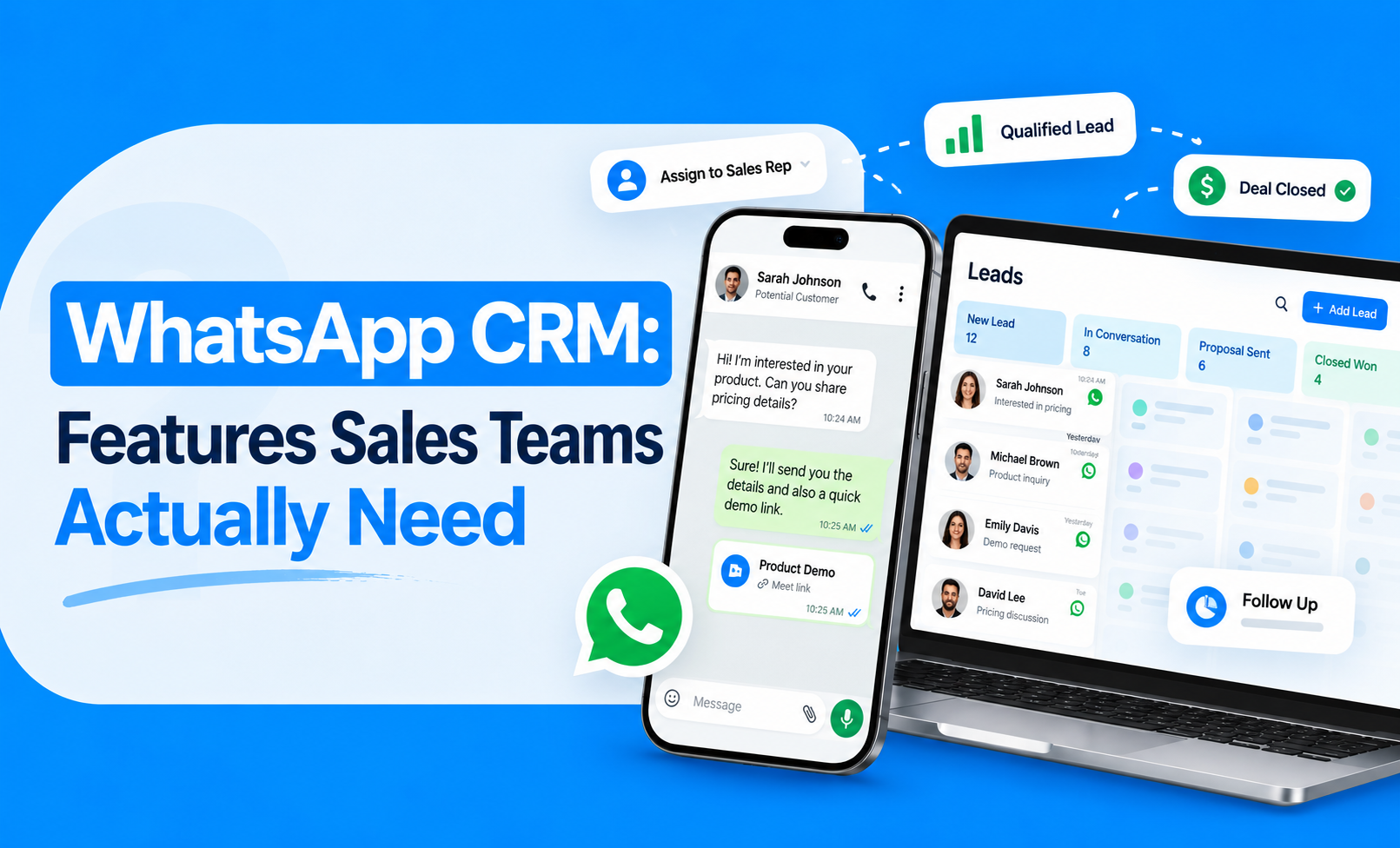
A good WhatsApp CRM should not simply store contacts. It should help sales teams manage conversations, assign leads, track follow-ups, monitor sales stages and make sure no opportunity gets missed.
If you are evaluating a WhatsApp CRM in India in 2026, these are the features that actually matter.
What Is a WhatsApp CRM?
A WhatsApp CRM connects WhatsApp conversations with customer information, sales activities and lead management.
Instead of keeping customer chats separate from the sales process, a CRM can connect each conversation with details such as:
Lead name
Contact number
Lead source
Assigned salesperson
Product interest
Sales stage
Follow-up date
Conversation history
Notes and tags
This helps sales teams understand who the customer is, what they need, who owns the lead and what should happen next.
If your business already uses another CRM platform, WhatsApp can also be connected through a proper WhatsApp CRM integration.
1. Shared WhatsApp Inbox
A WhatsApp shared inbox allows multiple sales representatives to manage conversations from one business number.
Instead of customer conversations staying inside one employee's WhatsApp account, the entire sales team can work from a central inbox.
A shared inbox should allow teams to:
Assign conversations
Transfer chats
Track ownership
View chat history
Add internal notes
Filter conversations
This becomes especially important when multiple agents are handling leads at the same time.
Businesses with growing sales teams can learn more about managing multiple agents on WhatsApp Business API.
2. Lead Assignment and Ownership
Every incoming WhatsApp lead should have a clear owner.
Without lead assignment, enquiries can remain unanswered or two salespeople may contact the same customer.
A good WhatsApp CRM for sales teams should support manual or automated lead assignment.
For example:
New WhatsApp enquiry → Lead created → Salesperson assigned → Qualification → Follow-up
This gives the sales manager visibility and makes each salesperson responsible for their opportunities.
3. Complete Conversation History
Sales teams should always know what was discussed with a prospect earlier. A WhatsApp CRM should maintain the complete customer conversation history along with sales notes and lead activity. This becomes important when a lead is transferred from one salesperson to another.
The new salesperson should immediately understand:
What the customer asked
What product they are interested in
What pricing was discussed
What objections were raised
What follow-up was promised
This prevents customers from repeating the same information.
4. Sales Pipeline Management
WhatsApp chats alone do not tell you how close a lead is to conversion. A CRM should allow sales teams to move opportunities through a clear pipeline, such as:
New Lead → Contacted → Qualified → Demo → Proposal → Follow-Up → Won
Pipeline tracking helps sales managers identify:
Number of active leads
Qualified opportunities
Leads waiting for follow-up
Deals stuck at a particular stage
Conversion by salesperson
This is particularly useful for businesses using WhatsApp for B2B selling. Our guide on WhatsApp Business API for B2B sales teams explains where WhatsApp fits in a longer sales journey.
5. Follow-Up Reminders
One of the biggest reasons sales teams lose opportunities is simple: follow-ups get missed.
A prospect may say:
"Call me next week."
If that information stays inside the chat, it can easily be forgotten.
A WhatsApp CRM should allow the salesperson to schedule the next action and clearly show:
Follow-ups due today
Overdue follow-ups
Inactive leads
Leads without a next action
Businesses can also combine CRM workflows with automated WhatsApp sales follow-ups to reduce repetitive manual work.
6. Lead Source Tracking
Sales teams should know where each WhatsApp lead came from.
A lead may enter through:
Click-to-WhatsApp Ads
Website forms
Landing pages
QR codes
Google Ads
Organic traffic
Referrals
Tracking the lead source allows businesses to understand which campaigns generate better opportunities.
This is especially important for businesses running paid campaigns because a high number of WhatsApp chats does not automatically mean high-quality leads.
Read more about tracking the complete CTWA ad-to-sale lead journey.
7. Tags and Lead Segmentation
Tags help salespeople organise and filter prospects quickly.
Typical tags may include:
Hot Lead
Demo Requested
Proposal Sent
Follow-Up Required
Existing Customer
Product A
Bengaluru Lead
Segmentation becomes useful when businesses want to send relevant follow-ups instead of treating every contact the same way.
8. Workflow Automation
A good CRM should also reduce repetitive tasks.
Useful WhatsApp sales automation may include:
Automatic lead assignment
Qualification workflows
Demo confirmations
Follow-up reminders
Re-engagement messages
CRM updates after customer actions
The objective is not to automate every sales conversation.
Automation should handle predictable tasks while salespeople focus on conversations that need judgement and negotiation.
What Features Should Sales Teams Prioritise?
For most businesses, these are the essential capabilities:
A CRM with 100 features is not automatically better.
The right WhatsApp CRM is the one that helps your team respond faster, organise leads better, follow up consistently and move more opportunities toward conversion.
Choose a WhatsApp CRM Around Your Sales Process
Before selecting a platform, map your existing sales workflow.
Ask:
Where do leads enter?
Who handles them?
How are leads assigned?
How are follow-ups tracked?
Where is customer history stored?
How does management track conversions?
Once those questions are clear, choosing the right CRM becomes much easier.
EMOVUR's WhatsApp CRM is designed to bring WhatsApp conversations, sales teams and lead workflows into one connected system.
Want to see how it fits your sales process? Book a CRM demo.