

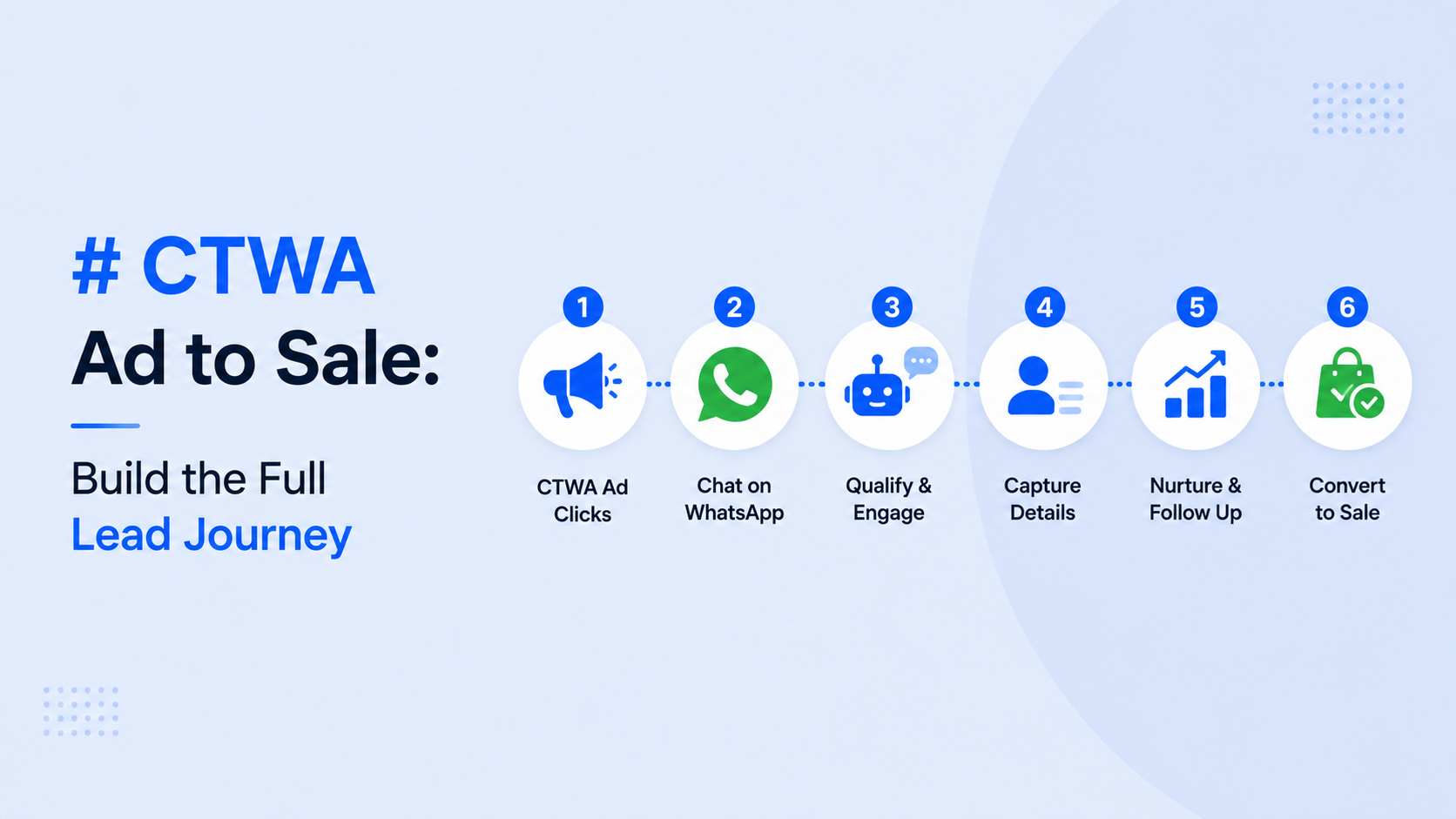
A CTWA ad-to-sale journey should connect the Meta ad, WhatsApp conversation, qualification, CRM record, salesperson, follow-up and final conversion as one measurable funnel. The ad creates intent, WhatsApp captures the conversation, qualification determines fit, CRM records the opportunity and sales moves qualified prospects towards purchase. For Indian businesses, the biggest CTWA opportunity is not simply generating more chats. It is preventing leads from disappearing between the first WhatsApp message and the final sale.
Map the Journey Before Launching the CTWA Campaign
Click-to-WhatsApp campaigns often underperform because the advertising team owns the ad while the sales team owns everything after the click. Nobody owns the complete CTWA lead journey.
Meta has increasingly positioned business messaging as part of the wider commerce journey in India. Its 2026 India retail research describes WhatsApp as connecting discovery, purchase and post-purchase interactions, while reporting strong adoption of Business Messaging and Click-to-WhatsApp among retailers.
Before launching, define the complete funnel:
Ad Impression → Ad Click → WhatsApp Conversation → Qualification → CRM Lead → Sales Assignment → Sales Conversation → Opportunity → Sale
Assign a measurable event and owner to each stage.
Advertising: Generate the right conversation.
WhatsApp automation: Identify intent and collect essential information.
CRM: Preserve source, qualification and lead status.
Sales team: Own commercially valuable conversations.
Follow-up system: Prevent qualified opportunities from going cold.
Analytics: Connect campaign source with eventual revenue.
The campaign should not be considered complete when a WhatsApp conversation starts.
Stage 1: Make the Ad Set the Sales Context
The first part of the CTWA ad-to-sale funnel happens before WhatsApp opens. The ad should communicate enough information for the prospect to understand what the business offers and why they should start a conversation.
This does not mean repeating the full pre-chat targeting strategy. At journey level, the important requirement is context continuity.
Capture or preserve information such as:
Campaign: Which campaign generated the lead?
Ad set: Which audience or market was targeted?
Creative: Which message produced the conversation?
Offer: What did the customer expect after clicking?
Product/service: Which commercial proposition generated interest?
Location: Which geography applies where relevant?
If someone clicks an ad for a specific apartment project, course or SaaS demo, WhatsApp should not behave as if the business knows nothing about their intent.
Emovur's Click-to-WhatsApp Ads setup is designed to connect Facebook and Instagram CTWA conversations with lead qualification, team assignment and CRM workflows.
Stage 2: Continue the Ad Inside WhatsApp
The first WhatsApp interaction should feel like the next step of the ad, not a separate customer journey.
Meta's lead-generation guidance recommends making the greeting a continuation of the ad, using easy qualifying questions first and making the next step clear. Its guidance also suggests keeping chat qualification relatively concise rather than building unnecessarily long conversational forms.
For example, if the ad says:
“Book a demo for your sales team.”
Do not begin with:
“Welcome. Choose Sales / Support / Products / About Us.”
Continue the intent:
“Thanks for requesting a demo. How many people are currently on your sales team?”
Useful first-chat objectives include:
Confirm intent: What does the customer want?
Capture one key qualifier: Ask what genuinely influences routing.
Identify urgency: Does the prospect need help now or later?
Determine next action: Qualification, booking or human sales.
Preserve campaign context: Do not ask questions already answered by the ad.
The first interaction should reduce the distance between ad click and qualified lead.
Stage 3: Qualify Enough to Route, Not Enough to Interrogate
The purpose of CTWA qualification is not to complete an exhaustive customer profile before sales can speak to the prospect.
Collect the minimum information required to determine fit and next action.
For B2B: use case, company size, required integration, approximate scale or purchase stage may matter.
For real estate: project/location preference, budget range, configuration and purchase timeline may matter.
For education: course interest, current background, learning requirement and joining timeline may matter.
For appointment-led services: service, location and appointment intent may be sufficient.
A useful qualification output is:
Qualified → Route to Sales
Needs More Information → Continue Structured Qualification
Not Currently Relevant → Exit or Appropriate Alternate Journey
For structured qualification, WhatsApp Flows can collect defined customer fields without forcing every answer through an open-ended chatbot. The purpose is to produce usable structured data, not longer conversations.
Stage 4: Create the CRM Record While Intent Is Fresh
A WhatsApp chat should not remain only inside the messaging platform.
Once enough information exists to identify a potential sales opportunity, create or update the CRM lead.
The CRM record should ideally contain:
WhatsApp number
Customer name where available
Campaign source
Campaign/ad identifier where available
Product or service interest
Qualification fields
Lead stage
Lead score where used
Conversation owner
Last interaction
Next required action
The most important rule is one customer, one current lead record. If the same person returns through another campaign, update or associate the existing record rather than creating uncontrolled duplicates.
Use the WhatsApp CRM Integration Guide for the integration architecture itself. In the CTWA journey, CRM's role is simple: maintain the commercial state of the lead after the conversation starts.
Meta's lead-generation material also recommends syncing generated leads with CRM systems so businesses can access and follow up with them quickly.
Stage 5: Assign Qualified Leads to a Named Owner
A qualified lead without an owner is not a sales opportunity. It is simply organised data.
Create assignment rules around the way the business actually sells.
Route by:
Territory: City, region or branch.
Product: Different sales specialists for different offerings.
Lead quality: High-value opportunities may need senior reps.
Language: Route where communication preference matters.
Account ownership: Existing customers should return to the appropriate owner.
Availability: Balance conversations when several representatives perform the same function.
Once assigned, the salesperson should receive the context already collected. Do not make them ask the customer to repeat product, budget, location or requirement information.
A Shared Team Inbox can support conversation assignment, ownership, customer history and multi-agent handling on one WhatsApp number.
The ideal transition is:
Automation qualifies → CRM updates → Salesperson assigned → Human continues from existing context
Stage 6: Define the Sales Conversion Event
Different CTWA campaigns have different definitions of success.
Do not use conversation started as the final conversion event if the business actually needs appointments, demos or orders.
Choose a deeper event such as:
Qualified lead
Sales accepted lead
Appointment booked
Demo scheduled
Site visit booked
Quotation requested
Application completed
Order placed
Payment completed
Opportunity won
The event should match the real business model.
For example, real-estate advertising should usually care more about qualified site visits than raw chats. A SaaS campaign may care about qualified demos. Ecommerce may care about orders or revenue.
Meta's India automotive material includes a Vaishali Honda CTWA example where the business reported increased qualified enquiries and test drives, illustrating the importance of measuring activity deeper than the initial WhatsApp conversation.
Stage 7: Build Follow-Up Around the CRM Stage
Not every qualified lead converts during the first conversation.
This is where the CTWA journey must continue beyond chat handling without turning into an unrelated generic drip sequence.
Follow-up should respond to the current sales state.
New Qualified Lead: Salesperson has not yet established the next action.
Demo/Visit Pending: Customer has expressed intent but not scheduled.
Demo Completed: Decision or stakeholder follow-up is required.
Proposal Sent: Prospect may need clarification.
Decision Pending: Follow up according to the buyer's agreed timeline.
Won: Remove the customer from acquisition follow-up.
Lost: Stop the active opportunity journey or move to an appropriate later strategy.
Where automated follow-up genuinely helps, Emovur's WhatsApp Drip Campaign supports customer-stage and behaviour-driven sequences.
The CRM stage should control the follow-up. The follow-up should not control the CRM stage.
Stage 8: Preserve Human Ownership After Sales Takes Over
Once a salesperson is actively managing the conversation, broad automation should not continue interfering with it.
For example, avoid:
10:15 AM: Salesperson sends quotation.
11:00 AM: Automated bot asks, “Would you like to speak with our sales team?”
Next day: Generic lead nurture says, “Still interested?”
This creates a disconnected customer experience.
After human takeover:
Pause qualification automation.
Preserve salesperson ownership.
Allow relevant scheduled reminders only when appropriate.
Update CRM after meaningful customer actions.
Restart automation only from a clearly defined later trigger.
This makes CTWA a coordinated conversational sales funnel rather than a collection of independent messaging tools.
Stage 9: Connect the Sale Back to the Campaign
The final stage is frequently missing.
Advertising knows who clicked. WhatsApp knows who chatted. CRM knows who became a customer. These records must eventually connect.
At minimum, reporting should be able to move from:
Campaign → Conversations → Qualified Leads → Opportunities → Sales → Revenue
Meta continues investing in Conversions API and other data connections to help advertisers use downstream business outcomes in advertising measurement and optimisation. Its 2026 India retail research reports that businesses connecting offline sales data with advertising through Conversions API have been able to measure substantially more downstream impact, although results vary by business and campaign.
Do not stop reporting at:
Cost per click
Cost per conversation
Number of chats
Add:
Cost per qualified lead
Cost per appointment/demo
Opportunity rate
Lead-to-sale conversion
Revenue per CTWA campaign
Customer acquisition cost
Sales cycle length
That is how a CTWA ad-to-sale journey becomes measurable.
Use Funnel Leakage to Decide What to Fix
Once every stage is tracked, analyse where leads disappear.
This prevents the marketing team from changing targeting when the actual issue is salesperson response time, or changing chatbot questions when CRM integration is failing.
Build One CTWA Funnel Across Marketing and Sales
The strongest CTWA ad-to-sale journey has one definition of a lead across advertising, WhatsApp and CRM.
Marketing should know which campaigns create qualified prospects. Automation should know when qualification is complete. CRM should know who owns each opportunity. Sales should know what the customer has already discussed. Reporting should know which campaigns ultimately generate revenue.
A practical architecture is:
Meta Ad → WhatsApp Conversation → Minimum Qualification → CRM Record → Sales Assignment → Sales Progression → Follow-Up → Sale → Revenue Attribution
Do not optimise each stage independently.
A cheap conversation is not valuable if nobody qualifies it. A qualified lead is not valuable if sales never responds. A sale is difficult to scale if marketing cannot identify which campaign created it.
Meta's 2026 India research describes messaging as increasingly connecting discovery and conversion, while Indian businesses across retail, automotive and financial services are already using WhatsApp across deeper purchase journeys rather than treating messaging only as a support destination.
Build CTWA as a revenue funnel, not a messaging campaign. The ad starts the journey. The sale proves whether the complete journey worked.