

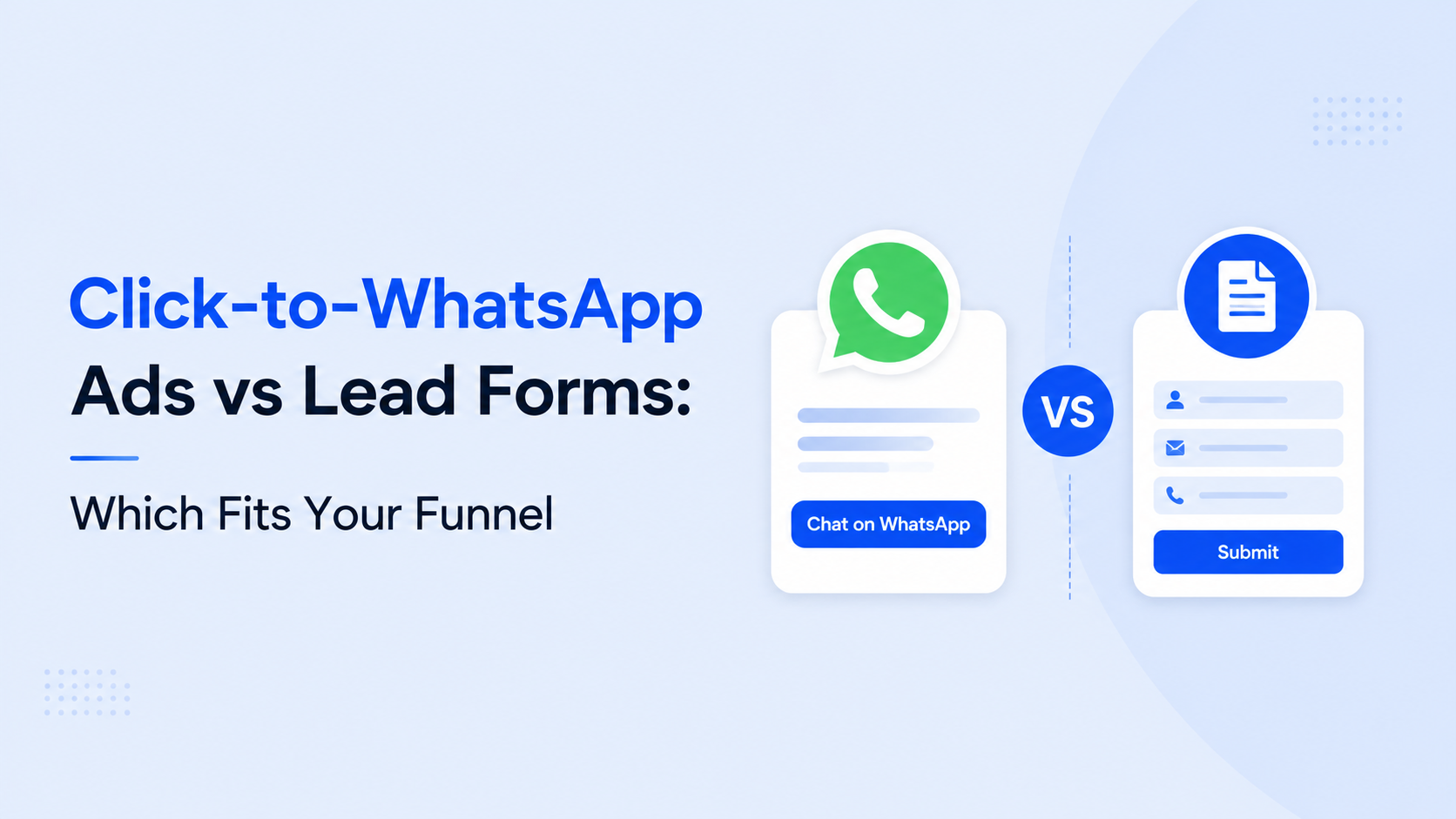
Click-to-WhatsApp Ads vs Lead Forms is not a choice between a better and worse Meta lead-generation format. The right option depends on what should happen immediately after a prospect shows interest. Meta Instant Forms are stronger when you need structured data capture before sales follow-up. Click-to-WhatsApp Ads are stronger when questions, qualification or consultation should begin immediately. For Indian businesses, compare them using qualified lead rate, sales progression and conversion, not cost per lead alone.
Click-to-WhatsApp Ads vs Lead Forms: The Core Difference
Both formats can generate leads from Facebook and Instagram, but they create different customer experiences. Meta Lead Ads with Instant Forms collect information first. Click-to-WhatsApp Ads (CTWA) open a messaging conversation first.
Meta describes lead-generation solutions as allowing customers to submit a form, start a chat or receive a call depending on the business journey. Meta has also added lead-generation objectives to ads that start WhatsApp conversations.
Choose Click-to-WhatsApp When Conversation Is Part of Conversion
Use Click-to-WhatsApp Ads when the customer is unlikely to convert by simply submitting contact details. This is particularly useful when prospects naturally have questions before taking the next step.
Strong CTWA funnels usually involve a product or service where the customer needs clarification, qualification, recommendation or appointment assistance.
CTWA tends to fit when:
Purchase consideration is high: Real estate, education, B2B services and other consultative categories often require discussion.
Questions influence conversion: Price, availability, configuration, eligibility or service suitability matter.
Speed matters: Sales should respond while intent is active.
The next step is conversational: Demo, consultation, appointment, quotation or product recommendation.
Several qualification paths exist: The next question depends on what the prospect says.
Salespeople need context: The conversation itself helps identify intent before assignment.
Meta's India automotive guidance includes a case where Vaishali Honda used geo-targeted Click-to-WhatsApp ads and reported substantial increases in test drives and qualified enquiries compared with its previous approach. That is one advertiser example rather than a general performance guarantee, but it illustrates where a conversation-led funnel can fit.
For the actual post-click workflow, Emovur's Click-to-WhatsApp Ads setup connects incoming ad conversations with qualification, CRM integration and team assignment.
Choose Meta Lead Forms When Structured Capture Matters More Than Immediate Conversation
Meta Instant Forms fit better when the business can identify a useful lead through a small number of structured questions and does not require an immediate chat to establish intent.
Instead of asking salespeople to collect basic information manually, the form can capture it before the lead enters the CRM.
Lead Forms are often stronger when:
Qualification criteria are fixed: Course, city, budget, company size or another standard field.
Lead volume is high: The business needs structured intake before sales prioritisation.
Sales cannot respond instantly: A form still captures the prospect's details.
The offer is simple: Consultation request, brochure, callback or application enquiry.
CRM scoring matters: Form fields can feed consistent values into the lead-management system.
The business needs mandatory information: Key fields can be collected before submission.
Meta has developed Instant Form features specifically around lead filtering and structured qualification. It has described using multiple-choice responses to help businesses distinguish more promising leads.
This makes forms particularly useful when lead capture needs to be standardised before conversation begins.
The Biggest Difference Is Where Qualification Happens
When comparing Click-to-WhatsApp Ads vs Lead Forms, look at the location of qualification.
With an Instant Form, qualification primarily happens before submission:
Ad → Form → Qualification Fields → Lead Submitted → CRM → Sales Follow-Up
With CTWA, much of the qualification happens through the conversation:
Ad → WhatsApp → Conversation → Qualification → CRM → Sales
Neither is automatically better.
Form-first qualification works well when:
Questions are fixed.
Answers fit structured fields.
The prospect does not need help answering.
Sales needs a minimum dataset before contacting the lead.
Conversation-first qualification works better when:
Questions depend on earlier responses.
Customers need explanation before sharing details.
Intent needs interpretation.
Recommendation forms part of the sales process.
For businesses using WhatsApp qualification, connect the resulting conversation data with sales records through a WhatsApp CRM Integration. The CRM should own the lead even when WhatsApp owns the conversation.
Compare Lead Quality After Submission, Not CPL Alone
The cheapest Meta lead is not necessarily the most commercially useful lead.
Suppose the campaigns produce:
The Lead Form appears stronger if the dashboard stops at cost per lead. CTWA becomes stronger once qualification and appointments are considered.
The reverse can also happen. A well-designed Instant Form with conversion-lead optimisation and strong CRM feedback can produce excellent qualified-lead economics. Meta's India automotive guide reports that MG Motor India used Instant Forms with CRM Conversions API and the conversion-leads performance goal, achieving 40% more qualified leads and 29% lower cost per qualified lead in the cited campaign.
That is why Click-to-WhatsApp Ads vs Lead Forms should be evaluated on downstream quality, not format preference.
Track:
Cost per qualified lead
Qualification rate
Sales-accepted lead rate
Appointment or demo rate
Lead-to-opportunity rate
Lead-to-sale rate
Revenue per lead source
Time to first sales action
Lead Forms Reduce Conversation Friction, CTWA Reduces Follow-Up Friction
Each format removes a different type of friction.
A Meta Instant Form makes it easier for the prospect to submit data without leaving the Meta environment. This works well when the business mainly needs contact and qualification information. However, once the form is submitted, the business still needs to create the customer conversation. That may mean a call, email or appropriately permissioned WhatsApp follow-up.
CTWA creates the conversation immediately. The business does not need to turn a passive form submission into an active messaging relationship because the customer has already entered WhatsApp.
Think about the friction you need to remove:
“We struggle to capture enough information.” Consider Lead Forms.
“We generate leads but cannot get them to answer afterwards.” CTWA may fit better.
“Customers need clarification before qualifying.” Consider CTWA.
“We need structured data before a salesperson gets involved.” Consider Lead Forms.
“Sales responds quickly and closes through conversation.” CTWA becomes more attractive.
“Sales needs to prioritise hundreds of leads first.” Forms may provide a cleaner intake layer.
This is primarily a sales-process decision, not an advertising-format decision.
Consider Sales-Team Capacity Before Choosing CTWA
Click-to-WhatsApp can create an immediate conversation, which becomes a disadvantage if nobody is available to manage it properly.
A customer who enters WhatsApp expects a different experience from someone who submits a form for later contact.
Before scaling CTWA, check whether the organisation can manage:
Incoming conversation volume
Lead assignment
Response times
Qualification
Duplicate ownership
Follow-up
CRM updates
Human takeover from automation
A Shared Team Inbox can help distribute incoming WhatsApp leads across sales teams, maintain conversation ownership and preserve customer history.
If the team cannot respond effectively, a structured lead form may provide better operational control until the messaging workflow is ready.
Lead Forms Fit Better When the Funnel Requires Scoring Before Contact
Some businesses should not send every new enquiry directly to a salesperson.
For example, a B2B company may need company size, role, business requirement and expected implementation timeline before deciding whether a lead belongs with SDRs, self-service onboarding or another team.
A Lead Form can perform that structured first filter.
This is useful for:
B2B lead scoring
Education eligibility
Recruitment enquiries
Franchise applications
Dealer enquiries
Financial-product enquiries where permitted and appropriately designed
High-volume service requests
The business can then use CRM logic to determine the next follow-up rather than creating a live conversation with every form respondent.
CTWA Fits Better When the Conversation Itself Creates Intent
In other funnels, the prospect may not be fully qualified when they click the ad, but the conversation helps build enough confidence to progress.
This commonly happens when customers ask:
Which option is suitable?
What is currently available?
Does this work for my requirement?
Can I visit?
Can I speak with someone?
What would this cost for my use case?
Which course or plan should I choose?
These are difficult to compress into a static lead form because the answer may change the next question.
In this situation, WhatsApp lead generation becomes part of qualification rather than merely the destination receiving the lead.
Do Not Force a Single Format Across Every Campaign
The same business can use both formats for different funnel stages or offers.
A real-estate company might use a Lead Form for broad project-interest campaigns and CTWA for campaigns promoting site visits or current availability. An education company might use forms for webinar registrations and CTWA for counselling enquiries. A B2B company might collect gated-resource leads through forms but use CTWA for demo intent.
Choose based on the action.
These are starting points, not rigid rules. Testing should confirm what works for the actual business.
A Hybrid Funnel Can Use Both Strengths
There are situations where the business benefits from structured data capture and subsequent WhatsApp conversation.
A practical hybrid model can be:
Meta Lead Form → CRM Record → Lead Scoring → Appropriate WhatsApp Follow-Up → Sales Conversation
This model can work when the business first needs structured information and then wants faster conversation-based follow-up, provided the messaging workflow and customer permissions support that communication.
Another model is:
CTWA → Short Conversation → Structured Qualification → CRM
The important distinction is whether structure should happen before or after the conversation begins.
Do not add both steps merely because the technology allows it. Every extra interaction should have a clear role.
Build the Decision Around Your Funnel
The best answer to Click-to-WhatsApp Ads vs Lead Forms depends on what your sales process needs immediately after the ad response.
Choose Meta Lead Forms when the business needs structured information, scoring and orderly lead capture before conversation. Choose Click-to-WhatsApp Ads when customer questions, qualification, consultation or sales interaction should begin while intent is active.
A useful decision framework is:
Need data first? Lead Form.
Need conversation first? CTWA.
Need fixed qualification? Lead Form.
Need adaptive qualification? CTWA.
Need to process large volumes before sales? Lead Form.
Need rapid sales interaction? CTWA.
Need both? Capture structured information first, then continue through the appropriate conversation workflow.
Do not compare the two only using cost per lead. Compare cost per qualified lead, sales progression, appointment rate, opportunity creation and final conversion.
That is where the real difference between Click-to-WhatsApp Ads vs Lead Forms appears.
TABLE OF CONTENTS