

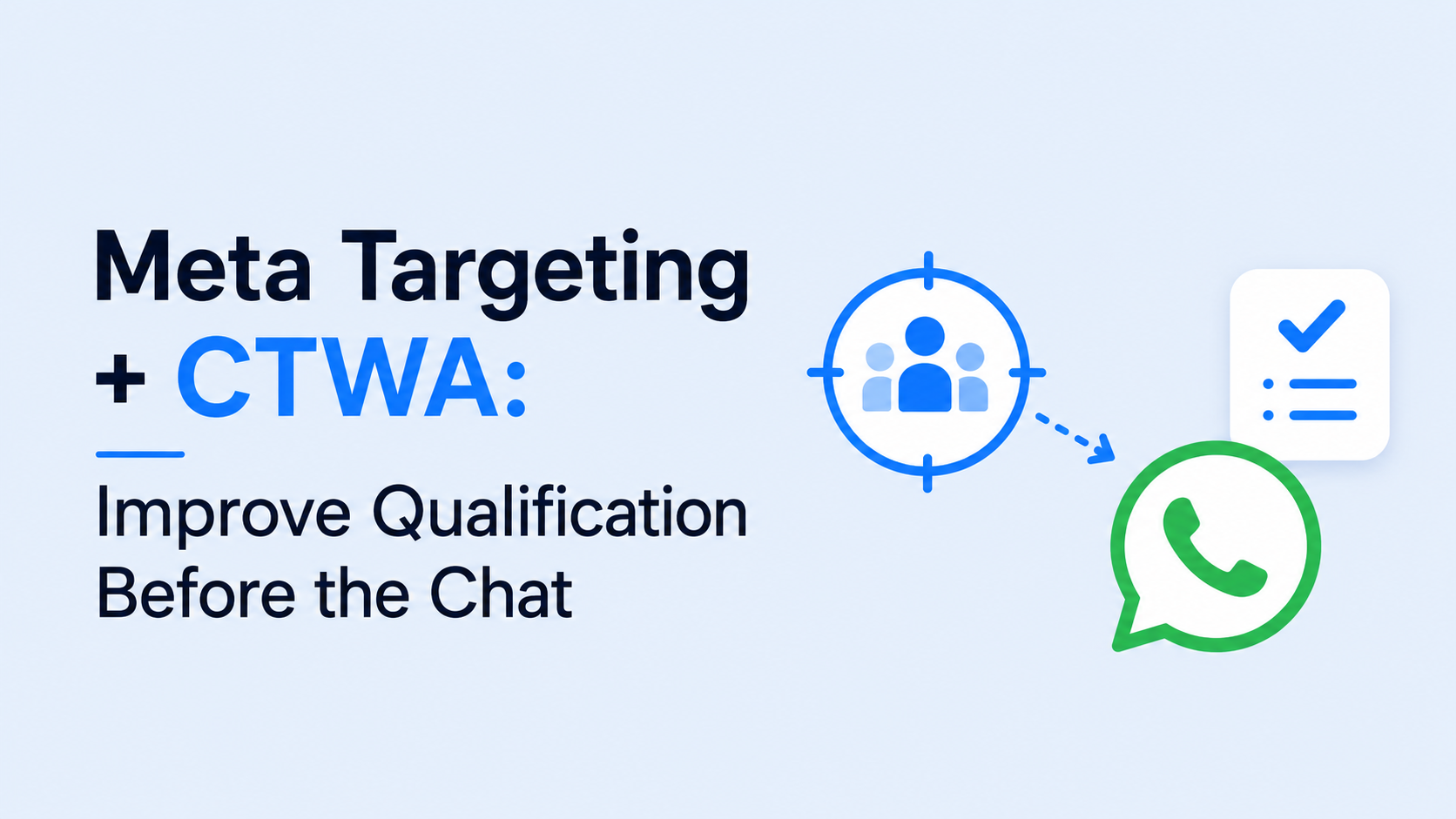
Meta targeting + CTWA should do more than generate WhatsApp conversations. The ad should filter for the right customer before the chat begins. With Click-to-WhatsApp ads, businesses can combine Meta audience signals, lead optimization, specific creative, offer framing and clear qualification cues so fewer low-intent users enter WhatsApp. For Indian businesses, the objective should be qualified conversations, not the cheapest cost per messaging conversation. The better the pre-chat filtering, the less work your chatbot and sales team need after the click.
What Does “Qualify Before the Chat” Mean?
Click-to-WhatsApp ads (CTWA) move users from Facebook or Instagram directly into a WhatsApp conversation. Meta describes these ads as supporting lead generation, sales and marketing, with targeting options including geography, age, gender, Custom Audiences and Lookalike Audiences.
But targeting alone does not create a qualified lead. Qualification starts before WhatsApp through the combination of who sees the ad, what the creative says, what the offer promises and what action the CTA asks the customer to take.
A strong pre-chat setup should help answer:
Who is this for? The ideal customer should recognise themselves immediately.
Who is this not for? Poor-fit prospects should have enough information to self-filter.
What is being offered? Avoid vague “Contact Us” propositions.
What happens after clicking? Tell users why they should start the WhatsApp conversation.
What level of intent is expected? Quote, demo, booking and consultation CTAs attract different behaviour.
The goal is not to stop people from messaging. It is to increase the percentage of chats that have genuine commercial intent.
1. Optimise for Qualified Leads, Not Conversation Volume
One of the most important CTWA decisions happens before audience interests or creative: what outcome Meta should optimise towards.
Meta currently offers down-funnel optimization for eligible Ads that Click to WhatsApp campaigns, including lead optimization and purchase optimization. Meta says lead optimization is designed to deliver ads towards people more likely to become leads rather than merely start conversations.
This distinction matters because a messaging campaign can generate large numbers of:
“Hi”
“Details?”
Accidental clicks
General curiosity
Unqualified price enquiries
Those conversations can produce an attractive cost per messaging conversation while giving sales very little value.
For lead-generation businesses, track:
Qualified leads
Qualification completion rate
Cost per qualified lead
Appointment or demo rate
Sales-accepted leads
Qualified lead-to-sale rate
Meta reports that, in a large 2024 experiment, CTWA campaigns optimized for leads produced an average 24% lower cost per lead than campaigns optimized for conversations. Results vary by advertiser, so treat this as evidence for testing the optimization rather than a guaranteed benchmark.
2. Start Meta Targeting From Your Best Customer Signals
Do not build Meta targeting for CTWA only from broad interests related to the product. Start with signals that describe customers who already produce business value.
Useful audience inputs can include:
Existing customer audiences: Suitable first-party customer groups can help inform future targeting where the business has the necessary rights to use that data.
High-quality lead audiences: Separate genuinely qualified leads from every enquiry ever collected.
Lookalike audiences: Meta supports Lookalike Audiences designed to find new users similar to existing audience sources.
Geographic relevance: Restrict campaigns where the service is genuinely location-dependent.
Age or other appropriate demographic criteria: Apply only when they materially relate to the offer.
Retargeting audiences: Previous website or business interactions can represent a different level of intent from cold discovery.
Meta's Custom Audience terms require advertisers using customer data to have the necessary rights, permissions and lawful basis for that use.
The internal WhatsApp process should also know where the lead came from. Connect campaign source and lead data through your WhatsApp CRM integration so sales can distinguish campaigns producing qualified opportunities from campaigns producing only chats.
3. Make the Creative Perform the First Qualification
Creative is often treated only as a click-generation tool. For CTWA, it should also perform the first layer of lead qualification.
If the ad is broad, every curious user can enter WhatsApp. If it contains useful decision information, some unsuitable prospects will filter themselves before clicking.
Include information that changes customer eligibility or intent.
Depending on the business, useful qualifiers can include:
Starting price: Useful when affordability is a major qualification factor.
Location: Essential for local services or property campaigns.
Customer type: “For B2B teams”, “For working professionals”, “For existing Shopify stores”.
Product category: Make the exact solution clear.
Minimum requirement: Volume, business size or another genuine threshold.
Primary outcome: State what the service actually helps achieve.
Availability: Mention relevant service areas, programme dates or other meaningful restrictions.
For example, compare:
Weak: “Looking for your dream home? Message us now.”
Better: “3 & 4 BHK premium apartments in North Bengaluru, starting from ₹1.6 Cr. Message us for current availability and site-visit options.”
The second ad may receive fewer clicks, but more of those clicks arrive with context.
WhatsApp's own CTWA guidance recommends being specific about what is being sold, who it is for and what the user will receive by messaging the business.
Once the lead enters WhatsApp, an AI chatbot can continue qualification using the context collected from the campaign rather than restarting from a generic “How can we help you?” question.
4. Match the CTA to the Customer's Intent Level
Generic CTAs attract generic conversations.
Instead of always using Message Us, position the purpose of the WhatsApp chat clearly in the advertising copy.
Examples include:
Get Current Price
Check Availability
Book a Site Visit
Ask for a Quote
Check Eligibility
Find the Right Plan
Book a Demo
Check Available Slots
Get Product Recommendation
Each CTA sets an expectation before the customer enters WhatsApp.
“Book a Demo” naturally filters more strongly than “Learn More”. “Check Eligibility” prepares the customer for qualification questions. “Get Product Recommendation” signals that the conversation will require the customer to share preferences.
Meta's current WhatsApp lead-generation guidance similarly recommends giving the customer a clear first action such as requesting today's price, sending a size for recommendations or booking a slot.
5. Use the Offer to Filter Intent
Sometimes poor lead quality is not a targeting problem. It is an offer problem.
An offer such as “Message us for more details” has almost no qualification threshold. Anyone can click.
A stronger CTWA offer gives a specific reason for the right customer to start a conversation.
Better offer types include:
Consultation: Useful when customers need expert guidance before purchasing.
Custom quote: Stronger for services with variable pricing.
Availability check: Useful for inventory, property or appointments.
Eligibility check: Useful when customers must meet certain criteria.
Product recommendation: Useful when several options exist.
Demo booking: Strong B2B intent signal.
Site visit: High-intent property action.
The offer should still be genuine. Do not make the qualification barrier artificially difficult just to improve dashboard metrics.
Once the lead shows enough intent, move the conversation to the appropriate salesperson through a Shared Team Inbox rather than allowing qualified opportunities to remain inside unnecessary automation.
6. Align Ad Creative With the First WhatsApp Question
There should be continuity between the ad and the WhatsApp conversation.
If the ad says “Check your eligibility”, the first question should begin qualification. If the ad says “Book a consultation”, the conversation should move towards booking.
Avoid:
Ad: “Get a customised quote.”
WhatsApp: “Hi! Welcome to ABC Company. Please choose: About Us / Products / Contact Us.”
The customer has already told you why they clicked.
A cleaner journey is:
Ad Promise → WhatsApp Entry → One Relevant Question → Qualification → Next Action
Useful first questions may include:
“Which location are you interested in?”
“How many team members will use the platform?”
“Which course are you considering?”
“When are you planning to purchase?”
“Which service do you need?”
“What approximate budget range are you considering?”
Meta's own WhatsApp lead-generation guidance recommends using the first few messages to understand factors such as budget, timeline or service interest.
7. Do Not Ask Five Questions the Ad Could Have Answered
Every unnecessary question increases friction after the click.
Use the Meta ad to establish information that applies to everyone entering the conversation.
If the ad already says:
“Data Science course for working professionals, weekend classes, Bengaluru + online options.”
do not begin WhatsApp by asking:
Are you interested in Data Science?
Are you a working professional?
Do you want weekend classes?
Are you in Bengaluru?
The ad has already created context.
Use WhatsApp for information that is customer-specific:
Experience level
Career goal
Joining timeline
Preferred learning mode
Counselling interest
This reduces the number of questions required to identify a qualified prospect.
8. Feed Qualified Lead Outcomes Back Into Meta
Qualification becomes much more powerful when Meta receives a meaningful downstream signal rather than only knowing that someone opened WhatsApp.
Meta supports measurement beyond the initial conversation using tools such as Meta Pixel, Conversions API and Offline Conversions, and its CTWA lead optimization is specifically intended to optimise towards meaningful lead outcomes.
Your funnel should therefore distinguish:
Conversation Started → Qualification Completed → Qualified Lead → Sales Accepted → Appointment/Demo → Sale
Do not mark everyone who messages as a qualified lead.
Define qualification in advance.
For example:
Real estate: correct location + required budget + relevant purchase timeline.
B2B SaaS: business use case + appropriate company size + requirement + sales intent.
Education: suitable course + eligibility + joining intention.
The stronger the event definition, the more useful your optimization and reporting become.
9. Test Lead Quality by Creative and Audience, Not Only CPL
Two ad sets may produce the same cost per conversation but very different business outcomes.
Use a qualification report like:
Ad Set A looks better when judged by conversation cost. Ad Set B is much stronger when judged by actual sales intent.
Measure CTWA using:
Conversation-to-qualified-lead rate
Cost per qualified lead
Lead-to-demo rate
Lead-to-appointment rate
Sales acceptance rate
Revenue by campaign
Low-quality conversation rate
This is how Meta targeting + CTWA qualification should be evaluated.
10. Use Broad Delivery Carefully, but Make the Message Specific
Meta's current CTWA setup guidance encourages advertisers to give its delivery system sufficient audience scale and notes that broader audiences can help performance.
That does not mean your message should become broad.
A useful distinction is:
Audience can be broad enough for Meta to optimise. Creative should remain specific enough for customers to self-qualify.
Over-restricting targeting with dozens of assumptions can reduce Meta's ability to learn. Conversely, broad targeting combined with vague creative can flood WhatsApp with curiosity clicks.
Test combinations rather than assuming that either maximum audience restriction or completely open targeting will automatically produce better leads.
Build Qualification Into the Ad, Not Only the Chatbot
The strongest Meta targeting + CTWA strategy starts qualification before the customer sends the first WhatsApp message.
Use audience signals to reach plausible prospects. Use Meta's lead optimization where eligible to optimise towards more meaningful lead actions. Use creative to state who the offer is for. Add price, location, eligibility or another genuine qualifier where it affects customer fit. Make the CTA describe why the person should open WhatsApp, then ensure the first question continues from the exact promise made in the ad.
The operating model should be:
Audience Signal → Specific Creative → Self-Qualification → Clear CTWA Intent → Relevant First Question → Qualified Lead Event
Meta's own CTWA case studies support this distinction. Indian nutrition business Nutryfit reported 12% lower cost per lead when testing lead optimization against its usual conversation-optimized CTWA campaigns, while Meta's broader lead-optimization experiment showed an average 24% lower CPL. These are advertiser-specific and experimental results, not guaranteed outcomes, but they reinforce the need to optimise towards qualified leads rather than raw chats.
The better question is not “How do we get more people into WhatsApp?” It is “How do we make sure the people entering WhatsApp already understand the offer and have a reason to continue?”