

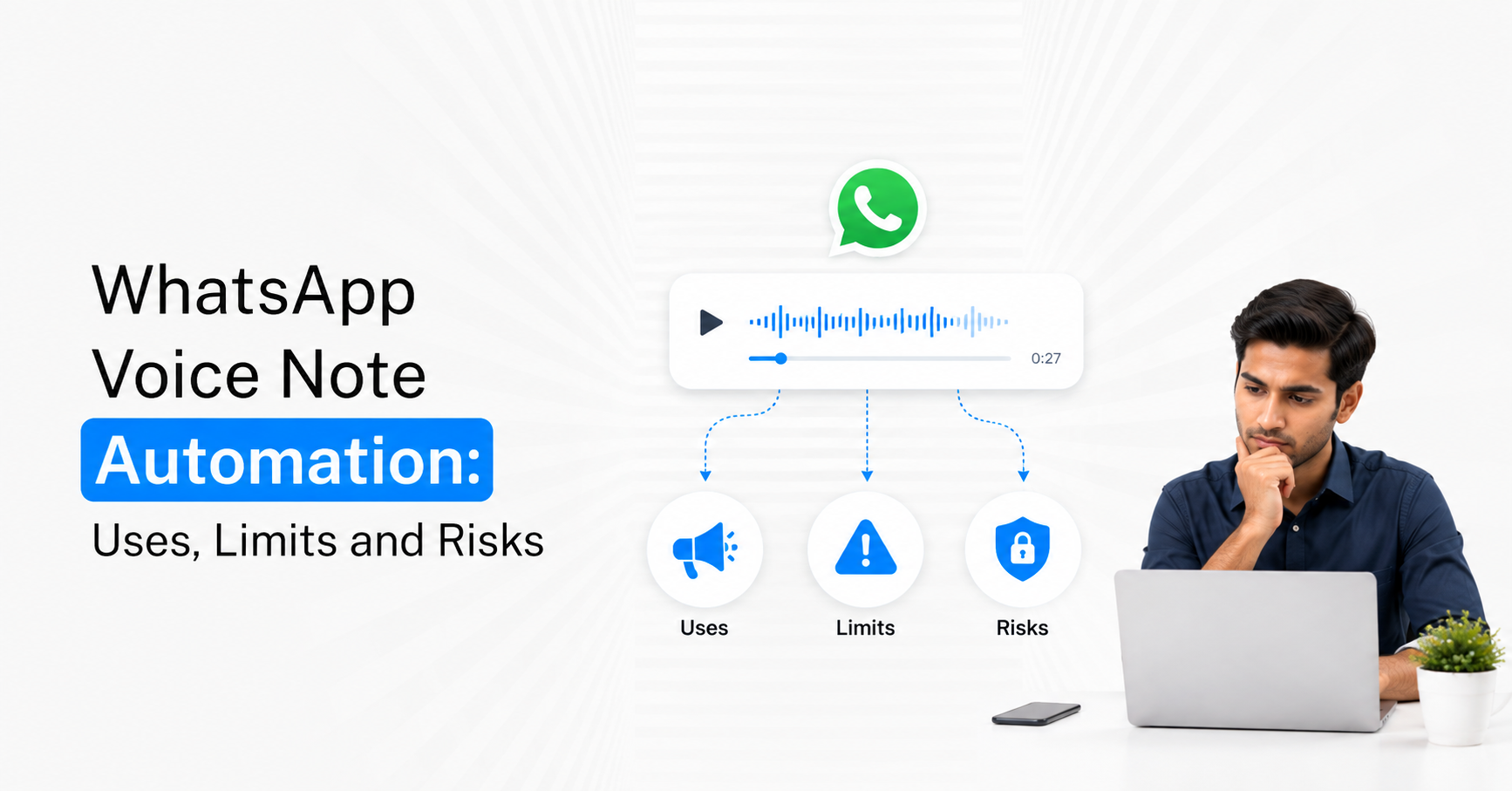
WhatsApp voice note automation allows businesses to send or process audio messages through the WhatsApp Business Platform when voice adds more value than text. It can be useful for short explanations, regional-language communication, personalised service updates and inbound voice-note processing, but it should not become the default format for every automated message. In 2026, businesses should use WhatsApp voice note automation selectively because audio takes longer to consume, is harder to scan, creates accessibility challenges and still operates within WhatsApp's messaging, consent and customer-service rules.
What Does WhatsApp Voice Note Automation Actually Mean?
WhatsApp voice note automation can refer to two different workflows. The first is sending an automated audio or voice message to a customer. The second is receiving a customer's voice note, processing the audio through another system and using the result to trigger a business workflow.
Meta's official WhatsApp Business Platform supports audio as a media-message type. Businesses can send an audio message using either an uploaded media ID or an audio URL. Meta's current API example also provides a voice option that can make supported audio appear as a voice message rather than a standard audio attachment. When using that mode, Meta specifies OGG audio encoded with Opus.
The WhatsApp Cloud API also supports incoming audio messages through webhook events, which means a connected system can detect that a customer has sent an audio or voice message and process the associated media according to the business workflow.
A typical voice-message workflow can include:
Trigger: Customer performs an action or sends a voice note.
Audio retrieval: The system retrieves an approved audio file or incoming media.
Processing: The workflow may classify, transcribe or route the audio using connected services.
Business logic: CRM, support or another system determines what happens next.
Response: The customer receives text, audio or human assistance depending on the use case.
Logging: Relevant delivery, customer and workflow events are stored for reporting.
This is different from simply recording a voice note manually and sending it to a customer. The value comes from connecting audio with a repeatable WhatsApp automation workflow.
For the wider workflow architecture around triggers, CRM events and automated responses, see WhatsApp Automation Workflows in India.
Where WhatsApp Voice Note Automation Can Add Real Value
The strongest use cases for WhatsApp voice note automation are situations where hearing a short explanation is genuinely easier or more natural than reading a long text message. Audio should solve a communication problem, not simply make automation appear more human.
1. Short Explanations That Sound Awkward in Text
Some customer questions need a little context but do not justify a long paragraph. A short recorded explanation can be easier to follow, particularly after the customer has already asked for clarification.
Useful situations include:
Product explanation: Clarifying a feature that customers frequently misunderstand.
Service process: Briefly explaining what happens before an appointment or consultation.
Onboarding: Giving a short orientation before the next step.
Complex instruction: Explaining a process that is difficult to communicate with fragmented chat messages.
Keep the audio focused on one purpose. A three-minute sales pitch is usually less useful than a 30-second explanation plus a text CTA.
2. Regional-Language Customer Communication
India's language diversity makes voice useful in specific customer journeys. A customer may understand a spoken Kannada, Hindi, Tamil, Telugu or another supported business language more comfortably than lengthy written copy.
WhatsApp voice message automation can therefore support:
Regional sales explanations
Local-service instructions
Customer onboarding
Event or appointment information
Voice-led assistance for customers less comfortable typing
However, businesses should not assume that preferred speaking language automatically equals preferred audio communication. Give customers a usable text alternative where practical.
3. Inbound Customer Voice Notes
Customers already use voice notes naturally, especially when explaining a problem is faster than typing it. The API can receive audio messages through webhooks, allowing businesses to build an incoming voice note processing workflow.
Depending on the systems connected by the business, the workflow could:
Detect an incoming voice note.
Retrieve the associated media.
Create a transcription using an authorised speech-to-text service.
Attach the transcript to a CRM or support record.
Identify the appropriate team or workflow.
Allow an employee to review the original audio where needed.
This is especially useful for operational efficiency because the business is responding to the customer's chosen format rather than forcing customers to type everything again.
4. Human-Originated Audio Used at Specific Journey Points
Automation does not mean every audio message needs to be synthetically generated. A business may record a small library of approved voice explanations from a real employee or spokesperson and trigger the correct recording when the situation matches.
Examples might include an onboarding explanation, event instruction or service preparation note.
This approach keeps the audio controlled while still allowing automated WhatsApp voice messages to scale across repeated situations.
Technical Limits You Need to Design Around
Before implementing WhatsApp voice note automation, businesses should understand what the WhatsApp Business Platform actually provides and what must be built separately.
Meta's official Cloud API supports audio media and lists supported audio formats including AAC, MP4 audio, MPEG, AMR and OGG. The current media documentation lists a maximum audio-media size of 16 MB and notes that OGG requires the Opus codec.
For voice-message presentation specifically, Meta's official API examples show voice: true and specify an .ogg file encoded with Opus.
Important technical considerations include:
Audio generation is separate: WhatsApp delivers the audio, but creating speech from text requires your own approved text-to-speech system if you want generated voice.
Transcription is separate: Receiving an audio message does not automatically mean your application has a usable transcript.
Media storage needs planning: Decide how long incoming or generated audio needs to be retained within your own systems.
Backend integration is required: CRM updates, speech processing and routing happen through your own integrations.
Delivery status is not listening analytics: WhatsApp webhooks provide message states such as sent, delivered and read, but the published webhook status model does not provide a dedicated "customer listened to the complete voice note" metric.
This last point is important. A read status should not be presented internally as proof that the customer listened to or understood the audio.
Businesses using Emovur can connect third-party systems through webhook-based integrations for triggered message delivery and workflow processing. Emovur Integrations describes its webhook integration model.
Messaging Windows Still Apply to Voice Automation
WhatsApp voice note automation does not create a separate messaging rulebook. Audio messages still operate within WhatsApp Business Platform policy.
WhatsApp's current Business Messaging Policy states that businesses can reply without a template within the 24-hour customer-service window following the user's last message. Outside that window, business-initiated communication must use approved message templates. WhatsApp also requires businesses to obtain appropriate opt-in and respect opt-out requests.
This means businesses should not assume they can automate free-form voice notes to old leads at any time simply because the content is audio.
Before sending automated voice communication, check:
Conversation state: Is the business inside the current customer-service window?
Customer expectation: Would the customer reasonably expect an audio response?
Messaging eligibility: Does the business have appropriate permission for the communication?
Purpose: Is this customer service, sales follow-up, onboarding or another workflow?
Fallback: Can the customer continue through text or human support if audio is inconvenient?
For the underlying API and messaging environment, refer to the main WhatsApp Business API page rather than turning voice-note automation into a separate API implementation strategy.
The Biggest Risks Are Customer Experience Risks
The main danger with WhatsApp voice note automation is not that audio cannot be automated. It is that businesses can automate it too aggressively.
Audio Is Slower to Scan
A customer can read the key point of a short text message in seconds. A 60-second audio message requires roughly 60 seconds of attention.
This makes voice a poor format for:
OTPs or codes
Addresses
Dates and times
Prices
Order numbers
Links
Technical identifiers
Information the customer may need to copy
Keep precise information in text even when an audio explanation accompanies it.
Customers Cannot Always Listen
People may be at work, travelling, in a classroom, in a meeting or in a public place. Some customers may also have hearing impairments or simply prefer text.
A strong WhatsApp audio automation strategy should therefore consider:
Short text summaries
Captions or transcripts where feasible
A text-based alternative
Clear CTA buttons or links in text
Audio should add convenience, not create a new accessibility barrier.
Repeated Voice Notes Can Feel Intrusive
An automated text message can be quickly scanned. Repeated voice bubbles demand more attention and may feel unusually personal when they are actually automated.
Avoid using voice for every stage of:
Promotional nurturing
Repeated sales reminders
Cart recovery
Routine transactional updates
Large broadcast campaigns
These areas are usually better served by text, templates and structured interactive messages.
Synthetic Voice Creates Trust Questions
If businesses use AI-generated speech, customers may interpret the voice as a real employee. Be careful not to design synthetic audio in a way that impersonates individuals or misleads customers about who is speaking. WhatsApp's Business Messaging Policy explicitly prohibits impersonation or misleading customers about the identity or nature of the business.
Use synthetic speech for clarity and convenience, not to imitate a real person without appropriate permission.
Use a Voice-or-Text Decision Rule
The easiest way to avoid overusing WhatsApp voice note automation is to decide the format based on the information being communicated.
A practical principle is: use voice when tone and explanation matter, use text when precision and scanability matter.
How to Implement WhatsApp Voice Note Automation Safely
A good implementation should begin with one narrow use case rather than enabling audio throughout the entire customer journey.
Use this workflow:
Choose one trigger: For example, a customer asks for an explanation or sends a voice note.
Define the audio purpose: Decide exactly what the audio should solve.
Keep recordings short: Remove introductions and filler.
Provide text context: Tell the customer what the audio contains.
Store structured data separately: Important information should not live only inside audio.
Set failure handling: If transcription or delivery fails, fall back to text or a human.
Control sending eligibility: Apply WhatsApp's messaging-window and opt-in requirements.
Monitor customer behaviour: Compare responses with equivalent text journeys.
If the voice workflow forms part of a larger automation system, use WhatsApp Automation Workflows to structure triggers and backend actions instead of creating an isolated audio bot.
Measure Whether Voice Actually Improves the Journey
Do not assume WhatsApp voice note automation performs better because it feels more personal. Test it against a clear text alternative.
Useful metrics include:
Delivery rate: Did the audio reach the customer?
Response rate: Did customers reply after receiving it?
Task completion: Did the intended customer action occur?
Conversion rate: Did voice improve the relevant commercial outcome?
Human escalation: Did audio reduce or increase the need for assistance?
Repeat-question rate: Did customers still ask for the same explanation?
Opt-out or negative feedback: Did the format create friction?
Text fallback usage: How frequently did customers need the information in another format?
Because WhatsApp's published message-status webhooks track sent, delivered, read and failed states rather than full audio-listening completion, businesses should measure customer actions after the voice message rather than treating "read" as "listened".
Use Voice Notes as a Format, Not as the Automation Strategy
The strongest WhatsApp voice note automation use cases are narrow and intentional. Audio can make a short explanation easier to understand, support regional-language communication and help businesses process customers who naturally send voice notes. The WhatsApp Business Platform provides the audio-message transport layer, while transcription, text-to-speech, CRM updates and workflow logic need to be designed around it.
The practical model is Trigger → Decide Voice or Text → Process Audio → Deliver Useful Context → Capture Next Action → Fall Back When Needed.
Do not replace readable text with audio simply because voice feels more conversational. Keep codes, dates, prices, links and transactional details visible in text; reserve automated voice notes for communication where listening provides a genuine advantage.
That is where WhatsApp voice note automation adds value without becoming another source of customer friction.