

WhatsApp Business API for B2B sales teams works best as a fast conversational layer between lead generation, CRM activity and human sales follow-up. In India, B2B companies can use WhatsApp for enquiry response, lead qualification, demo scheduling, proposal follow-up, account communication and team collaboration. It should not replace email, CRM or sales calls. Instead, WhatsApp fits where prospects need quick, low-friction communication while the CRM remains the system of record for the sales pipeline.
Where Does WhatsApp Fit in a B2B Sales Process?
B2B sales rarely happen through one channel. A prospect may discover a company through Google or LinkedIn, submit a website form, speak with an SDR, attend a demo, receive a proposal by email and continue follow-up with an account executive.
A practical journey looks like Website/Ads → CRM → WhatsApp → SDR/AE → Demo → Proposal → Follow-Up → Deal.
Each channel should have a clear role:
CRM: Stores account information, lead stages, opportunity value, ownership and pipeline activity.
Email: Handles proposals, agreements, detailed communication and formal documentation.
Calls and meetings: Support discovery, negotiation, technical discussions and complex buying decisions.
WhatsApp: Handles quick qualification, confirmations, reminders, clarifications and short follow-ups.
Automation: Takes care of repetitive steps before human sales involvement becomes necessary.
The value of WhatsApp in B2B is not replacing existing sales tools. It is reducing the communication gaps between them.
1. Respond Faster to Inbound B2B Leads
Inbound B2B prospects often evaluate several vendors at the same time. A long response delay can reduce the chances of starting a meaningful sales conversation.
WhatsApp Business API can improve inbound lead handling through:
Immediate acknowledgement: Confirm that the enquiry has reached the company.
Requirement capture: Identify which product, service or solution the prospect needs.
Company qualification: Collect organisation, designation, team size or another useful qualifier.
Purchase intent: Determine whether the prospect is researching, comparing or actively buying.
Lead routing: Send the opportunity to the appropriate salesperson, territory or product team.
Next-action creation: Move qualified prospects towards a demo, consultation or sales call.
A typical workflow is Form Submission → WhatsApp Response → Qualification → CRM Update → SDR Assignment.
Businesses building this connection can refer to the guide on connecting website forms with WhatsApp Business API, while this article remains focused on the B2B sales application.
2. Qualify Leads Before an SDR Gets Involved
Not every incoming enquiry deserves the same amount of salesperson time. WhatsApp can act as an initial qualification layer before an SDR begins a full sales conversation.
Useful B2B qualification fields include:
Company size: Helps determine whether the account matches the ideal customer profile.
Business requirement: Identifies the problem the prospect is trying to solve.
Current solution: Gives the salesperson context before the first conversation.
Purchase timeline: Separates active opportunities from early-stage research.
Location or market: Supports regional or territory-based assignment.
Preferred meeting time: Reduces unnecessary scheduling exchanges.
The aim is not to recreate an entire discovery call inside WhatsApp. Collect enough information to identify the right next action, then involve sales.
Structured information can also be collected through WhatsApp Flows.
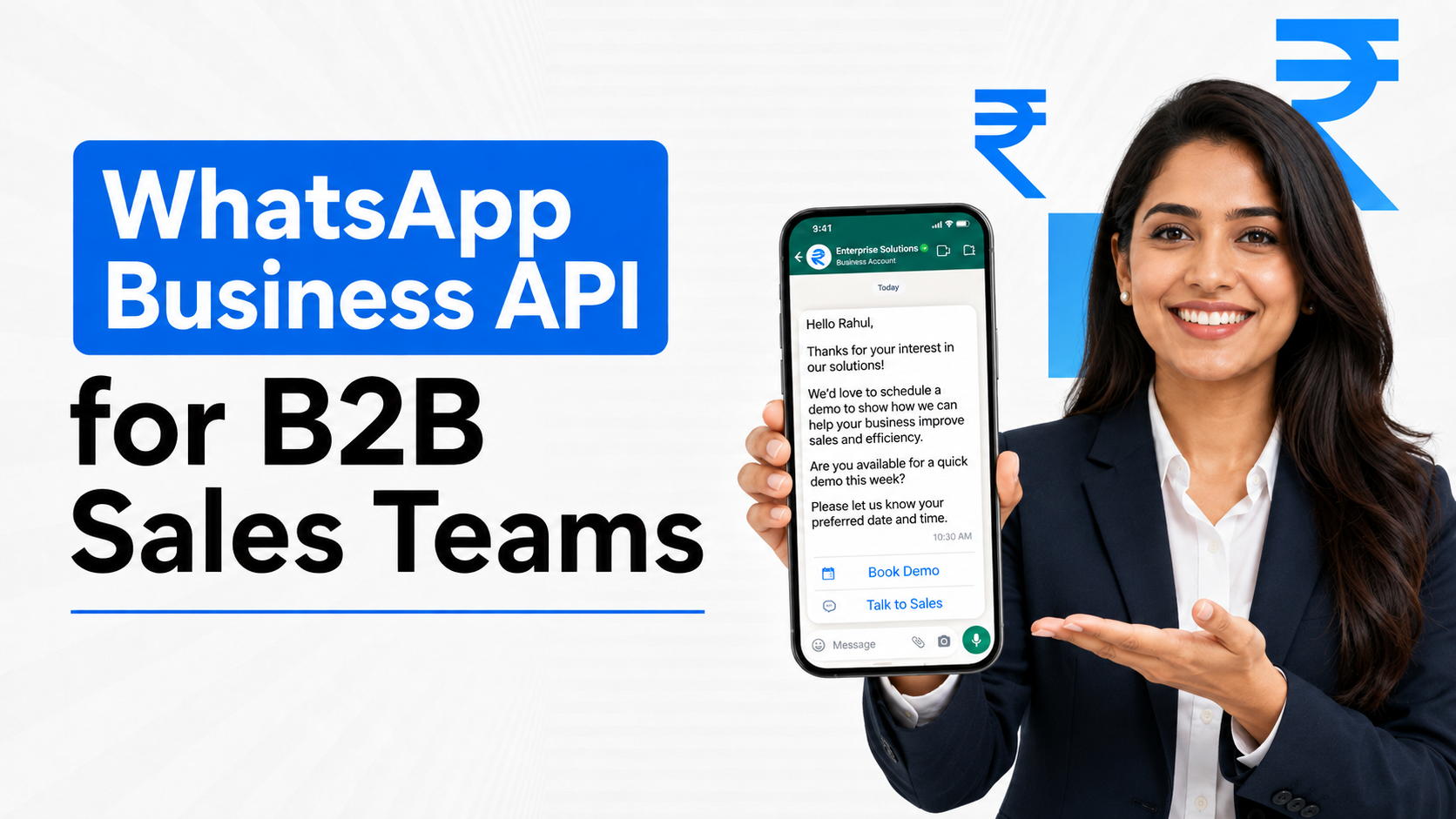
3. Schedule Product Demos and Sales Meetings
Scheduling is one of the easiest B2B processes to simplify through WhatsApp.
Instead of multiple emails discussing dates and timings, the prospect can move directly towards a confirmed meeting.
A demo-booking workflow can support:
Demo request: Confirm that the prospect wants to speak with sales.
Date selection: Capture a suitable day or time.
Meeting confirmation: Share the confirmed schedule.
Reminder: Notify the prospect before the meeting.
Rescheduling: Allow changes without creating a long email thread.
Sales notification: Inform the assigned SDR or AE when the appointment changes.
The journey becomes Qualified Lead → Demo Requested → Time Selected → Confirmation → Reminder → Sales Call.
For organisations handling hundreds of enquiries, reducing even one scheduling exchange per prospect can save significant sales time.
4. Use WhatsApp for Follow-Up Without Replacing Email
Follow-up is one of the strongest WhatsApp B2B sales use cases, but businesses should define where WhatsApp ends and formal communication begins.
WhatsApp works well for:
Meeting confirmations: Confirm upcoming demos or discussions.
Post-demo check-ins: Ask whether the prospect needs clarification.
Proposal acknowledgement: Confirm that an emailed proposal has been received.
Next-step reminders: Follow up on an agreed action.
Document notifications: Let the prospect know requested material has been sent.
Handover messages: Introduce an account executive or onboarding contact.
Email remains better for:
Detailed commercial proposals
Long technical explanations
Contracts and agreements
Communication involving multiple stakeholders
Document version control
Formal records
The principle is simple: WhatsApp for speed; email for structure.
5. Connect WhatsApp With the CRM
WhatsApp CRM integration is particularly important in B2B because opportunities may remain active for weeks or months. If customer conversations remain outside the CRM, important context can disappear when the opportunity moves between SDRs, AEs or managers.
A CRM-connected WhatsApp setup can maintain:
Lead identity: Match WhatsApp activity with the correct contact.
Company information: Connect individual buyers with the relevant account.
Lead source: Identify which campaign or page generated the enquiry.
Sales ownership: Record the SDR or AE responsible for the opportunity.
Pipeline stage: Connect conversations with qualification, demo, proposal or negotiation.
Follow-up tasks: Create the next required sales action.
Conversation context: Give the next salesperson visibility into previous interactions.
For implementation details, use the existing WhatsApp CRM Integration: Complete Setup Guide rather than duplicating that technical intent here.
The B2B operating rule should be: WhatsApp handles the conversation; CRM owns the opportunity.
6. Give Multiple Salespeople Access to One Business Number
A growing B2B organisation should not allow important customer relationships to remain locked inside an individual salesperson's phone.
A WhatsApp Shared Team Inbox allows multiple team members to work through one business number while maintaining conversation ownership.
For B2B teams, this helps with:
Lead assignment: Route enquiries to the appropriate sales representative.
Ownership clarity: Prevent multiple SDRs from contacting the same prospect.
Conversation history: Give employees access to relevant previous communication.
Internal collaboration: Add context before transferring an opportunity.
Conversation transfer: Move accounts between SDR, AE, onboarding or support teams.
Manager visibility: Monitor workload, response activity and unresolved conversations.
This is particularly important when employees change teams, accounts are reassigned or several departments interact with the same customer.
7. Improve SDR-to-AE Handoffs
B2B sales frequently involve several roles. An SDR may qualify the prospect, an AE may run discovery, a solution consultant may handle technical questions and another employee may manage onboarding.
A stronger handoff looks like Inbound Lead → SDR Qualification → CRM Update → AE Assignment → Context Transfer → Demo/Discovery.
The next salesperson should already know:
Customer requirement
Organisation
Contact role
Product interest
Previous questions
Meeting history
Current sales stage
Agreed next action
The customer should not hear, “Can you explain your requirement again?” every time the account changes hands.
8. Re-Engage Warm B2B Opportunities
B2B opportunities frequently pause because of internal approval, procurement, budget cycles, technical evaluation or timing.
WhatsApp can support contextual re-engagement when there is an existing customer relationship and communication follows applicable messaging rules.
Relevant use cases include:
Following up near an agreed decision date
Sharing information specifically requested by the buyer
Reopening a postponed evaluation
Confirming whether the project timeline has changed
Inviting an existing prospect to a relevant webinar or demo
Asking whether another stakeholder should join the evaluation
The objective is not increasing message frequency. B2B buyers need relevant follow-up connected to the opportunity.
9. Manage Webinar, Event and Demo Leads
Many B2B opportunities originate from webinars, conferences, workshops and trade events rather than traditional website enquiries.
WhatsApp can help connect event participation with the next sales action.
A typical journey could be Registration → WhatsApp Confirmation → Reminder → Attendance → Relevant Follow-Up → Qualification → Sales Assignment.
This works particularly well for:
Product demonstrations
Industry webinars
Trade exhibitions
Business workshops
Networking events
Consultation sessions
However, not every attendee should automatically become a sales-ready lead. Qualification should determine whether sales involvement is appropriate.
10. Support B2B Onboarding and Account Handover
WhatsApp can continue to play a role after the deal closes, particularly during onboarding and early customer coordination.
Useful post-sale interactions include:
Onboarding confirmation: Confirm the first implementation meeting.
Contact introduction: Introduce the implementation or account-management team.
Information collection: Request specific setup details.
Action reminders: Follow up on agreed onboarding tasks.
Urgent coordination: Handle short operational queries.
Service escalation: Direct the customer to the appropriate team when necessary.
Formal project documentation should remain inside the company's approved systems. WhatsApp should reduce small communication delays, not become the entire customer-success platform.
Where WhatsApp Should Not Be Used in B2B Sales
WhatsApp Business API should not become the default channel for every B2B interaction. It is less suitable for complex proposals, contracts, lengthy technical evaluations, legal communication or discussions involving many decision-makers. Email, meetings, CRM records and document-management systems provide better structure for these situations.
Avoid using WhatsApp as the primary system for:
Contracts and legal agreements: Use appropriate signing and document platforms.
Long commercial proposals: Use email or a controlled proposal system.
Detailed technical architecture: Use documentation and meetings.
Multi-stakeholder discussions: Email and meetings generally provide better visibility.
Pipeline management: WhatsApp should connect with the CRM, not replace it.
Sensitive internal information: Follow the organisation's security and compliance policies.
A strong B2B WhatsApp strategy includes clear boundaries.
Where Does WhatsApp Fit Across the B2B Funnel?
WhatsApp is strongest in the communication gaps between major B2B sales actions.
Four Questions B2B Sales Teams Ask About WhatsApp Business API
Is WhatsApp Business API useful for B2B sales?
Yes. WhatsApp Business API is particularly useful when a B2B sales process involves inbound enquiries, qualification, meeting scheduling and repeated short follow-ups. It works best as a conversational layer connected to CRM and human sales activity rather than replacing formal email, proposals or sales calls. Its biggest value is reducing communication delays between important stages of the B2B buying journey.
Should B2B companies use WhatsApp or email for sales?
Use both for different purposes. Email remains stronger for formal, detailed and multi-stakeholder communication, while WhatsApp can reduce friction around confirmations, qualification, reminders and shorter follow-ups. A mature B2B sales process selects the channel according to the communication task instead of forcing the complete customer journey into either email or WhatsApp.
Can WhatsApp Business API integrate with a B2B CRM?
Yes. WhatsApp Business API can support CRM-connected workflows where customer conversations, lead details, ownership and follow-up activity move between systems. The exact implementation depends on the CRM and integration architecture. For B2B organisations, the CRM should remain the system of record while WhatsApp provides a faster customer-facing conversational layer.
Can multiple sales representatives use the same WhatsApp number?
Yes. An appropriate WhatsApp Business Platform solution can allow several sales or support employees to manage conversations through a shared team inbox. This helps businesses assign leads, maintain ownership and preserve conversation context when an opportunity moves between SDRs, account executives or other departments instead of tying the customer relationship to one employee's device.
What Should B2B Sales Teams Automate First?
Automation should be used where the sales process is repetitive and predictable.
Strong candidates for automation include:
Lead acknowledgement
Basic qualification
Demo scheduling
Meeting reminders
Lead routing
CRM task creation
Follow-up triggers
Keep these primarily human-led:
Discovery
Commercial discussions
Objection handling
Negotiation
Complex technical questions
Enterprise stakeholder management
Strategic account conversations
For deeper workflow logic, use the existing WhatsApp automation workflows in India article rather than duplicating automation intent here.
Emovur's View: WhatsApp Should Shorten the B2B Sales Cycle
The wrong implementation simply adds WhatsApp to CRM + Email + Calls + LinkedIn + Meetings and gives the salesperson another inbox to manage.
A stronger implementation connects these systems.
The goal is to move prospects through Enquiry → Qualification → Salesperson → Demo → Follow-Up with fewer delays, fewer manual handoffs and better context.
WhatsApp should reduce:
Slow lead response
Manual qualification
Scheduling friction
Lost follow-ups
Ownership confusion
Repeated customer questions
while preserving human involvement where judgement, negotiation and trust influence the purchase.
Frequently Asked Questions
Is WhatsApp suitable for enterprise B2B sales?
Yes, as a supporting communication channel. Enterprise sales generally requires CRM, email, meetings, documentation and multiple stakeholders, so WhatsApp should complement rather than replace those systems.
Can B2B teams send proposals through WhatsApp?
Supported files can be exchanged through WhatsApp, but businesses should decide whether the channel meets their proposal governance, security and recordkeeping requirements. Formal proposals are often better controlled through email or dedicated proposal systems.
Can WhatsApp automate B2B lead qualification?
Yes. Structured questions, automation and tools such as WhatsApp Flows can collect relevant information before an enquiry is assigned to a salesperson.
Is WhatsApp better for SDRs or account executives?
It can support both. SDRs may use WhatsApp for qualification and scheduling, while account executives may use it for shorter follow-ups and coordination. Clear ownership rules should prevent overlapping communication.
Where WhatsApp Fits in the Modern B2B Sales Stack
WhatsApp for corporate sales is most valuable when it removes friction without removing sales discipline.
The stronger model is Lead Source → CRM → WhatsApp → SDR/AE → Sales Activity → CRM.
Use WhatsApp for speed, CRM for structure, email for formal communication, calls and meetings for complex discussions, automation for predictable actions and people where judgement matters.
B2B organisations that need multi-agent conversations, automation and integration capabilities can evaluate Emovur's WhatsApp Business API as part of their existing sales stack.
Start WhatsApp API Setup when WhatsApp can remove a measurable communication gap from your B2B sales process.