

Not every WhatsApp lead has the same buying intent. One prospect may ask for pricing, share a budget and request a demo, while another may send a generic enquiry and stop responding. For sales teams handling a high volume of conversations, deciding which lead deserves attention first can become difficult.
This is where AI lead scoring on WhatsApp can help. It uses conversation data, qualification inputs, engagement behaviour and CRM information to identify which leads show stronger purchase intent. The goal is not to replace the salesperson, but to help the sales team prioritise opportunities faster.
Quick Answer
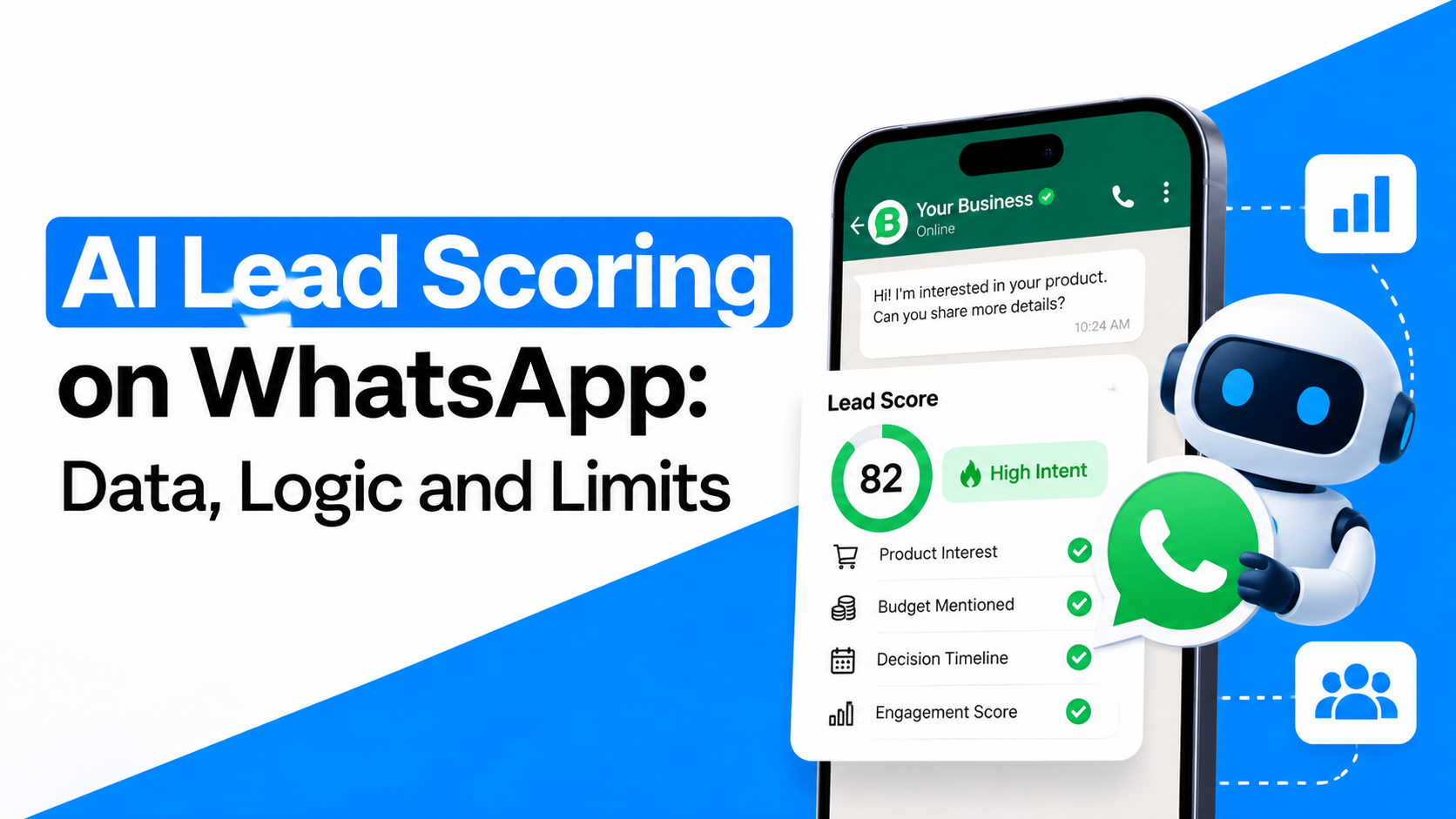
AI lead scoring on WhatsApp analyses signals from customer conversations and sales data to classify leads based on their likelihood to progress. A lead may be marked as high intent, warm, cold or follow-up required depending on signals such as pricing enquiries, budget, demo requests, response behaviour and qualification data.
When connected with a WhatsApp CRM, these scores can also help sales teams assign leads, plan follow-ups and prioritise conversations more effectively.
What Data Can AI Use for WhatsApp Lead Scoring?
The accuracy of WhatsApp lead scoring depends largely on the quality of data available. The stronger and more relevant the input signals are, the more useful the lead score becomes.
Conversation data: Questions about pricing, product features, implementation, demos, timelines and buying requirements can indicate stronger intent.
Qualification data: Budget, location, company size, requirement, decision-making authority and purchase timeline can improve scoring accuracy.
Engagement behaviour: Response speed, repeat conversations, link clicks, form completion and demo bookings can indicate how actively a prospect is considering the offer.
CRM data: Previous conversations, lead source, current sales stage, past purchases and follow-up history can add important context.
Campaign source: Leads arriving from high-intent campaigns may be scored differently from general awareness enquiries.
Businesses collecting structured information through WhatsApp Flows for B2B lead qualification can use those responses as additional scoring signals.
How Does AI Lead Scoring Logic Work?
Lead scoring does not always require a highly complex AI model. Many businesses can begin with a combination of predefined scoring rules and AI-assisted intent analysis.
For example:
Pricing enquiry: +10 points
Budget shared: +15 points
Demo requested: +20 points
Purchase timeline confirmed: +15 points
Target customer criteria matched: +10 points
Quick response to follow-up: +5 points
No response after repeated follow-ups: -10 points
A prospect accumulating stronger buying signals can then be moved higher in the sales queue.
More advanced systems can also analyse historical CRM data to identify patterns commonly associated with qualified leads or successful conversions. A proper WhatsApp CRM integration makes it easier to combine WhatsApp conversation signals with existing sales data.
Where AI Lead Scoring Helps Sales Teams
The biggest advantage of AI scoring is not simply creating a number. It helps sales teams decide what to do next.
Prioritise high-intent leads: Prospects asking about pricing, demos or purchase timelines can receive faster attention.
Improve lead assignment: High-value opportunities can be routed to experienced salespeople or specialised teams.
Reduce manual qualification: AI can identify intent signals from conversations before a salesperson reviews the lead.
Improve follow-up planning: Leads with strong intent but no recent response can be flagged for follow-up.
Support sales automation: Lead scores can trigger CRM updates, reminders or nurture workflows.
Focus sales effort: Representatives can spend more time on prospects showing stronger conversion potential.
This becomes particularly useful for businesses generating leads through Click-to-WhatsApp Ads, where a high volume of conversations does not necessarily mean a high volume of qualified opportunities.
What Are the Limits of AI Lead Scoring?
AI lead scoring should support sales decisions, not make every decision automatically. WhatsApp conversations can be short, informal and highly contextual, which means a score may not always reflect the customer's real buying intent.
A high score does not guarantee conversion: A highly engaged lead may still postpone the purchase or choose another provider.
Poor data creates poor scores: Missing CRM information or weak qualification criteria can reduce scoring accuracy.
Intent can be misunderstood: A prospect asking multiple pricing questions may be ready to buy or simply comparing vendors.
Historical data can introduce bias: A system trained only on previous customers may undervalue new customer segments.
Scores can become outdated: Customer intent changes, so lead scoring should update as new interactions happen.
Human judgement is still required: Complex B2B, high-ticket or enterprise opportunities often need salesperson evaluation.
AI scoring therefore works best when sales teams regularly review the logic behind the score rather than treating it as an absolute prediction.
How Should AI Lead Scoring Fit Into the Sales Workflow?
The strongest model combines automation with human sales judgement.
A typical workflow can be:
Lead enters through WhatsApp
Qualification data is collected
AI identifies intent signals
Lead score is updated
CRM record is updated
Lead is assigned to the right salesperson
High-priority leads receive faster follow-up
Salesperson reviews the context and continues the conversation
Businesses can also combine scoring with automated WhatsApp sales follow-ups so lower-priority or inactive leads continue to be nurtured without requiring constant manual intervention.
AI Lead Scoring Should Prioritise Leads, Not Replace Salespeople
The purpose of AI lead scoring on WhatsApp is to help sales teams identify where attention is most likely to produce results.
The most effective system combines:
Clean CRM data
Structured lead qualification
Conversation intent
Engagement behaviour
Clear scoring rules
Sales pipeline data
Human review
The result should not be “AI decides which lead is valuable.”
It should be:
“AI helps the sales team identify which lead deserves attention first.”
For businesses already exploring conversational AI, understanding the difference between WhatsApp AI agents and chatbots can also help determine where AI should support qualification, scoring and human handoff.