

WhatsApp Flows for B2B lead qualification help businesses turn an inbound enquiry into a structured prospect profile before an SDR or salesperson starts discovery. Instead of manually asking every lead about company size, requirement, current system, expected volume and purchase timeline, a Flow can collect the few fields that determine fit, route the prospect appropriately and send structured data into CRM. The objective is not to automate the entire B2B discovery process. It is to help sales know which leads deserve attention, what they need and what should happen next.
WhatsApp positions Flows as task-focused experiences that can collect lead information through predetermined sequences, multi-screen forms and, where needed, data exchange with business systems. Its own lead-generation documentation specifically identifies qualification as a Flow use case.
Start With the B2B Qualification Decision You Need to Make
Before building fields, decide what the completed Flow should tell the business.
Most B2B qualification processes need to answer three questions:
Is this company a potential fit? What does the prospect need? Who should handle the opportunity next?
Everything collected in the Flow should contribute to one of those decisions.
A SaaS company, for example, may need to distinguish a five-person business looking for a basic plan from a 500-person organisation requiring integrations and enterprise deployment. A digital agency may need to differentiate someone looking for a small one-off service from a company seeking an ongoing performance marketing engagement. An industrial supplier may need to identify application, required quantity, location and procurement timeline before assigning the enquiry to a sales engineer.
That is why copying a generic website lead form into WhatsApp usually produces poor qualification. Fields such as Name, Email, Phone, Company and Message create a contact record but reveal very little about sales readiness.
A stronger B2B Flow collects information that changes routing or prioritisation.
The right Flow does not necessarily collect every row. It chooses the fields most relevant to the company's actual sales model.
Build the Flow From Requirement to Company Fit
Question order matters in B2B qualification. Beginning with administrative information can make the interaction feel like a database form rather than a useful business conversation.
A better sequence starts with why the prospect is there.
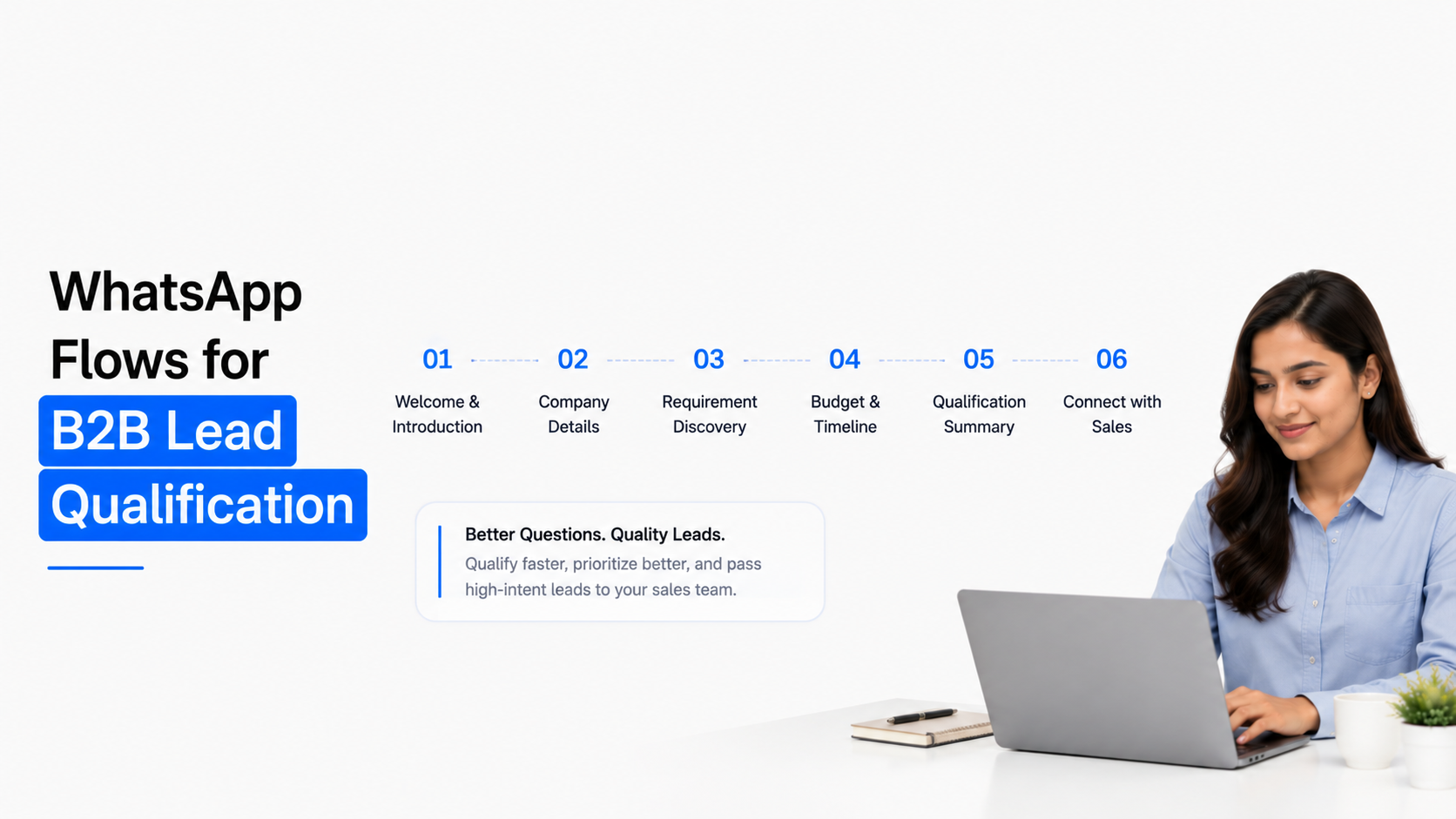
A practical multi-step structure could be:
Screen 1: Business Requirement
Ask what the company is trying to achieve. For a WhatsApp software provider, the options might include lead generation, sales automation, customer support, notifications, ecommerce or another defined use case.
This establishes context immediately.
Screen 2: Operating Scale
Collect one or two variables that influence solution fit. Depending on the business, this could be number of agents, customers, branches, transactions, users or monthly enquiry volume.
Screen 3: Current Environment
Ask only what materially changes the solution. A B2B software company may need the existing CRM or support system. A manufacturer may need current equipment type or production requirement.
Screen 4: Buying Stage
Determine whether the company is exploring options, actively comparing providers, planning implementation or ready to speak with sales.
Screen 5: Next Action
Give the qualified prospect a clear path towards a demo, consultation, quotation or another relevant next step.
WhatsApp Flows support multi-screen journeys specifically so related information can be collected as a structured task rather than through a lengthy sequence of individual messages.
This order also gives the salesperson something more useful than a generic contact form. They receive the business problem first, then the context required to evaluate it.
Use Firmographic Data Selectively
B2B teams often over-collect company information because firmographic fields are easy to add.
Company size, industry and geography can be valuable, but only when they influence how the company sells.
For example, company size may determine which product package is appropriate. Geography may determine territory ownership. Industry may matter if the product has specialised implementations. Number of locations may influence account complexity.
But there is little value in asking for:
Industry → Department → Designation → Revenue → Employee Count → Headquarters → Number of Offices
if only employee count actually changes lead routing.
The Flow should minimise the gap between information collected and information used.
A good test is:
If the customer chooses a different answer, does anything change?
If yes, the field may belong in qualification.
If no, consider whether it really needs to be collected before the first sales conversation.
This is particularly important in WhatsApp because the customer has entered expecting a relatively low-friction interaction, not a lengthy enterprise registration form.
Ask About the Business Problem Before the Product
B2B prospects do not always know which product or package they need.
A weak qualification Flow may begin with:
Which solution are you interested in?
Product A
Product B
Product C
Product D
That requires the customer to understand your product architecture before sales understands their problem.
A stronger Flow begins with the requirement.
For example:
What are you primarily trying to improve?
Manage inbound WhatsApp leads
Automate customer support
Run customer notifications
Build sales follow-up
Connect WhatsApp with CRM
Something else
The resulting answer can then determine which later questions appear.
This provides better data for both routing and discovery because the prospect is describing the job to be done, not guessing which product name applies.
For a B2B agency, the same principle could be:
What are you trying to improve?
Lead volume, lead quality, search visibility, conversion rate or marketing operations.
For a machinery supplier:
What do you need the equipment for?
Production expansion, replacement, new facility, capacity increase or another defined requirement.
WhatsApp's lead-generation guidance recommends using qualification to understand service interest, budget, timeline and customer need before moving leads towards an appropriate next action.
Use Branching to Create Different Qualification Depths
Not every B2B prospect deserves the same Flow.
Conditional paths can make qualification shorter for straightforward leads while collecting additional information when the opportunity is larger or technically more complex.
Consider a SaaS example.
A prospect selects:
Team size: 1–10
The Flow may need only use case, current solution and preferred next action.
Another prospect selects:
Team size: 500+
The Flow could reveal additional questions about CRM integration, deployment requirements, number of locations or technical consultation.
Similarly, if someone selects Just researching, the journey may end with useful information or a lighter next step. A prospect selecting Planning implementation within 30 days may be routed directly towards sales availability.
The logic might look like:
Core Questions → Fit Signal → Relevant Additional Questions → Classification → Next Action
Rather than:
Every Lead → 15 Identical Questions → Sales Team
This is one of the strongest reasons to use a multi-step Flow rather than a static lead form.
The customer sees only what their previous answers make relevant, while the business can still collect deeper information from opportunities where it matters.
Separate Fit, Intent and Value
B2B qualification becomes unreliable when everything is collapsed into one concept called a hot lead.
A prospect can have strong fit but weak immediate intent. Another can have urgent intent but poor product fit. A third may be a strong fit and active buyer but commercially small.
Treat these as separate signals.
Fit
Does the company resemble the type of customer your product or service is designed to serve?
Signals might include company size, industry, required use case, geography or technical environment.
Intent
How actively is the company evaluating a purchase?
Useful signals may include implementation timeline, demo request, quotation request, provider comparison or stated project status.
Potential Value
How large or commercially significant could the opportunity become?
Relevant variables might include number of users, branches, locations, expected volume, contract scope or estimated requirement.
A Flow should collect enough information for your CRM or qualification logic to distinguish these dimensions.
For example:
High Fit + High Intent + High Potential Value → Priority Sales Routing
High Fit + Low Intent → Appropriate Nurture or Later Follow-Up
Low Fit + High Intent → Human Review or Alternative Solution
Low Fit + Low Intent → Low Priority
Do not force the customer to see the internal score. The scoring belongs in CRM or workflow logic, while the Flow simply collects the inputs required to make the classification.
Do Not Turn the Flow Into a Discovery Call
There is an important boundary between B2B lead qualification and sales discovery.
Qualification determines whether a meaningful conversation should happen.
Discovery determines how the customer should solve the problem.
The Flow can reasonably ask:
What are you trying to achieve?
How large is the relevant team or requirement?
Which system are you currently using?
When are you planning to implement?
What would you like to do next?
The Flow should usually not try to explore:
Every stakeholder involved
Detailed decision criteria
Procurement process
Full technical architecture
Every competitor being evaluated
Negotiation constraints
Detailed ROI assumptions
Complex implementation concerns
Those require human judgement and follow-up questions.
Emovur's current B2B sales guidance makes the same distinction: WhatsApp can collect company size, requirement, current solution, purchase timeline and similar qualifiers before an SDR becomes involved, but it should not recreate the entire discovery call inside WhatsApp.
A good B2B Flow should therefore make the first sales conversation better, not attempt to eliminate it.
Send Completed Qualification Into CRM in a Usable Structure
The most valuable output of a B2B qualification Flow is not the Flow submission itself. It is the structured prospect record created from it.
Instead of giving sales a transcript such as:
Customer selected Option 2, then Option 4, then entered “Zoho”.
map those responses into fields the sales team already understands.
A CRM record could contain:
Lead Source: WhatsApp
Company: ABC Technologies
Primary Requirement: Lead Management
Team Size: 50–100
Current CRM: Zoho CRM
Monthly Enquiries: 2,000–5,000
Buying Stage: Comparing Providers
Implementation Timeline: 1–3 Months
Qualification Status: Sales Qualified
Next Action: Product Demo
Owner: Enterprise Sales Team
This creates an immediately usable sales record.
Emovur's WhatsApp Flows product supports structured response collection and webhooks for sending Flow submissions into other systems, while its CRM integration architecture is designed to create or update lead records rather than leaving customer data isolated inside WhatsApp.
For the technical CRM mapping itself, use the dedicated WhatsApp CRM Integration Guide.
The important rule for this Flow is simpler: every qualification answer should land in a field, classification or workflow that sales can actually use.
Route the Prospect According to What the Flow Learned
Once qualification is complete, do something with the information immediately.
The next action should reflect the customer's profile.
A high-fit enterprise lead asking for implementation within a month may need immediate routing to a senior salesperson.
A smaller business researching options may be better served by product information and an appropriate later conversation.
A technically complex prospect may need a solutions consultant rather than a general SDR.
Routing criteria can combine:
Use Case + Company Size + Geography + Buying Stage + Required Next Action
For example:
Enterprise + CRM Integration + 30-Day Timeline → Enterprise AE
SMB + Standard Use Case + Demo Requested → Inside Sales
Technical Integration Question → Solutions Team
Existing Customer → Account Owner
This is where structured qualification becomes operationally valuable. Salespeople do not need to manually read every new message before determining whether the enquiry belongs to them.
Emovur's Click-to-WhatsApp setup supports automatic qualification and routing of qualified WhatsApp leads to appropriate teams, while CRM connectivity can preserve the lead data generated during that process.
The same routing principle applies whether the Flow begins from an ad, website, event, QR code or another inbound source.
Measure Whether the Flow Improves Sales Efficiency
Do not judge a WhatsApp Flow for B2B lead qualification only by completion rate.
A 90% completion rate is meaningless if the Flow qualifies everyone.
Measure whether the Flow improves the transition between inbound demand and salesperson activity.
Useful metrics include:
Sales acceptance is especially important. If the system marks 200 leads as qualified but sales considers only 60 useful, the Flow's qualification criteria need adjustment.
Meta's Learnwise case study demonstrates the operational principle, although in an education rather than B2B setting. Learnwise used WhatsApp Flows to create structured lead profiles before counsellor follow-up and reported 4X more qualified leads, 60% less employee time spent qualifying and a 31% lower cost per qualified lead during its October-November 2025 test. Meta notes that the results were self-reported and individual results will differ.
The relevant lesson for B2B teams is not the percentage improvement. It is the architecture: structured inputs helped the human team prioritise stronger prospects before spending time on manual qualification.
Build a Qualification Layer, Not Another Long Form
The strongest WhatsApp Flows for B2B lead qualification sit between inbound interest and human sales discovery.
Start by understanding the business requirement. Collect only the firmographic and operational information that affects fit. Use conditional paths when enterprise or complex opportunities require deeper qualification. Keep fit, intent and opportunity value separate. Pass the completed information into CRM and route the prospect according to what the Flow learned.
A practical B2B qualification architecture is:
Inbound B2B Enquiry → Requirement → Company Fit → Scale → Current Environment → Buying Stage → Qualification Classification → CRM → Correct Sales Owner
WhatsApp Flows are well suited to this task because Meta explicitly supports lead-generation workflows with predetermined inputs, multi-screen journeys and backend data exchange, while keeping the interaction inside WhatsApp.
For businesses implementing the qualification layer through Emovur, WhatsApp Flows can handle structured response collection, while the broader WhatsApp and CRM architecture can move qualified opportunities to the appropriate sales team.
The purpose is not to ask B2B prospects more questions. It is to ensure that when a salesperson enters the conversation, they already know who the company is, what it needs, how serious the opportunity appears and what should happen next.