

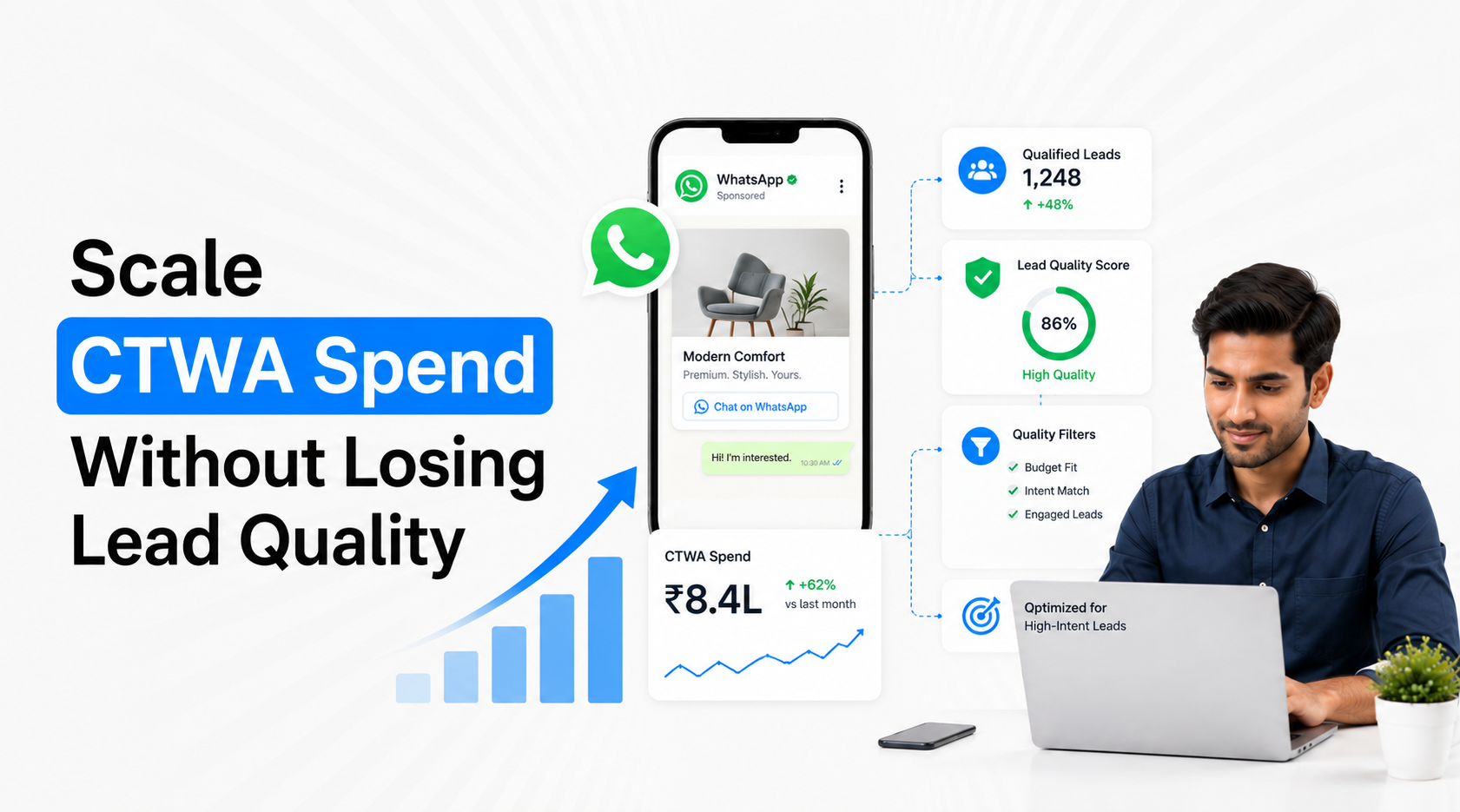
Scaling Click-to-WhatsApp advertising is not simply increasing the Meta Ads budget on a campaign with a low cost per conversation. A CTWA campaign is ready to scale when additional spend continues producing qualified leads, appointments, opportunities or purchases at acceptable economics. For Indian businesses, the safest approach is to establish a lead-quality baseline, optimise Meta towards deeper outcomes, increase spend in controlled stages, expand creative and audience capacity, and monitor qualification rate alongside cost. If chat volume rises while qualified-lead rate falls, the campaign is growing but the business is not necessarily scaling.
1. Establish a Quality Baseline Before Increasing Spend
Do not scale a CTWA campaign because it generated a few inexpensive conversations. First determine what a good lead actually looks like and establish enough baseline data to compare future performance.
The baseline should reflect outcomes beyond the WhatsApp entry point.
Track before scaling:
- Cost per conversation: Useful for diagnosing acquisition cost, but not enough alone.
Conversation-to-lead rate: How many chats provide enough information to become actual leads?
Qualification rate: What percentage meet your defined commercial criteria?
Cost per qualified lead: The primary scaling metric for most lead-generation CTWA campaigns.
Appointment or demo rate: Are qualified leads progressing?
Sales acceptance rate: Does the sales team agree these are useful leads?
Lead-to-sale rate: Are conversations creating customers?
Revenue or opportunity value: What commercial value is generated?
For example, if a campaign normally converts 30% of WhatsApp conversations into qualified leads, that 30% becomes part of your scaling baseline. If increasing spend pushes conversation volume up 70% but qualification falls to 14%, performance has materially changed even if the cost per chat remains attractive.
2. Optimise Meta Towards Leads, Not Chats
One of the strongest protections against quality dilution is giving Meta a deeper optimisation goal.
WhatsApp currently supports lead optimisation for eligible Click-to-WhatsApp campaigns, which is intended to deliver ads to people more likely to become leads rather than simply initiate conversations. Meta reports that, in an experiment across 116,000 CTWA campaigns, lead-optimised campaigns produced an average 24% lower cost per lead than conversation-optimised campaigns. Results vary by advertiser and should not be treated as a guaranteed outcome.
Meta also offers purchase optimisation for eligible CTWA use cases where transactions occur through messaging.
Before scaling, check whether your optimisation event matches the business goal:
Need qualified enquiries: Optimise towards leads where eligible.
Need direct purchases: Evaluate purchase optimisation where available and appropriate.
Need only conversations: Conversation optimisation may still fit, but do not assume those conversations are qualified leads.
Need appointments or opportunities: Feed meaningful downstream outcomes into the measurement architecture where supported.
The campaign objective should move as close as practical to the real conversion.
For the underlying CTWA setup and WhatsApp lead-routing environment, use Emovur's Click-to-WhatsApp Ads workflow rather than treating WhatsApp conversations as an isolated ad metric.
3. Scale Spend in Controlled Stages
A campaign that works at ₹2,000 per day will not necessarily behave identically at ₹10,000 per day. Increasing spend forces the delivery system to find more opportunities, which may change audience composition, auction conditions, creative exposure and resulting lead quality.
There is no universal percentage by which every advertiser should increase budget. Use business outcomes to determine the pace.
A practical scaling cycle is:
Increase spend: Make one meaningful but controlled budget change.
Allow delivery to stabilise: Avoid making several simultaneous changes.
Measure qualified outcomes: Compare with the established baseline.
Check sales feedback: Determine whether lead quality changed.
Continue or hold: Scale again only when downstream economics remain acceptable.
Reduce or restructure: If quality deteriorates materially, investigate before adding more money.
Avoid changing budget, audience, creative and qualification flow simultaneously. If performance changes, you will not know which variable caused it.
4. Set a Lead-Quality Floor
Campaign teams usually have a maximum acceptable CPL. CTWA scaling also needs a minimum acceptable lead-quality threshold.
Suppose your normal campaign produces:
1,000 conversations
300 qualified leads
30% qualification rate
₹500 cost per qualified lead
After scaling:
1,800 conversations
360 qualified leads
20% qualification rate
₹720 cost per qualified lead
The campaign generated more leads, but efficiency declined.
Whether this is acceptable depends on customer value and sales capacity.
Create thresholds for:
Minimum qualification rate
Maximum cost per qualified lead
Minimum sales acceptance rate
Maximum low-quality conversation rate
Minimum appointment/demo conversion
Maximum acquisition cost
Minimum revenue or pipeline return
Scaling should stop when one of the critical business thresholds is consistently breached, even if Ads Manager continues reporting more conversations.
5. Expand Qualification Capacity Along With Media Spend
If the media budget doubles but your qualification system remains unchanged, sales teams can become the bottleneck.
More CTWA conversations mean more customers requiring:
First response
Qualification
Routing
CRM updates
Sales assignment
Follow-up
Meta's Indian Learnwise case study demonstrates the operational side of CTWA scaling. Learnwise used WhatsApp Flows to structure qualification and reported 4X more qualified leads, a 60% decrease in employee time spent qualifying leads and a 31% lower cost per qualified lead compared with its previous approach. These are self-reported advertiser results, not universal benchmarks.
Use WhatsApp Flows when structured qualification needs to handle larger lead volumes without turning every conversation into manual sales work.
Before increasing spend, verify that you can handle the additional volume:
Can automation acknowledge new conversations immediately?
Can qualification process additional leads?
Can high-intent prospects reach sales quickly?
Can the CRM accept the additional volume?
Can salespeople handle the projected qualified leads?
Can inactive or low-fit enquiries exit efficiently?
Media scaling and operational scaling must happen together.
6. Scale Creative Capacity, Not Just Budget
One ad cannot carry unlimited CTWA growth indefinitely.
As spend rises, creative exposure increases and the campaign may need a wider set of messages to continue finding relevant customers.
The solution is not random creative volume. Build variations around meaningful commercial angles.
Test creative around:
Customer problem: What problem triggers the conversation?
Product or service: Which offering produces stronger intent?
Use case: Which customer requirement generates better qualified leads?
Proof: What credibility signal improves response quality?
Offer: Quote, consultation, demo, availability check or recommendation.
Customer type: Which business or buyer segment is the proposition designed for?
Meta's current WhatsApp CTWA guidance recommends making the ad specific about what is sold, who it is for and what the customer will receive after messaging.
When scaling, protect that specificity. Broadening spend should not mean making the offer so generic that every curious user starts a conversation.
7. Feed Qualified Outcomes Back Into Your Reporting
CTWA cannot scale intelligently when Meta reports conversations while the CRM reports sales and nobody connects the two.
Create consistent stages such as:
WhatsApp Conversation → Lead → Qualified Lead → Sales Accepted → Appointment/Demo → Opportunity → Customer
Then analyse performance by campaign, ad set and creative.
The WhatsApp CRM Integration Guide explains the integration layer for passing WhatsApp lead information into CRM records. For scaling, the important requirement is that campaign source and downstream outcome remain connected.
Your scaling report should answer:
Which campaigns generate qualified leads?
Which creatives generate sales-accepted leads?
Which audiences produce appointments?
Which leads become opportunities?
Which campaigns generate actual revenue?
Where does quality begin falling as spend increases?
Meta continues investing in Conversions API and downstream business-outcome optimisation. Meta's 2026 India retail research also highlights the value of connecting offline sales information with advertising measurement rather than evaluating digital acquisition separately from eventual purchases.
8. Watch for Quality Dilution by Segment
Overall campaign averages can hide the source of declining quality.
Suppose your original CTWA campaign performs well in Bengaluru, Hyderabad and Chennai. After increasing budget, overall CPL rises.
Break performance down.
You may discover:
Bengaluru remains strong.
Hyderabad remains stable.
Chennai conversation volume expanded sharply but qualification collapsed.
The solution may not be reducing the entire campaign.
Analyse quality by:
Geography
Placement
Creative
Audience
Product
Lead source
Device where useful
Time period
Sales team
Customer type
Scaling decisions become more accurate when weak segments can be isolated rather than treating the campaign as one number.
9. Separate Creative Fatigue From Audience Exhaustion
When CTWA lead quality falls after scaling, teams often assume the audience has been exhausted. Sometimes the problem is simply that the same creative is being shown too often or the message is attracting progressively weaker intent.
Look for different signals.
Possible creative fatigue indicators:
Engagement declines.
Cost per conversation rises.
The same ads dominate spend for too long.
New creative quickly restores performance.
Possible lead-quality dilution indicators:
Conversation volume remains high.
Qualification rate falls.
Sales reports weaker enquiries.
Cost per qualified lead increases despite stable chat cost.
These are different problems and require different fixes.
10. Do Not Scale Low-Quality Conversations Faster
A low conversation cost can encourage aggressive budget increases. This is one of the easiest ways to create CTWA volume without sales value.
Meta's Nutryfit case study is useful here. The company found that conversation-optimised CTWA ads initiated chats but not enough became quality leads. After testing lead optimisation, Nutryfit reported 12% lower cost per lead and more genuine enquiries. Results were advertiser-specific.
The principle is broader than the case study:
Cheap conversations are useful only when enough of them progress.
Always pair cost per conversation with:
Qualification rate
Cost per qualified lead
Sales acceptance
Conversion
If those metrics deteriorate, do not reward the campaign with more budget simply because messaging starts remain inexpensive.
11. Protect Sales Response Quality During Scale
CTWA lead quality is partly determined by the advertising and partly by what happens immediately afterwards.
If spend increases from 100 to 500 daily conversations, sales response time may deteriorate. Strong leads can then appear weaker simply because nobody contacted them properly.
Before scaling, establish operational thresholds for:
Unassigned qualified leads
Time to sales takeover
Conversations waiting in queue
Leads without next action
Duplicate assignments
Follow-up completion
A campaign should not generate more qualified demand than the sales operation can handle.
This is especially important for high-ticket and consultation-led businesses where the salesperson remains a major part of conversion.
12. Know When to Stop Scaling
More budget is not always the next growth move.
Pause further scaling when:
Qualification rate drops materially.
Cost per qualified lead exceeds your acceptable range.
Sales acceptance deteriorates.
Sales capacity is full.
Creative fatigue is obvious.
CRM attribution is unreliable.
Follow-up backlog is growing.
Appointment or opportunity conversion falls.
Additional volume is not producing additional profitable customers.
At that point, improve the limiting factor before adding spend.
The problem may be creative, qualification, sales capacity, follow-up, offer quality or conversion, not the campaign budget itself.
Use a CTWA Scaling Scorecard
A practical weekly scaling review can remain compact.
Do not make a scaling decision from one metric.
A campaign is genuinely scaling when spend increases, qualified lead volume increases and downstream economics remain inside acceptable thresholds.
Scale Outcomes, Not WhatsApp Conversations
The safest way to scale CTWA spend without losing lead quality is to treat qualification rate as a scaling constraint.
First establish what a qualified lead means. Give Meta the deepest useful optimisation signal available. Increase spend in controlled stages. Expand creative and qualification capacity as volume grows. Connect WhatsApp leads to CRM outcomes and analyse quality by campaign, audience and creative rather than only looking at account averages.
A practical scaling model is:
Stable Qualified Lead Economics → Increase Spend → Monitor Quality → Expand Creative/Capacity → Feed Downstream Results Back → Scale Again
If spend doubles and chats double but qualified opportunities barely increase, the campaign has not scaled successfully.
Meta's own CTWA guidance increasingly focuses on lead and purchase optimisation rather than conversation volume alone, reinforcing the same principle: the objective is not to buy more WhatsApp chats. It is to use additional budget to produce more valuable business outcomes.