


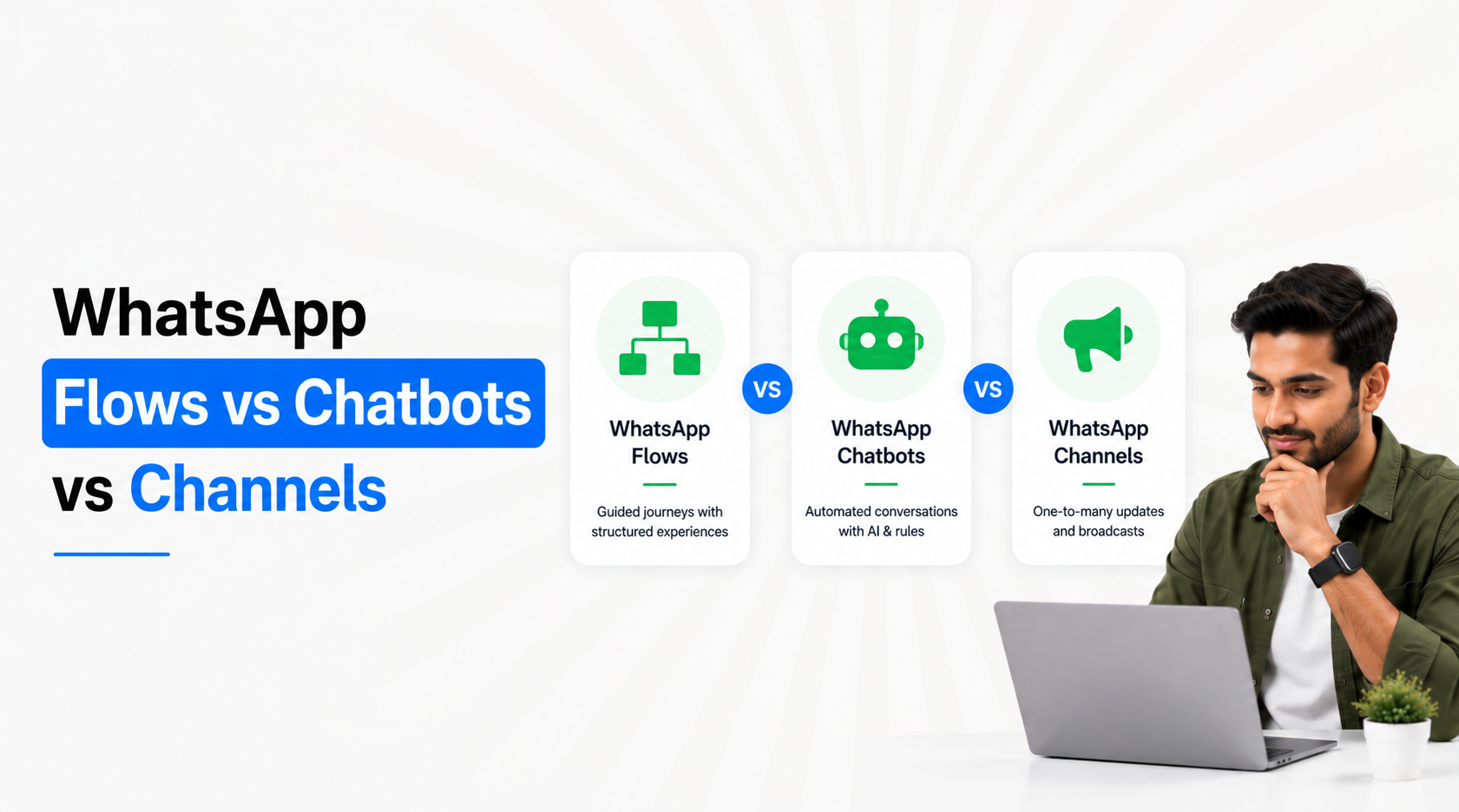
WhatsApp Flows, chatbots and Channels solve three different business problems. Flows help customers complete structured tasks such as qualification, registration or booking. Chatbots handle two-way conversations, questions and automated assistance. WhatsApp Channels are primarily a one-to-many publishing tool for updates and audience building. Indian businesses should therefore not choose between them as competing features. The right decision depends on whether the customer needs to complete a task, have a conversation or consume an update. In many cases, the strongest WhatsApp strategy uses all three at different stages of the customer journey.
WhatsApp Flows vs Chatbots vs Channels at a Glance
The easiest way to understand the difference is to look at the customer's intended action.
Someone completing an appointment form needs a different interface from someone asking, “Which plan is right for my company?” A customer trying to receive weekly product announcements has a different requirement again.
WhatsApp itself positions Flows around structured activities such as bookings, newsletter sign-ups and insurance quotes. Meta's current Business Agent also demonstrates the conversational side of WhatsApp automation, answering questions, gathering information and directing customers towards sales. Channels, meanwhile, sit inside the Updates tab and are designed around discovery and recurring content rather than normal customer chats.
That distinction should determine the architecture before a business starts building automation.
Use WhatsApp Flows When the Customer Needs to Complete a Defined Task
WhatsApp Flows are strongest when the business already knows which information it needs and the range of possible customer responses can be structured.
Think of a Flow as an interactive task interface inside WhatsApp rather than a conversational assistant.
A property company may ask buyers to choose a preferred location, configuration, budget band and purchase timeline. A clinic may collect appointment type and scheduling preferences. An education company may ask for programme interest, qualification and joining timeline. The questions and expected answers are predictable.
This is where Flows are more efficient than chatbots because the customer does not need to type each answer individually or interpret a long sequence of conversational questions.
Meta currently describes WhatsApp Flows as customizable experiences for actions including appointment booking, newsletter signup and quote collection, while supporting both simpler template-based creation and more advanced Flow Builder/API implementations.
Where Flows fit particularly well
A business should favour a Flow when several related pieces of structured information must be collected before the next step. Strong use cases include lead qualification, appointment booking, event registration, consent or preference collection, surveys, feedback, service requests and structured product selection.
The important characteristic is predictability. The business can map the task before the customer begins it.
For example:
Poor chatbot experience
Customer: “I want to book a consultation.”
Bot: “Which service?”
Customer replies.
Bot: “Which branch?”
Customer replies.
Bot: “Which date?”
Customer replies.
Bot: “Which time?”
Customer replies.
Better Flow experience
Service → Branch → Preferred Date → Preferred Slot → Submit
The second approach reduces unnecessary message exchange while creating cleaner structured data.
Emovur's WhatsApp Flows implementation currently supports qualification, appointment booking, feedback and event-registration use cases, with structured response collection, CSV export and webhooks for passing Flow data into other systems.
Flows become less suitable when the customer's question cannot be predicted. If a prospect wants to explain a complex requirement or ask a detailed product question, forcing them through predefined fields can create more friction than it removes.
Use a WhatsApp Chatbot When the Customer Needs a Conversation
A WhatsApp chatbot is appropriate when the customer's language, questions or requirements cannot be fully predicted in advance.
This distinction has become even more important with AI chatbots. Traditional rule-based bots work well when conversations follow known decision trees. AI-powered systems can interpret natural language, use business knowledge and respond to more varied customer questions.
For example, imagine a SaaS prospect asking:
“We have 40 salespeople using Zoho and receive around 3,000 WhatsApp enquiries every month. Can this work with our current setup?”
A Flow would require the business to anticipate and separately collect company size, CRM, enquiry volume and requirement. A capable chatbot can interpret the complete question, answer relevant parts and decide whether the prospect needs human assistance.
Current Meta Business Agent functionality similarly focuses on open customer conversations, including answering questions using business content, gathering information and alerting businesses when human attention is required.
Chatbots fit best when interpretation matters
Strong chatbot use cases include frequently asked questions with multiple possible phrasings, product discovery, customer support, order questions, conversational lead qualification, initial troubleshooting and routing customers to the correct team.
A chatbot can also connect different actions. For example:
Customer: “I want to book a demo.”
Chatbot: Understands demo intent.
Chatbot: Answers any immediate product question.
Chatbot: Opens a structured Flow to collect company and scheduling information.
Flow completed: Lead passes to sales.
This is a stronger architecture than forcing the chatbot to collect every field conversationally.
Emovur's WhatsApp AI Chatbot is designed around this conversational layer, using approved business information to answer questions, identify customer intent, collect details and hand complex conversations to the appropriate team.
The key distinction is simple: Flows collect structured answers efficiently; chatbots interpret conversations.
Use WhatsApp Channels When the Business Needs Reach, Not Individual Qualification
WhatsApp Channels solve an entirely different problem.
A Channel is not a replacement for a chatbot and should not be evaluated against Flows based on lead qualification or automation depth. Channels belong primarily to the content distribution and audience-building layer of WhatsApp.
Meta places Channels inside the Updates tab alongside Status rather than within personal chats. The Updates tab is used by approximately 1.5 billion people globally each day, according to Meta's June 2025 announcement. Meta has also been expanding discovery and monetisation features around Channels, including promoted Channels and Channel subscriptions.
For businesses, Channels are better suited to recurring content such as:
Product and company updates
New launches
Educational content
Industry insights
Event announcements
Offers and relevant updates
Community-oriented content
The communication model is fundamentally different from a chatbot.
With a chatbot, one customer asks:
“Does your product integrate with HubSpot?”
The business responds specifically to that customer.
With a Channel, the business might publish:
“New HubSpot integration now available. Here is what it supports.”
Many followers can receive that information.
A Channel therefore creates awareness and recurring attention, while a direct WhatsApp conversation handles individual commercial intent.
This distinction is important because businesses sometimes expect Channels to operate like broadcast campaigns or lead-generation chatbots. They should instead be considered part of an organic WhatsApp content strategy.
The Real Decision Is Structured Task vs Conversation vs Audience
Rather than asking “Should we use WhatsApp Flows or a chatbot?”, map the customer requirement first.
Consider these situations.
A prospect wants to check eligibility
If eligibility depends on six predictable fields, a Flow is usually stronger. The customer can complete the information in a structured experience and the backend can evaluate or route the submission according to defined rules.
If the customer asks complex questions about eligibility before providing those details, use a chatbot first, then open the Flow when the customer is ready.
A customer wants product recommendations
If the recommendation can be made from three known selections such as category, budget and usage, a Flow may work.
If customers describe their requirements differently and need explanation or comparison, a chatbot is more appropriate.
A business wants to publish weekly industry updates
This should generally be handled through a Channel, not by forcing people through a chatbot or sending an interactive Flow.
A business wants to collect event registrations
Use the Channel for event discovery, direct conversation or chatbot for questions and a Flow for registration.
This is why the three features become much more useful when understood as layers rather than substitutes.
Combine Flows and Chatbots Instead of Making One Do Everything
For many businesses, the strongest design is a hybrid WhatsApp journey.
Emovur's current automation guidance also distinguishes these roles: Flows are better suited to structured data collection such as forms and bookings, while chatbot logic works better for open questions and customer support.
Consider an education enquiry.
Step 1: Chatbot handles the conversation
The prospect asks:
“I'm working in finance and want to move into analytics. Which course should I take?”
The chatbot can interpret the requirement, answer basic questions and clarify the customer's goal.
Step 2: Flow captures the structured information
Once the prospect wants counselling, the chatbot opens a Flow asking for programme interest, experience level, preferred learning mode and counselling timing.
Step 3: CRM receives the Flow response
The structured response can update fields in the customer record and route the prospect to the appropriate counsellor.
Step 4: Human takes over
The salesperson or counsellor receives both the conversational history and the structured qualification information.
This architecture uses each component for what it does best.
A chatbot should not spend ten messages collecting predictable form fields. A Flow should not attempt to understand open-ended customer problems.
Combine Channels With Flows and Chatbots Across the Customer Journey
Channels become more powerful when they sit at the beginning of the journey rather than being expected to complete the transaction.
A complete WhatsApp ecosystem could look like:
Channel → Direct Conversation → Chatbot → Flow → CRM → Human Team
For example, a training company publishes useful career content through its Channel. A follower sees an announcement for a new programme and develops interest. They move into a direct business conversation, where a chatbot answers initial questions. When the customer requests counselling, a Flow collects the required information and a counsellor receives the qualified enquiry.
For ecommerce, the journey may be:
Channel Product Launch → Customer Enquiry → Chatbot Answers Product Question → Product Selection/Checkout Journey → Human Support if Required
For healthcare:
Channel Health Update → Customer Enquiry → Chatbot Handles Basic Navigation → Appointment Flow → Clinic Confirmation
The Channel creates attention, the chatbot interprets intent and the Flow completes the structured task.
That division of responsibility prevents a WhatsApp automation system from becoming one enormous chatbot trying to perform every business function.
When You Should Not Use All Three
Businesses do not need to deploy every available WhatsApp capability simply because the technology exists.
A small clinic may only need a Flow for appointments and a shared inbox for staff. A support-heavy SaaS business may gain more value from a chatbot and human handoff than from Channels. A media or creator-led organisation may use Channels extensively while requiring little structured Flow functionality.
Choose based on customer behaviour.
Use primarily Flows when: customers repeatedly complete predictable tasks and structured data is important.
Use primarily chatbots when: the business handles high volumes of varied questions or conversational customer journeys.
Use primarily Channels when: recurring content, announcements and audience engagement are major objectives.
Combine them when: discovery, conversation and task completion are all important parts of the same customer lifecycle.
The complexity of the technology stack should match the complexity of the customer journey.
Build the WhatsApp Architecture Around Customer Intent
The difference between WhatsApp Flows vs chatbots vs Channels is ultimately the type of interaction each feature is designed to handle.
WhatsApp Flows = Complete
Use them when customers need to submit structured information or complete a defined task.
WhatsApp Chatbots = Converse
Use them when customers need questions answered, requirements interpreted or conversations automated.
WhatsApp Channels = Discover
Use them when the business needs to publish recurring content and maintain attention among followers.
The strongest architecture often connects these roles:
Channel Builds Attention → Chatbot Understands Intent → Flow Completes the Task → Human Handles Complexity
Meta's current product direction reflects this separation. Flows continue to expand structured in-chat experiences, Business Agent and chatbot capabilities handle conversational interactions, while Channels and the Updates tab provide a dedicated surface for audience discovery and content.
For businesses implementing WhatsApp through Emovur, WhatsApp Flows can handle structured interactions while the AI WhatsApp Chatbot handles conversational automation. Channels can remain the audience-building layer rather than being forced into the same automation architecture.
The decision therefore should not be which WhatsApp feature is better. It should be which customer action needs to happen next, and which feature is designed to handle that action properly.