

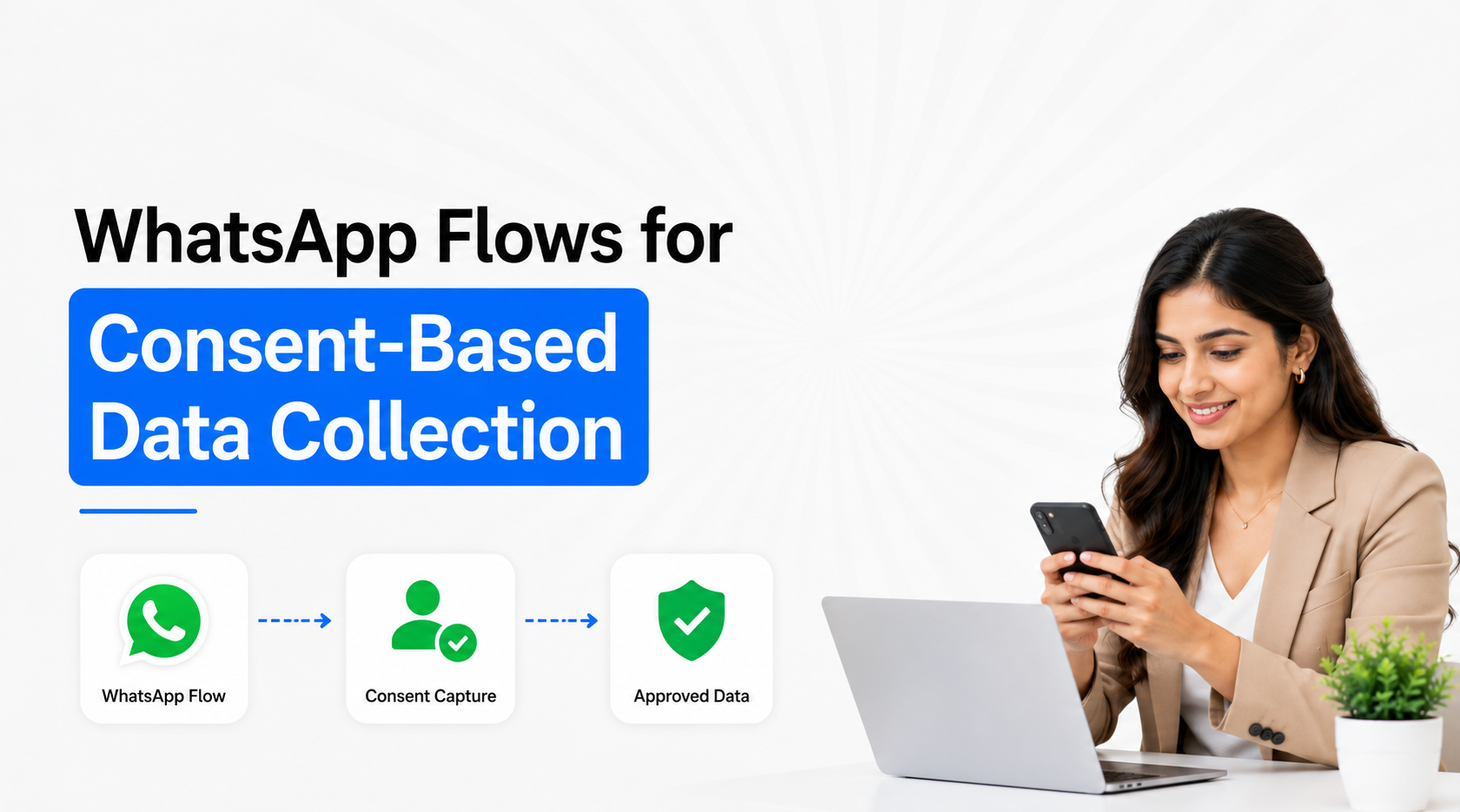
WhatsApp Flows for consent-based data collection give businesses a structured way to explain why information is being requested, collect the customer's choices and store those responses for later use. Instead of treating consent as a hidden checkbox or assuming that starting a WhatsApp conversation means agreeing to every future communication, businesses can build a Flow that separates different purposes such as enquiry handling, promotional communication and preference collection. For Indian businesses preparing for stronger privacy requirements, the value of a consent Flow is not simply collecting a “Yes”. It is creating a clear record of what the customer agreed to, for which purpose and when.
What Consent-Based Data Collection Means Inside WhatsApp
WhatsApp Flows are interactive, multi-step experiences that allow businesses to collect structured information without moving customers to an external form. Meta designed Flows for tasks such as booking, registration, selection and data collection directly inside the conversation.
For consent-based use cases, the same structure can be used to separate the information a customer provides to complete a current request from permissions relating to future use of that information.
Consider someone contacting a real-estate company about a particular project. The business may need their name, preferred configuration, approximate budget and visit preference to respond to that enquiry. Separately, the business may want permission to send future project launches or promotional offers. Those are different purposes and should not automatically become one combined choice.
A well-designed consent Flow therefore answers four questions clearly:
What information is being collected? The customer should understand which information the business is requesting rather than facing a vague statement about “personal data”.
Why is it being collected? The purpose should correspond to a real customer or business activity, such as processing an enquiry, booking an appointment or sending selected marketing communication.
What is the customer agreeing to? Consent choices should be understandable and connected with the particular purpose rather than hidden inside broad terms.
What happens afterwards? The business should know where the submitted preference is stored, which communications it enables and how the customer can later change that choice.
That makes WhatsApp Flows for consent-based data collection useful as part of a wider data-governance process rather than merely as another form builder.
Separate Service Data From Marketing Permission
One of the most important design decisions is separating information required for the customer's immediate request from permission to receive promotional messages later.
Meta's 2026 guidance for marketing messages specifically recommends that businesses make opt-in experiences clear, tell people what types of messages they should expect and seek explicit permission for promotional messages rather than bundling marketing with transactional communication. It also recommends respecting opt-out requests received either on or outside WhatsApp.
A Flow might therefore collect:
Information needed for the current request
Name, service interest, preferred location, booking information or other fields required to respond to what the customer has asked for.
Communication preferences
Whether the person wants updates relating to the current enquiry, future relevant offers, product launches, educational content or another clearly described communication category.
These choices should not be designed so that agreeing to one automatically enables everything else.
For example, avoid a single option such as:
“I agree to receive updates, offers, promotions, service messages and communications from the company and its partners.”
A more useful structure separates the purposes so the resulting preference record can actually control future messaging.
This also prevents a common operational problem. If marketing permission and transactional communication are stored as one Boolean field, withdrawing from promotions may accidentally suppress order or appointment communication, or continuing operational messages may incorrectly be interpreted as permission for marketing.
For the broader legal framework around DPDP, notice and withdrawal, keep that detail on the dedicated Emovur DPDP compliance article rather than repeating the complete legal explanation here. DPDP and WhatsApp Marketing: Consent, Notice and Withdrawal
Design the Flow Around Purpose, Not Around the Number of Fields
The best consent Flow is usually short. A customer should not have to navigate six screens simply because the business wants a detailed database.
A practical WhatsApp consent Flow might use three or four screens.
Screen 1: Explain the Immediate Purpose
Start by telling the customer why the Flow is being shown.
For example:
“Tell us what type of property you are interested in so our team can share relevant availability.”
The customer then selects the property type, location or other genuinely necessary information.
Screen 2: Collect Only the Required Details
Ask for the minimum information required to complete the stated purpose. Avoid collecting fields simply because the CRM has empty columns.
A qualification Flow for an education business might need programme interest, current background and intended joining period. It probably does not need ten demographic fields simply to arrange a counselling conversation.
Screen 3: Present Separate Communication Choices
If the business wants to use the customer's information for additional communication, present those purposes distinctly.
For example, customers could separately choose whether they want:
Relevant product or programme updates.
Promotional offers.
Event or webinar announcements.
No additional marketing communication.
The exact choices should reflect what the business actually sends. Do not provide five consent categories if all five lead to the same broadcast list.
Screen 4: Confirm the Submission and Next Action
After submission, tell the customer what happens next. The confirmation might explain that a salesperson will contact them, an appointment request has been received or their communication preferences have been updated.
Emovur's Flow builder supports multiple screens, single-choice and multiple-choice responses, short answers and longer text inputs, while Flow responses can be captured and passed into other systems.
The technical capability is flexible. The design should remain simple.
Store Evidence of the Consent, Not Only a “Yes” Field
A consent process becomes difficult to audit when the CRM contains only:
Marketing Consent = Yes
That tells the business very little.
If consent is important to the processing or communication being performed, the underlying record should preserve enough context to understand what happened.
Depending on the system architecture, useful fields can include:
The important concept is versioning.
Suppose a business changes its Flow six months later. If both old and new customers simply have “Consent = Yes,” it may be impossible to determine which wording or purposes each person actually saw.
Recording the Flow or consent version makes the history clearer.
India's DPDP Act states that where consent is the basis for processing, the Data Fiduciary may need to demonstrate that appropriate notice was given and consent was obtained. The Act describes consent as free, specific, informed, unconditional and unambiguous, involving clear affirmative action.
As of August 30, 2026, India is still within the DPDP framework's phased implementation. MeitY notified the DPDP Rules in November 2025, while the substantive notice and consent provisions are scheduled to become operational in the later implementation phase on May 13, 2027. Businesses can use the transition period to build the required data and workflow controls rather than redesigning them at the last moment.
Connect Flow Responses to CRM and Messaging Eligibility
Collecting consent inside WhatsApp is only useful if downstream systems actually use the result.
A customer who declines promotional messages should not continue appearing in every marketing segment because the Flow response was exported into a spreadsheet that nobody checks.
A stronger architecture is:
WhatsApp Flow → Response Captured → Customer Record Updated → Preference Field Updated → Messaging Eligibility Recalculated
Emovur supports Flow-response collection along with webhooks that can send Flow responses to another system in real time.
That allows businesses to connect Flow responses with CRM fields such as:
Marketing eligible
Product updates allowed
Event communication allowed
Transactional/customer-service status
Consent source
Consent date
Current preference
Suppression status
The CRM should then become the operational source used before campaigns are created.
For example, a broadcast segment should not be defined merely as:
Customers interested in Data Science
It may need to be:
Interested in Data Science + Marketing Preference Active + Not Suppressed
That distinction is important because interest and permission are not the same data point.
For the CRM integration architecture itself, use the existing Emovur guide rather than rebuilding that topic inside this article. WhatsApp CRM Integration: Complete Setup Guide
Make Preference Changes and Withdrawal Part of the Same System
Consent-based collection should not be designed as a one-time acquisition mechanism.
People change their preferences. Someone who initially wants promotional messages may later want only service updates. Another customer may still want product-launch communication but no longer want webinar announcements.
Meta's WhatsApp Business Policy places responsibility on businesses to obtain required notices, permissions and consents under applicable law, while Meta's marketing guidance also tells businesses to monitor and respect requests to stop or opt out of communication.
The operational system should therefore support changes such as:
All Marketing → Product Updates Only
Marketing Allowed → Marketing Withdrawn
Event Updates Allowed → Event Updates Disabled
A preference-update Flow can be useful when several categories exist because customers can manage those options through the same structured interface used to collect them.
The important part happens after submission. The updated selection should immediately change campaign eligibility so the customer is not re-added by an old spreadsheet, static audience or manually created broadcast list.
A practical lifecycle is:
Permission Collected → Preference Stored → Communication Sent According to Preference → Preference Changed → Record Updated → Future Eligibility Updated
This is substantially more useful than maintaining disconnected “opt-in” and “opt-out” files.
Use Consent Flows Where the Choice Actually Matters
Not every WhatsApp Flow needs a consent screen. Adding consent questions to every interaction can create unnecessary friction and may make the choice less meaningful.
Use WhatsApp Flows for consent-based data collection when the business is requesting information or communication permission that needs to be clearly separated and stored.
Good examples include lead registration, where a prospect supplies information for a consultation and can separately choose future marketing preferences; event registration, where attendance data is needed for the event but future promotional communication is optional; product-interest collection, where customers select categories they genuinely want to hear about; and preference centres, where existing subscribers update which communications they want to continue receiving.
Flows can also be useful when a customer moves between different business relationships. Someone completing a purchase may need order communication, but this should not automatically be treated as agreement to future marketing.
Where the objective is primarily to collect product preferences, interests and explicitly volunteered customer information for personalization, the dedicated zero-party data article should own that use case. A consent Flow has a narrower job: make the purpose and permission state clear and operationally usable.
Avoid Turning Consent Flows Into Data-Harvesting Forms
The availability of structured fields makes it technically easy to collect more information than the business needs. That does not make it good Flow design.
WhatsApp's Business Policy requires businesses to secure necessary permissions and comply with applicable law, and it restricts businesses from requesting certain highly sensitive identifiers through WhatsApp.
Before adding any field, ask:
What business purpose requires this information, and what will happen differently because we collected it?
If there is no clear answer, remove the field.
Also avoid dark-pattern design such as preselecting promotional preferences, making “No” intentionally difficult to find, presenting withdrawal as a warning, or requiring marketing permission simply to submit an unrelated service request.
Consent quality should not be measured by obtaining the highest possible percentage of “Yes” responses.
A better measurement framework includes:
Flow completion rate: Whether customers understand and complete the experience.
Permission rate by purpose: Which communications customers genuinely choose.
Withdrawal rate: Whether certain message categories create later dissatisfaction.
Suppression accuracy: Whether withdrawn customers actually stop receiving the relevant campaigns.
Preference utilisation: Whether segmentation respects the categories customers selected.
Record completeness: Whether source, version and timestamp information is consistently stored.
A lower opt-in rate accompanied by stronger engagement and fewer opt-outs can be more useful than maximising consent through vague wording.
Build Consent as a Reusable Data Layer
The strongest WhatsApp Flows for consent-based data collection do more than capture a checkbox. They create a reusable preference record that marketing, sales, CRM and automation systems can understand.
A practical architecture is:
Explain Purpose → Collect Necessary Data → Present Separate Permission Choices → Record Affirmative Selection → Store Source, Purpose, Version and Timestamp → Apply Messaging Eligibility → Allow Preference Changes
Use Emovur WhatsApp Flows to build structured in-chat data collection and connect responses to the systems that control the next customer action.
The important design principle is simple: the Flow should make the customer's choice clearer, while the backend makes that choice enforceable.
That is what separates a consent-based WhatsApp Flow from an ordinary form. The objective is not simply to collect more customer data. It is to know what the person provided, why it was collected, what communication they agreed to and whether that preference is still active when the business uses it.