

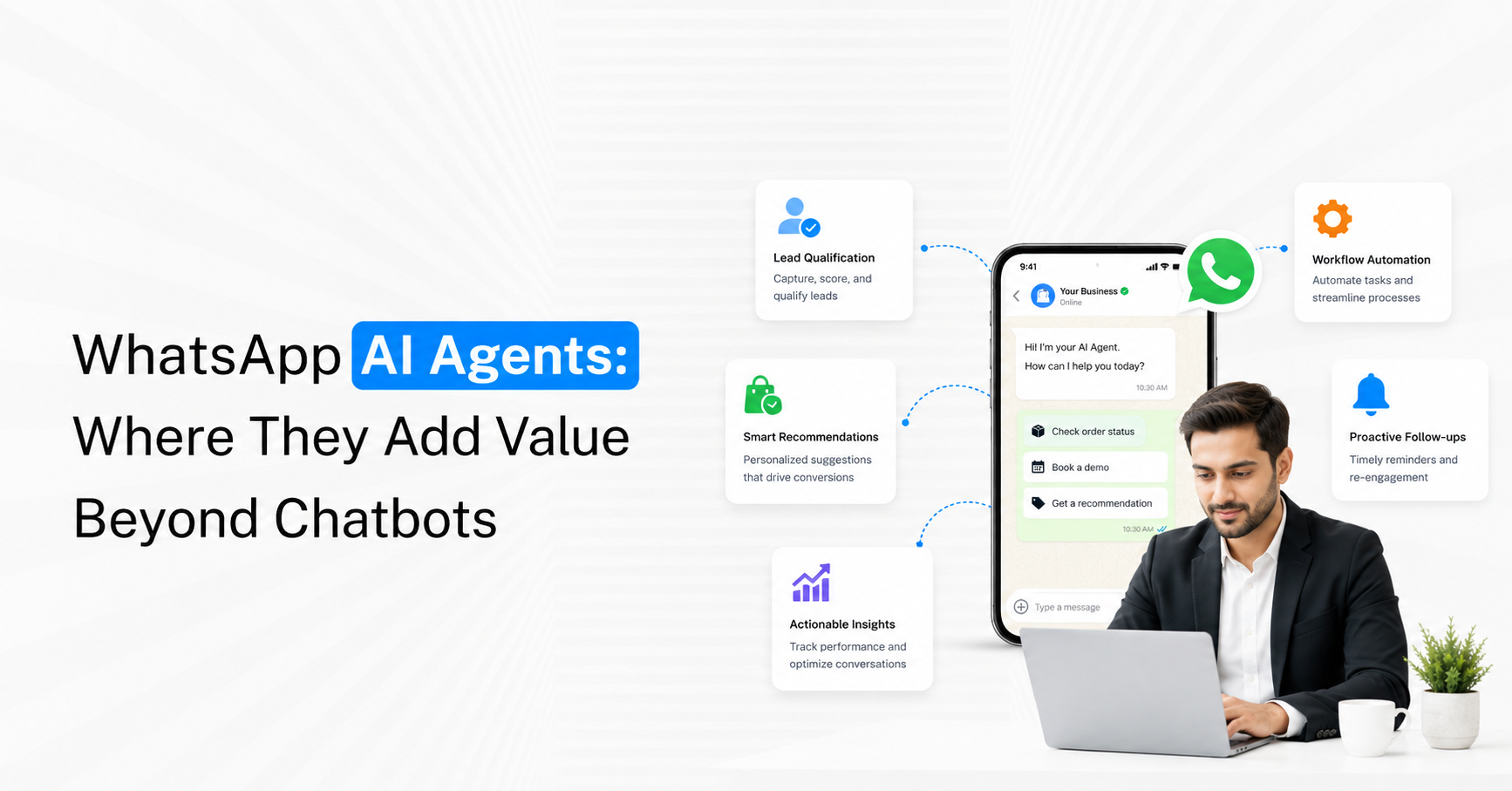
A WhatsApp AI agent adds value when customer conversations require more than predefined answers or fixed chatbot paths. It can interpret intent, use conversation context, decide the next action, work with connected business data, qualify leads, recommend products and hand complex cases to humans. For Indian businesses, the strongest use case is not replacing every WhatsApp chatbot with AI. It is using rules for predictable tasks, AI agents for variable conversations and human agents where judgement, negotiation or exception handling is required.
WhatsApp AI Agent vs Chatbot: What Is the Real Difference?
A traditional WhatsApp chatbot is usually strongest when the business already knows the possible questions, responses and workflow. An AI agent on WhatsApp becomes more useful when customer requests can be expressed in many different ways and the correct next action depends on context.
Meta's Business Agent, introduced in June 2026, is designed to answer business-specific questions, recommend products, qualify leads, book appointments, support human handoffs and take actions through connected business systems. Meta is also expanding its Business Agent Platform to support integrations with systems such as Shopify, Zendesk and other enterprise tools.
The difference is not simply that one uses AI and the other does not. The bigger difference is how much decision-making happens dynamically during the conversation.
1. AI Agents Add Value When Customers Do Not Follow a Script
Traditional chatbot flows assume customers will choose from expected questions or buttons. Real customer conversations rarely stay that clean.
A prospect may ask, “I need something for my sales team, we have around 25 people and already use Zoho. Can this work without changing our CRM?” That request contains team size, integration requirement, purchase context and a concern about migration.
An AI agent can help interpret that combined intent instead of forcing the customer through several menus.
AI agents are useful when customers:
Ask multiple questions together: The system needs to separate and answer several intents.
Use informal language: Customers may not use the exact terminology stored in your FAQ.
Change direction mid-conversation: The next question may depend on an earlier answer.
Provide incomplete information: The agent can determine what clarification is required.
Describe problems instead of products: The customer may explain a need without knowing which service solves it.
Expect conversational continuity: Previous answers should influence later responses.
For predictable menu-driven interactions, a conventional chatbot may still be simpler and more reliable.
2. Use AI Agents When Context Changes the Answer
Context is one of the strongest differences between basic automation and conversational AI on WhatsApp.
The same customer question can require different answers depending on purchase history, customer stage, previous conversation or current requirement.
For example, “What happens next?” means very little without context. After a demo request, it may refer to scheduling. After an order, it may refer to delivery. After submitting documents, it may refer to verification.
Useful context can include:
Previous messages: What has already been discussed?
Customer profile: New lead, customer or repeat buyer?
Product interest: Which product or service is under consideration?
CRM stage: New enquiry, qualified, proposal sent or customer?
Previous actions: Has the customer already booked, purchased or submitted information?
Pending task: What still needs to happen?
Emovur's WhatsApp AI Chatbot already uses business knowledge and conversation context to answer customer questions. An AI-agent layer becomes more valuable when that context must also determine what the system should do next.
3. AI Agents Can Move From Answering to Acting
Answering a question is chatbot territory. Taking the next appropriate business action is where agentic AI for WhatsApp becomes more interesting.
Meta's 2026 Business Agent announcement specifically positions agents around capabilities such as qualifying leads, booking appointments, recommending products and eventually interacting with connected business systems.
An AI agent could potentially move through actions such as:
Understand the request: Identify what the customer wants.
Retrieve information: Find relevant product, service or policy information.
Ask for missing details: Collect only what is required.
Select the next workflow: Decide whether the customer needs sales, support, booking or another process.
Call a connected system: Check available information where integrations permit it.
Complete an action: Create a lead, schedule an appointment or trigger another approved workflow.
Confirm the result: Tell the customer what happened.
Escalate when necessary: Transfer the conversation when automation should stop.
This is a more useful way to think about WhatsApp AI agents in India than simply calling them “smarter chatbots”.
4. AI Agents Improve Lead Qualification When Questions Cannot Be Fully Predefined
Basic lead qualification often uses fixed questions such as budget, location, company size or purchase timeline. That works when qualification criteria are straightforward. AI adds more value when answers need interpretation. A B2B prospect may write: “We currently send about 80,000 messages every month, mostly order updates, but now marketing wants campaigns too.”
A conventional chatbot may need several fields. An AI agent can potentially infer important signals from the sentence and ask only what remains unknown.
AI-assisted qualification can identify:
Business requirement: What problem is the prospect solving?
Current setup: What tools or processes already exist?
Scale: Message volume, team size, customers or transactions.
Urgency: Immediate implementation or future evaluation.
Commercial intent: Research, demo, quotation or implementation.
Integration need: CRM, ecommerce, helpdesk or internal systems.
Next best action: More qualification, demo booking or sales handoff.
The result should be fewer repetitive questions, not an AI interview that makes qualification longer.
5. Product Recommendation Is Stronger When the Choice Depends on Several Signals
A fixed chatbot can recommend products using predefined rules. AI agents become useful when product selection depends on several customer preferences expressed conversationally. For an ecommerce business, the customer might say: “I need something under ₹4,000 for daily use, preferably lightweight, and I didn't like the previous model because it felt too stiff.”
A useful AI system must understand several constraints at once.
Recommendation inputs can include:
Customer requirement
Budget
Product attributes
Previous purchases
Previous complaints
Current availability
Preferred category
Customer lifecycle
Conversation history
Meta's Business Agent is explicitly being developed around product recommendations using business catalogue information.
The important guardrail is that recommendations should be based on reliable business data rather than invented product details.
6. AI Agents Can Handle Conversation Branching Without Building Hundreds of Rules
Traditional automation becomes difficult to maintain when every answer creates another branch.
A simple workflow may be manageable:
Interested → Ask Budget → Show Option → Book Demo
But real conversations can create dozens of variations.
AI agents can reduce the need to manually design every conversational branch by interpreting what the customer says and selecting from permitted next actions.
This is useful when:
Customers ask questions in unpredictable order.
Different products require different qualification.
One answer changes several downstream decisions.
Customers return to previous topics.
The conversation alternates between support and sales.
The business operates across several services or categories.
Fixed automation still has an important role. Use deterministic workflows for actions that should always follow the same rule and AI where conversational variability creates excessive branching.
For multi-step journeys where timing and predefined lifecycle logic matter more than conversational reasoning, WhatsApp Drip Campaigns remain a better fit.
7. AI Agents Are Useful for Intelligent Routing
Not every customer needs the same team.
A rule-based routing system might use one field such as location or department. An AI agent can potentially evaluate the full conversation before deciding where it belongs.
Routing signals can include:
Customer intent
Product or service
Geography
Customer value
Lead stage
Problem complexity
Urgency
Language
Existing account status
Previous conversation history
For example, “I was charged twice for yesterday's order” should reach a different workflow from “Can I get enterprise pricing for 50 users?”
Both arrived on WhatsApp, but the required expertise is different.
When conversations need human handling, a Shared Team Inbox can provide the operational layer for assigning and continuing those customer conversations.
8. Human Handoff Is Part of Good AI Agent Design
A successful AI agent does not need to complete every conversation independently. Some conversations should deliberately move to people.
Escalate when the customer:
Requests a human: Do not trap them inside automation.
Needs negotiation: Pricing exceptions and complex commercial decisions may require sales.
Raises a complaint: Sensitive or unusual problems may need judgement.
Provides conflicting information: Human verification can prevent incorrect actions.
Asks outside approved knowledge: The agent should not improvise.
Reaches high buying intent: A salesperson may be more valuable than continued automation.
Needs an exception: Rules may not cover unusual cases.
Meta's Business Agent framework specifically allows businesses to determine when team members should step into customer conversations.
The best architecture is often AI handles routine complexity → human handles business judgement.
9. AI Agents Can Assist Human Agents Instead of Replacing Them
There is another useful AI-agent model: AI working alongside sales or support employees. Instead of speaking directly to the customer, AI can help the human respond faster and understand context.
Emovur's WhatsApp AI Copilot currently focuses on reply suggestions, conversation summaries, business information and customer context for human agents.
Human-assist AI can help with:
Suggested replies: Draft context-aware responses.
Conversation summaries: Reduce time spent reading long threads.
Knowledge retrieval: Find approved business information.
Customer context: Surface previous conversations and pending actions.
Next-action suggestions: Help agents understand what should happen next.
Consistency: Keep support and sales communication aligned with approved information.
For regulated, high-value or complex conversations, this copilot model may be preferable to fully autonomous AI.
10. Keep Deterministic Tasks Deterministic
Not every WhatsApp automation needs artificial intelligence. If the system already knows exactly what should happen, adding AI can create unnecessary complexity.
Keep rules or workflows for tasks such as:
Sending an order confirmation
Triggering a shipping update
Delivering an OTP
Sending an appointment reminder
Updating a known CRM field
Running a fixed approval process
Sending a predefined transactional notification
These are deterministic actions. They benefit from reliability more than reasoning.
AI becomes valuable when the system must interpret, choose, recommend or adapt.
A useful rule is:
Known Input + Known Output = Workflow
Variable Input + Contextual Decision = AI Agent
11. Combine Rules, AI and Humans in One Customer Journey
The strongest WhatsApp AI automation often uses all three rather than choosing one.
A B2B enquiry might work like this:
Rule: New website lead triggers WhatsApp acknowledgement.
AI Agent: Understands the business requirement.
AI Agent: Collects missing qualification information.
Rule: Qualified opportunities are created in CRM.
AI Agent: Answers relevant product questions.
Human: Handles demo, commercial discussion and negotiation.
Rule: CRM stage change triggers the next approved workflow.
Each layer does the job it is best suited for.
This is more reliable than forcing AI to control every operational step.
Where AI Agents Add the Most Value
Businesses should prioritise AI agents in areas where conversation volume and variability occur together.
Customer Support
AI agents can help interpret questions that do not match exact FAQ wording.
Strong use cases include:
FAQ resolution
Order-related enquiries
Policy questions
Initial troubleshooting
Support classification
Human escalation
Lead Generation
AI agents can convert unstructured conversations into usable sales information.
Strong use cases include:
Requirement capture
Lead qualification
Product matching
Demo intent detection
Sales routing
Appointment scheduling
Ecommerce
Product discovery often involves several preferences that are difficult to model with menus alone.
Strong use cases include:
Product recommendations
Product comparison
Availability questions
Pre-purchase assistance
Order queries
Human sales assistance
Appointment-Led Businesses
AI can help translate natural customer requests into structured booking information.
Strong use cases include:
Service selection
Location selection
Initial qualification
Appointment request
Rescheduling intent
Human escalation
The business should still define exactly what information the agent is allowed to access and which actions it is allowed to perform.
When a Traditional WhatsApp Chatbot Is Enough
An AI agent is unnecessary when customer journeys are predictable and rule-based.
Choose a simpler WhatsApp chatbot when:
Most questions come from a known FAQ set.
Customers primarily use buttons or menus.
There are few products or services.
Qualification uses a fixed questionnaire.
Workflow paths rarely change.
Business systems do not need dynamic actions.
Human agents already handle unusual requests efficiently.
A simpler solution is often easier to test, control and maintain.
The existing WhatsApp AI Chatbot page covers chatbot-specific implementation and capabilities. This article intentionally focuses on when businesses should move beyond that layer.
How to Decide Whether You Need a WhatsApp AI Agent
Before investing in an AI agent for WhatsApp, audit the conversations your team already handles.
Look for repeated situations where current automation fails because understanding or decision-making is required.
Good AI-agent signals include:
Customers regularly type questions outside existing chatbot paths.
Human agents repeatedly interpret the same kinds of complex requests.
Lead qualification requires reading free-text responses.
Customers expect recommendations rather than fixed menus.
Support teams spend time identifying what a customer actually needs.
Conversations need information from several systems.
Routing depends on more than one simple field.
Agents spend significant time reading conversation history.
Customer context affects the correct next action.
If these problems are rare, improving existing automation may produce more value than introducing another AI layer.
Measure AI Agent Performance by Business Outcomes
Do not evaluate an AI agent only by the number of conversations it handled automatically.
A high automation rate can look impressive while creating poor customer outcomes.
Track metrics such as:
Intent recognition success: Does the system understand why customers contacted the business?
Resolution rate: How many suitable conversations are completed without unnecessary escalation?
Qualification completion: Are sales teams receiving usable lead information?
Human handoff quality: Does the human receive enough context to continue?
Conversion rate: Do AI-assisted conversations progress towards the intended action?
Incorrect-answer rate: How frequently does the system need correction?
Fallback rate: How often can the AI not determine an appropriate response?
Time to resolution: Does AI shorten the customer journey?
Agent productivity: Can human teams manage more useful conversations?
The objective is better customer and business outcomes, not maximum automation.
Add Guardrails Before Giving AI More Autonomy
The more actions an AI agent can take, the more important operational controls become.
Define boundaries before launch.
Set clear rules for:
Knowledge sources: Which websites, documents and databases can the agent use?
Allowed actions: What can it create, modify, book or trigger?
Restricted actions: What always requires human approval?
Confidence thresholds: When should the agent stop and escalate?
Customer data: Which information can be accessed and used?
Business policies: Which answers must come from approved information?
Logging: Can the business review why actions occurred?
Fallback behaviour: What happens when the AI cannot confidently proceed?
AI should increase flexibility without removing business control.
Build an AI Layer Around the Customer Journey
The strongest use of WhatsApp AI agents in India is not adding generative AI to every chat. It is identifying where traditional automation becomes too rigid and giving AI a controlled role there.
Use a chatbot or workflow when the path is predictable. Use AI when the system must understand context, interpret customer intent, recommend an option or choose between permitted actions. Bring humans in when the conversation requires judgement, negotiation or exception handling.
A practical architecture is:
Rules for Certainty → AI for Variability → Humans for Judgement
Emovur's WhatsApp AI environment currently combines AI-assisted responses, conversation summaries, customer support automation and custom AI integrations, while separate AI Chatbot and AI Copilot capabilities address autonomous customer conversations and human-agent assistance.
Businesses already running broader workflows can also connect AI with WhatsApp Drip Campaigns and a Shared Team Inbox rather than treating AI as an isolated chatbot.
Book an Automation Demo when your WhatsApp conversations require contextual decisions, intelligent routing or task completion that fixed chatbot flows can no longer handle efficiently.