

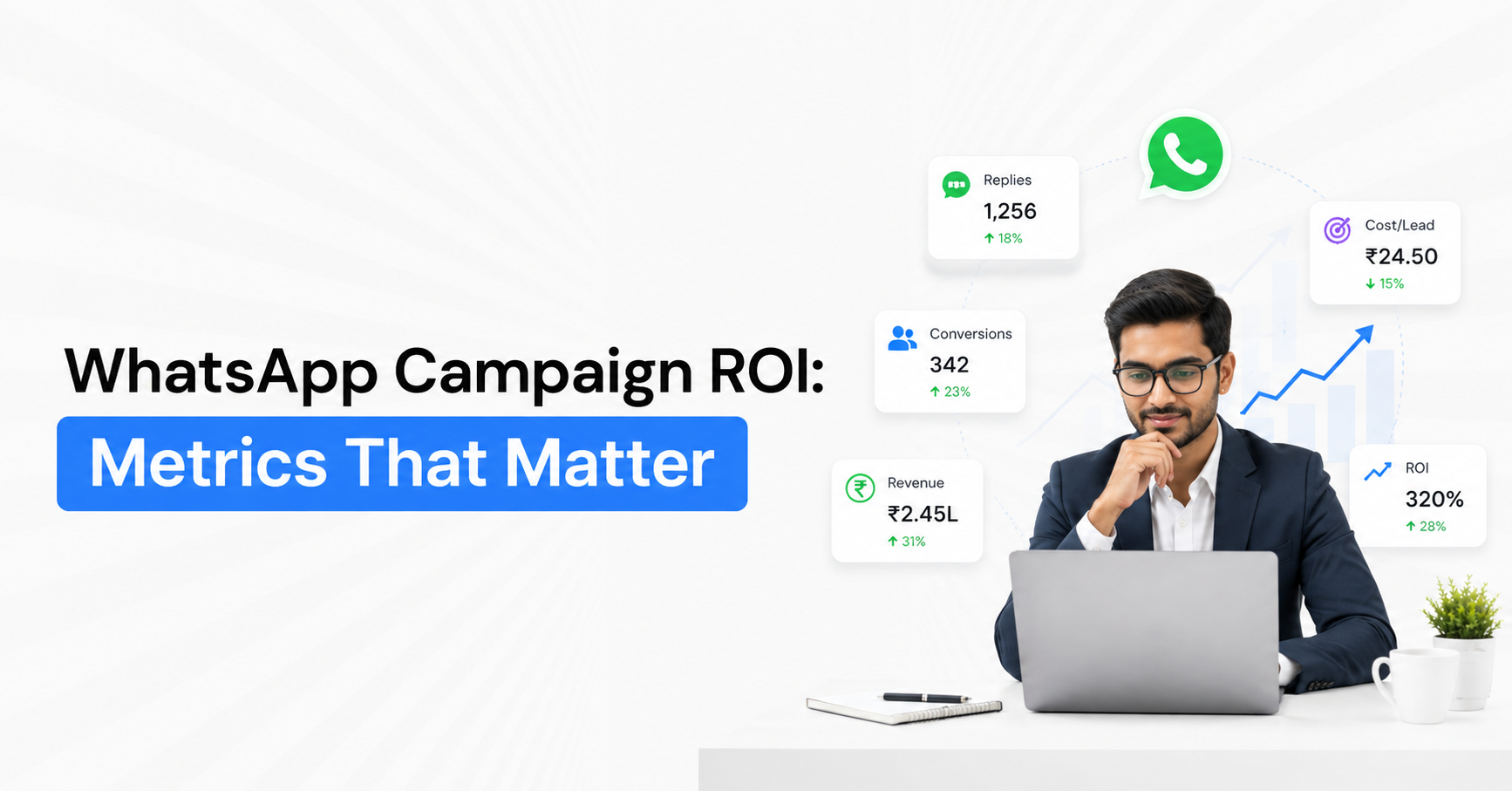
WhatsApp campaign ROI should be measured by what happens after a message is delivered, not by delivery or read rate alone. For Indian businesses in 2026, the most useful WhatsApp marketing campaign metrics are qualified response rate, click-to-action rate, conversion rate, cost per qualified action, revenue attributed to the campaign, opt-out rate and incremental business value. Delivery and read metrics diagnose the campaign, while conversions and revenue determine whether it actually worked.
Start With the Campaign Objective, Not the Dashboard
A WhatsApp marketing campaign can generate awareness, leads, appointments, purchases, renewals or customer re-engagement. The right ROI metric depends on which of these outcomes the campaign was designed to produce.
Meta's current WhatsApp Business Platform measurement resources recommend looking beyond basic conversation insights by connecting campaign activity with attribution, in-thread and off-thread events, historical comparisons and message testing.
Before evaluating performance, define one primary business outcome.
Lead generation campaign: Qualified leads generated.
Ecommerce campaign: Orders or revenue generated.
Appointment campaign: Confirmed bookings.
Re-engagement campaign: Dormant customers reactivated.
Renewal campaign: Successful renewals.
Event campaign: Registrations or attendance.
Product launch: Qualified product interest or purchases.
A campaign without a defined conversion event usually ends up being judged by easy metrics such as reads and clicks rather than business impact.
Measure WhatsApp Campaigns as a Funnel
The cleanest way to analyse WhatsApp campaign performance is to measure each stage separately. This helps identify whether the problem is delivery, message relevance, customer response or conversion after engagement.
A practical funnel is:
Audience → Delivered → Read → Engaged → Qualified Action → Conversion → Revenue
Each stage answers a different question.
Audience: How many eligible contacts were selected?
Delivered: Did the campaign successfully reach them?
Read: Did customers actually see the message?
Engaged: Did they reply, click or interact?
Qualified action: Did they take the action the campaign wanted?
Conversion: Did that action become a commercial result?
Revenue: What measurable value did the campaign produce?
Do not collapse all seven stages into one "campaign success rate". The value of funnel measurement is knowing exactly where performance drops.
1. Delivery Rate: Check Reachability First
Delivery rate tells you how much of your selected WhatsApp audience was actually reached.
Delivery Rate = Delivered Messages ÷ Messages Sent × 100
A weak delivery rate can indicate contact-quality, eligibility, template, account or technical problems. It should therefore be treated as a diagnostic metric.
Use delivery rate to identify:
Invalid contacts: Poorly maintained phone-number databases.
Technical failures: Problems within campaign execution or integrations.
Audience-quality issues: Old or incorrectly formatted customer records.
Unexpected delivery changes: Sudden differences between similar campaigns.
A high delivery rate is necessary, but it is not proof of ROI. A campaign can reach 99% of its audience and still generate no meaningful customer action.
2. Read Rate: Measure Attention, Not Revenue
WhatsApp provides businesses with basic campaign information such as read rates to help understand what is working and whether messaging frequency is appropriate. Meta also emphasises message relevance and avoiding customer overload.
Read Rate = Read Messages ÷ Delivered Messages × 100
Read rate is useful when comparing similar campaigns, but it should not become the main KPI.
Use it to diagnose:
Message timing: Was the campaign sent when customers were likely to engage?
Audience relevance: Does this segment usually pay attention to this topic?
Campaign fatigue: Are repeated campaigns becoming easier to ignore?
Message preview: Does the opening communicate why the message matters?
A read without an action is attention, not conversion.
3. Engagement Rate: Did the Message Create a Response?
After customers read the campaign, measure whether they interact.
Depending on the campaign, engagement may include a reply, button click, link click, Flow start, product enquiry or another defined interaction.
Engagement Rate = Customers Who Interacted ÷ Delivered Messages × 100
Track the interaction that actually matters rather than combining every possible action.
Useful engagement metrics include:
Reply rate: Customers who responded to the campaign.
CTA click rate: Customers who selected the primary call to action.
Link click rate: Customers who moved to the intended destination.
Flow start rate: Customers who opened a structured WhatsApp Flow.
Product enquiry rate: Customers who asked about the promoted product.
Conversation-start rate: Customers who moved from broadcast communication into a direct conversation.
Meta positions WhatsApp marketing messages across awareness, sales, re-engagement and relationship-building use cases, which means the meaningful engagement signal changes according to campaign objective.
4. Qualified Response Rate: Separate Interest From Intent
This is one of the most useful WhatsApp campaign metrics for lead-generation businesses.
Ten customers replying "Hi" is not necessarily better than four customers requesting an appointment.
Define what constitutes a qualified response before launching the campaign.
Qualified Response Rate = Qualified Responses ÷ Delivered Messages × 100
A qualified response could mean:
Real estate: Site-visit interest or matching budget.
Education: Course eligibility plus counselling interest.
B2B: Demo request or relevant business requirement.
Healthcare: Appointment request.
Automotive: Test-drive interest.
Ecommerce: Product-selection or purchase intent.
This metric prevents marketing teams from presenting every reply as a lead.
5. Conversion Rate: Measure the Intended Outcome
The WhatsApp conversion rate should reflect the business result the campaign was designed to produce.
Conversion Rate = Completed Conversions ÷ Relevant Campaign Audience × 100
The denominator can change depending on what you are analysing.
For campaign-level performance:
Conversions ÷ Delivered Messages
For post-engagement performance:
Conversions ÷ Engaged Customers
For sales-team effectiveness:
Conversions ÷ Qualified Leads
These ratios diagnose different parts of the funnel.
Example: If 20,000 messages are delivered, 1,000 customers interact, 300 become qualified leads and 60 purchase, you can calculate delivery-to-sale, engagement-to-sale and qualified-lead-to-sale conversion separately. That is more useful than reporting only "60 conversions".
6. Cost per Qualified Action: Connect Spend With Intent
A low cost per WhatsApp message does not automatically mean an efficient campaign. Calculate the cost of the customer action that actually matters.
Cost per Qualified Action = Total Campaign Cost ÷ Qualified Actions
Depending on campaign objective, this could become:
Cost per qualified lead
Cost per appointment
Cost per demo
Cost per registration
Cost per recovered cart
Cost per renewal
Cost per order
For example, Campaign A may cost ₹10,000 and generate 100 qualified leads, while Campaign B costs ₹15,000 and generates 250. Campaign B costs more but produces qualified leads at ₹60 instead of ₹100.
This article intentionally focuses on campaign measurement. For the broader financial model covering total WhatsApp investment, operational savings and contribution margin, use the existing WhatsApp API ROI Measurement Framework.
7. Revenue per Campaign: Attribute Commercial Value
For revenue-generating campaigns, track actual sales associated with the campaign rather than stopping at clicks or enquiries.
Campaign Revenue = Revenue Attributed to Customers Exposed to or Engaging With the Campaign
Then calculate:
Campaign ROAS = Attributed Revenue ÷ Campaign Cost
or, when analysing return after costs:
Campaign ROI = (Campaign Value - Campaign Cost) ÷ Campaign Cost × 100
Be consistent about which formula your reporting team uses. ROAS and ROI are not interchangeable.
Revenue attribution may come from:
Direct WhatsApp purchases: Customer converts within the conversation or associated purchase flow.
Tracked links: Campaign links connect to ecommerce or landing-page conversions.
CRM opportunity matching: WhatsApp engagement is matched with later sales.
Coupon or campaign codes: Purchases are associated with a specific campaign.
Appointment-to-sale tracking: Booking generated through WhatsApp becomes revenue later.
Offline conversion matching: Customer conversation eventually produces an offline transaction.
Meta's WhatsApp measurement guidance specifically points businesses towards attribution modelling and tracking both in-thread and off-thread events, which matters when conversion occurs outside the WhatsApp conversation itself.
8. Opt-Out Rate: Measure the Cost of Irrelevance
Revenue metrics show what the campaign gained. Opt-out rate can reveal what it damaged.
Opt-Out Rate = Campaign Opt-Outs ÷ Delivered Messages × 100
Track this by audience segment and campaign type.
A rising opt-out rate can indicate:
Poor segmentation: The offer was irrelevant to the recipient.
Excessive frequency: Customers are receiving too many promotions.
Expectation mismatch: The subscriber expected another type of communication.
Weak targeting: Broad campaigns are reaching low-intent customers.
Repeated offers: Customers keep seeing similar promotions.
Meta continues to emphasise expected, valuable business messaging and has introduced controls intended to reduce marketing-message overload.
A campaign producing short-term revenue but damaging the quality of your subscriber base should not automatically be considered successful.
9. Revenue per 1,000 Delivered Messages
When comparing campaigns with different audience sizes, absolute revenue can be misleading.
A useful normalised metric is:
Revenue per 1,000 Delivered = Campaign Revenue ÷ Delivered Messages × 1,000
Suppose:
Campaign A produces more total revenue, while Campaign B extracts more value from each 1,000 delivered messages.
That difference can reveal stronger segmentation, creative, offer relevance or customer intent.
10. Conversion Value per Subscriber
For repeat campaigns, measure whether your WhatsApp audience is becoming more commercially valuable over time.
Conversion Value per Subscriber = Campaign Revenue ÷ Eligible Subscribers
This is especially useful for businesses running regular WhatsApp marketing campaigns across product launches, seasonal promotions and retention activity.
Compare the metric by:
Customer lifecycle
Product-interest segment
Acquisition source
Location
Existing versus new customer
Previous purchase behaviour
The purpose is not to find one universal benchmark. It is to identify which audience groups consistently produce more business value.
Do Not Treat Every Metric as a KPI
A strong WhatsApp campaign dashboard separates diagnostic metrics from business KPIs.
Diagnostic Metrics
These explain what happened inside the campaign:
Delivery rate
Read rate
Click rate
Reply rate
Flow completion
Message failures
Business KPIs
These determine whether the campaign created value:
Qualified leads
Appointments
Orders
Revenue
Cost per qualified action
Conversion rate
Campaign ROI
Customer reactivation
Delivery and read rates help improve campaigns. They should not replace commercial outcomes.
Use Different KPIs for Different WhatsApp Campaign Types
One reporting template should not be forced across every campaign.
This prevents reporting from becoming a collection of metrics that have no relationship to the campaign objective.
Segment-Level ROI Matters More Than Account-Level Averages
Overall WhatsApp campaign performance can hide major differences between audiences. Break results down by meaningful segments.
Compare performance by:
Customer lifecycle: Lead, first-time buyer, repeat buyer or dormant customer.
Product interest: Which customer categories respond to which campaigns?
Acquisition source: Website, Meta Ads, QR code, retail store or another source.
Location: Which regions produce stronger qualified actions?
Purchase history: Do previous buyers outperform prospects?
Recency: How recently did the customer engage or buy?
Campaign frequency: Does performance decline as contact frequency increases?
A campaign with average results may contain one highly profitable segment and several audiences that should not receive the same message again.
Compare Against Your Own Baseline Before External Benchmarks
Generic WhatsApp benchmarks can be tempting, but campaign performance varies significantly by industry, audience quality, objective, offer, price point and customer lifecycle. Build your own baseline first.
Track the previous 5 to 10 comparable campaigns and calculate typical:
Delivery rate
Read rate
Engagement rate
Qualified response rate
Conversion rate
Cost per qualified action
Revenue per 1,000 delivered
Opt-out rate
Then identify whether the new campaign improved or declined against your normal performance. Meta's measurement resources also recommend comparing WhatsApp results with past performance and other channels rather than evaluating campaigns in isolation.
A/B Test the Part of the Funnel That Is Weak
Do not test random template variations simply because A/B testing is available. Identify the weak metric first, then test the variable most likely to affect it.
Low read or engagement: Test message opening, timing or audience relevance.
High reads but low clicks: Test offer clarity and CTA.
High clicks but low conversion: Audit landing page, checkout or handoff.
High replies but low qualification: Improve audience selection or qualifying message.
Good conversion but high opt-outs: Review frequency and targeting.
Strong conversions but weak revenue: Review customer value, order value or offer economics.
Meta's WhatsApp Business Platform measurement resources explicitly include A/B testing of message templates as part of campaign-effectiveness measurement.
Build a Compact WhatsApp Campaign Scorecard
A campaign report does not need dozens of KPIs. For most revenue or lead-generation campaigns, a useful scorecard can contain:
Add segment-level performance below this scorecard when it helps explain why the campaign performed differently.
Audit the Funnel, Not Just the Final ROI
When a WhatsApp campaign underperforms, saying "ROI was low" does not tell the team what to fix.
Audit sequentially:
Delivered but not read: Review audience quality, timing and campaign expectations.
Read but not engaged: Review relevance, copy and offer.
Engaged but not qualified: Review targeting and qualification.
Qualified but not converted: Review sales process or conversion journey.
Converted but unprofitable: Review campaign economics and customer value.
Converted with rising opt-outs: Review frequency and audience experience.
This turns WhatsApp campaign analytics into an optimisation system rather than a monthly reporting exercise.
Measure the Business Action That Comes After the Message
The most important principle for WhatsApp campaign ROI metrics in India in 2026 is simple: the message itself is not the outcome.
Delivery tells you whether the message arrived. Read rate tells you whether it gained attention. Engagement shows whether it generated interest. Qualified actions, conversions, revenue and customer value show whether the campaign created a business result.
Use delivery and read metrics for diagnosis, qualified actions and conversion for performance, and revenue, cost per outcome and ROI for business evaluation. Monitor opt-outs alongside them so short-term campaign gains do not come at the expense of audience quality.
For businesses building WhatsApp into a larger acquisition, sales and customer-engagement system, review the main WhatsApp Business API platform and audit the complete path from message delivered → customer action → qualified outcome → revenue.
Audit Your WhatsApp Funnel by identifying where customers stop progressing, then optimise that stage rather than chasing higher read rates alone.
TABLE OF CONTENTS