

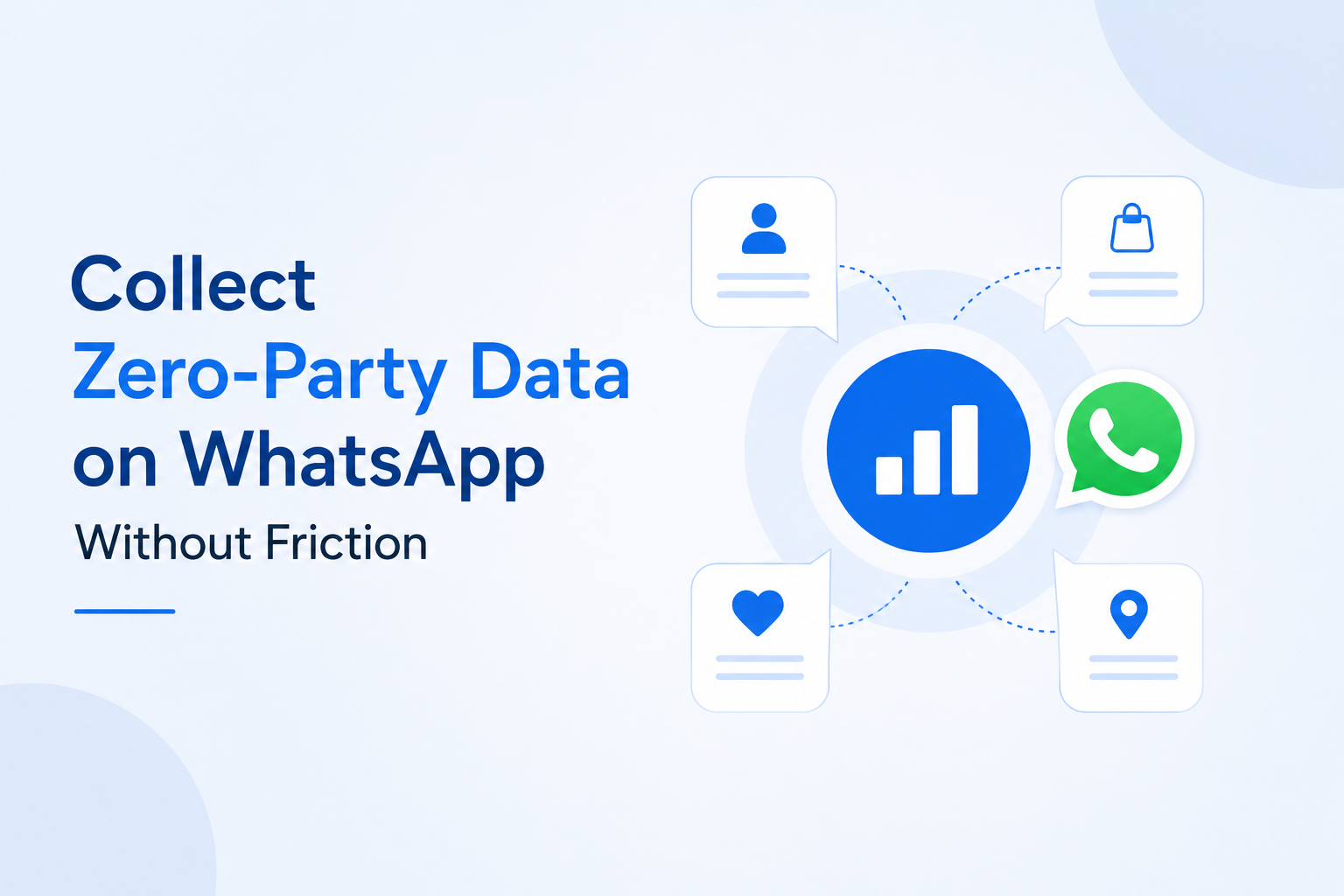
Zero-party data on WhatsApp is information customers intentionally share about their preferences, needs, interests or purchase plans. Instead of guessing from clicks or past behaviour, businesses can ask customers directly through WhatsApp forms, quick choices, conversational questions and WhatsApp Flows. For Indian businesses, the best approach is not to ask for everything at once. Collect only the information needed for the next customer action, store those answers as usable CRM fields and progressively enrich the customer profile across future interactions.
What Is Zero-Party Data on WhatsApp?
Zero-party data is information a customer knowingly provides to a business. On WhatsApp, this could be a preferred product, budget range, location, appointment date, language, purchase goal or communication preference.
Unlike behavioural data that must be inferred from actions, zero-party data comes directly from the customer.
Common examples include:
Product preference: “Which category are you interested in?”
Budget range: “What budget are you considering?”
Location preference: “Which branch or city works for you?”
Purchase timeline: “When are you planning to buy?”
Service requirement: “What do you need help with?”
Communication preference: “Which updates would you like to receive?”
Appointment preference: “Which date or time works best?”
Customer goal: “What are you trying to achieve?”
The value comes from collecting information the business can actually use, not from asking customers more questions.
Why WhatsApp Works Well for Zero-Party Data Collection
Traditional web forms often ask customers to complete several fields before anything useful happens. WhatsApp allows businesses to distribute those questions across a conversation instead.
Meta's WhatsApp Flows feature was designed to support structured experiences such as selecting options, booking appointments and completing customizable forms without leaving the WhatsApp chat.
This creates several practical advantages:
Familiar environment: Customers can continue inside the WhatsApp conversation.
Structured responses: Questions can use selectable choices instead of open-ended typing.
Immediate context: Data can be collected when the customer is already interested.
Progressive collection: Not every question needs to appear at the beginning.
Faster routing: Answers can determine which product, team or workflow should come next.
Reusable customer intelligence: Responses can be stored for future segmentation.
The objective should be less typing, fewer questions and more useful answers.
Start With the Decision You Need to Make
Do not create a WhatsApp form by starting with a list of every customer field your CRM can store.
Start with the business decision the data needs to support.
If sales needs to decide which salesperson receives a property lead, you may only need property type, location, budget and purchase timeline. If a clinic needs to route an enquiry, service required and preferred location may be enough.
Ask yourself:
What decision will this answer influence?
Will it change the next message or workflow?
Will sales or marketing actually use this field?
Can we obtain this information later instead?
Does the customer already expect us to know the answer?
If an answer does not influence segmentation, personalisation, routing or service, consider removing the question.
Use Progressive Profiling Instead of One Long WhatsApp Form
One of the strongest ways to reduce friction is progressive profiling. Rather than collecting ten customer attributes in one interaction, gather information gradually as it becomes relevant.
For example, a real-estate conversation does not need to begin by asking name, email, city, property type, configuration, budget, possession preference, investment objective and site-visit date simultaneously.
A better sequence could be:
First interaction: Property type + preferred location
After interest is confirmed: Budget range + purchase timeline
When qualified: Site-visit preference
The customer profile becomes richer over time without turning the first conversation into an application form.
Good progressive profiling prioritises:
Immediate need: What is required to continue the current journey?
Qualification: What helps determine whether the lead is relevant?
Personalisation: What genuinely changes the recommendation?
Conversion: What information is required to complete the next action?
Future preference: What would improve later communication?
Collect data at the moment it becomes useful.
Prefer Choices Over Open Text Where Possible
Typing creates friction. Structured options usually make WhatsApp data collection faster and easier to analyse.
Instead of asking:
“Tell us what type of property you are looking for and your approximate budget.”
split the information into selectable choices.
Property Type
Apartment
Villa
Plot
Budget
Below ₹1 Cr
₹1 Cr to ₹1.5 Cr
₹1.5 Cr to ₹2 Cr
Above ₹2 Cr
This improves both the customer experience and the quality of data entering the CRM.
Structured choices are especially useful for:
Product categories
Service requirements
Locations
Budget bands
Appointment slots
Purchase timelines
Customer types
Feedback scores
Use free-text fields only when customers genuinely need to describe something in their own words.
Use WhatsApp Flows When the Journey Needs Structure
For more complex data collection, WhatsApp Flows can provide multi-step in-chat forms rather than forcing customers through a long bot conversation.
Emovur's current WhatsApp Flows implementation supports interactive forms for lead qualification, appointments, feedback and event registration. Its Flow Builder can also collect responses, export structured data and pass responses through webhooks for further processing.
Flows are particularly useful when you need:
Multiple related questions: Such as product, budget, location and timeline.
Structured selections: Instead of asking users to type every answer.
Appointment booking: Collect preferred date, location or service.
Lead qualification: Capture important sales criteria before assignment.
Feedback: Gather scores and structured customer opinions.
Registration: Collect event or programme information.
System integration: Pass customer responses into CRM or automation.
Use a WhatsApp Flow when structure improves the journey. Do not build a five-screen Flow when two quick questions would solve the problem.
Do Not Ask Questions You Already Know the Answer To
Zero-party data collection becomes annoying when businesses repeatedly ask customers for information already available in their systems.
If a returning customer has already provided their city, product category and language, avoid requesting those fields again unless the information needs updating.
Before asking a question, check:
CRM data: Has the customer already provided this information?
Order history: Can the preference reasonably be derived from a completed action?
Current conversation: Did the customer just state the answer?
Previous Flow responses: Is the information already stored?
Account information: Is the field already part of the customer profile?
A strong WhatsApp customer journey should feel like the business remembers the conversation.
Collect Intent, Not Just Contact Details
Name, mobile number and email identify the customer. They do not explain what the customer wants.
High-value zero-party customer data usually captures intent.
For a B2B software company, useful fields may include:
Business size
Primary use case
Monthly enquiry volume
Current tool
Required integration
Purchase timeline
For an ecommerce business:
Product category
Size or preference
Price range
Purchase occasion
Preferred product type
For education:
Course interest
Current qualification
Career objective
Preferred learning mode
Joining timeline
For healthcare or appointment-led businesses, keep data collection limited to appropriate operational information required for routing or scheduling and avoid unnecessary sensitive information.
The best questions reveal what the customer wants next.
Turn Every Useful Answer Into a CRM Field
Collecting zero-party data has little value if it remains buried inside chat transcripts.
Convert important answers into structured fields that marketing, sales and automation can use.
This is where WhatsApp forms become more valuable than simple surveys. The collected information can influence the next customer interaction.
A useful architecture is:
Customer Response → Structured Field → CRM Profile → Segment → Next Action
Use Conditional Questions to Reduce Friction
Not every customer should see every question.
Conditional logic allows the next question to depend on the previous answer.
For example:
Question: Are you looking for an apartment or villa?
If Apartment, ask configuration and budget.
If Villa, ask preferred location and budget.
There is no reason to show apartment-specific questions to someone who selected villa.
Conditional data collection can help reduce:
Unnecessary questions
Long customer journeys
Irrelevant form fields
Drop-offs
Incorrect responses
Manual sales qualification
The result is a shorter journey for the customer and cleaner data for the business.
Use Zero-Party Data to Improve WhatsApp Segmentation
Once customer preferences are stored properly, they can become the foundation of WhatsApp audience segmentation.
Instead of sending campaigns to broad lists such as “All Leads” or “All Customers”, businesses can create more relevant segments.
For example:
Apartment Interest + Bengaluru + ₹1.5 Cr+ Budget + Purchase Within 6 Months
or:
Existing Customer + Running Shoes Buyer + Interested in New Launches
Useful zero-party segmentation signals include:
Customer interest
Preferred category
Location
Budget
Purchase timeline
Communication preference
Customer objective
Service requirement
These signals can then support more relevant WhatsApp Broadcast and Bulk Messaging campaigns without turning this article into another broadcast-management guide.
Ask for Preferences at Natural Moments
The timing of the question matters almost as much as the question itself.
Do not interrupt a new enquiry with a preference survey before answering what the customer came for.
Better opportunities to collect zero-party data include:
After an initial enquiry: Ask the minimum qualification questions.
Before a recommendation: Ask what the customer prefers.
During booking: Collect date, location or service choice.
After purchase: Ask about future interests where relevant.
During onboarding: Capture setup preferences.
Before campaign personalisation: Allow customers to select topics or categories.
During feedback: Ask what could improve their next experience.
A well-timed question feels like part of the service rather than data collection.
Separate Preference Data From Marketing Permission
Knowing that someone prefers Category A does not automatically mean the business can use that information for every future marketing campaign.
Keep customer preference data and campaign eligibility as separate database concepts.
For example:
Product Interest: Running Shoes
Preferred Size: 9
Preferred Language: English
WhatsApp Marketing Status: Active
This prevents marketers from treating any submitted form as automatic promotional permission.
For building and maintaining campaign eligibility, use the separate DPDP-Ready WhatsApp Subscriber List guide rather than duplicating that compliance workflow here.
Avoid These Zero-Party Data Collection Mistakes
Most friction comes from collecting too much information or failing to use what customers provide.
Avoid:
Long first interactions: Do not ask eight questions before providing value.
Unnecessary mandatory fields: Collect only what the workflow needs.
Repeated questions: Reuse existing customer data where appropriate.
Too much free text: Use structured choices when possible.
Generic surveys: Ask questions tied to an actual customer journey.
Collecting without activation: Do not gather preferences that never influence marketing or sales.
Poor CRM mapping: Define where every useful answer will be stored.
Permanent assumptions: Customer preferences can change and should be refreshable.
Good zero-party data should make subsequent conversations shorter, not longer.
Measure Whether the Data Collection Is Working
Do not evaluate a WhatsApp form only by how many people opened it.
Measure whether customers complete it and whether the resulting data improves business outcomes.
Useful metrics include:
Flow start rate: How many eligible customers begin.
Completion rate: How many complete the required questions.
Drop-off by question: Identifies fields creating friction.
Average completion time: Shows journey complexity.
Qualified lead rate: Measures whether collected data improves filtering.
Segment conversion rate: Measures performance of preference-based audiences.
Data usage rate: Percentage of collected fields actually used in campaigns or workflows.
Profile completeness: Shows how much useful customer data has been progressively collected.
If one field creates a major drop-off but is rarely used later, remove it.
A Simple Zero-Party Data Framework
Businesses do not need a complicated data strategy to start.
Use five stages:
1. Ask: Collect one piece of information that helps the current journey.
2. Structure: Convert the answer into a standard field or tag.
3. Store: Save it against the correct customer record.
4. Activate: Use it for routing, personalisation, segmentation or recommendations.
5. Refresh: Allow customer preferences to change over time.
For example, an education business could collect Course Interest → Data Analytics, store it in the CRM, use it to route the lead to the correct counsellor and later include the customer only in relevant course communication.
That is more valuable than collecting ten profile fields that nobody uses.
Build Customer Profiles One Useful Answer at a Time
The strongest zero-party data strategy on WhatsApp in India is not a long questionnaire. It is a series of useful questions placed naturally throughout the customer relationship.
Use WhatsApp forms, WhatsApp Flows, structured choices and conversational questions to learn what customers actually want. Prioritise intent, preferences, requirements and timing over unnecessary personal information, then convert those answers into structured CRM fields that improve qualification and segmentation.
The practical model is:
Ask Less → Learn More → Store Clearly → Segment Better → Personalise the Next Action
Emovur currently supports WhatsApp Flows for structured lead qualification, appointments, feedback and form-response collection, including webhook-based workflows and structured exports.
Once those customer preferences have been collected and your eligible audience is ready, use WhatsApp Broadcast and Bulk Messaging to apply those insights to more relevant campaigns rather than sending the same message to every contact.
Start a Compliant Campaign built around what customers have actually told you they want.