

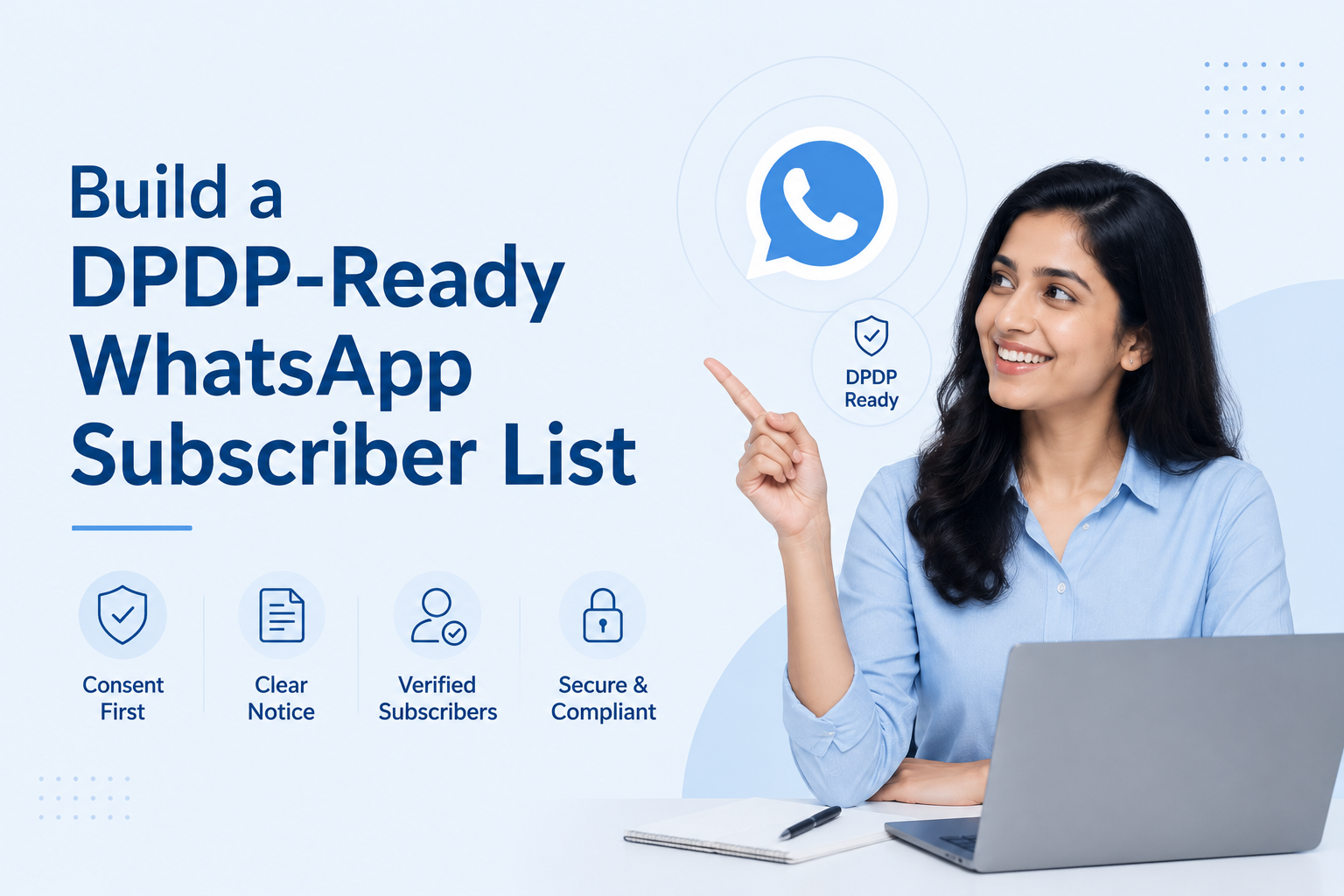
A DPDP-ready WhatsApp subscriber list is a structured first-party audience where every contact has a known source, clear marketing status, relevant interest data and current campaign eligibility. For Indian businesses, the aim is not to collect the maximum number of phone numbers. It is to build a clean WhatsApp marketing database that can be segmented, maintained and activated for relevant campaigns without repeatedly checking whether each contact should receive promotional communication.
What Is a DPDP-Ready WhatsApp Subscriber List?
A DPDP-compliant WhatsApp list in India should give your marketing team enough information to understand where a subscriber came from, what they are interested in and whether they are currently eligible for a campaign.
A usable subscriber record should contain more than a name and phone number.
Your WhatsApp subscriber database should ideally track:
Subscriber source: Website, landing page, QR code, event, checkout, Meta Ads or Click-to-WhatsApp.
Marketing status: Active, paused, suppressed or requiring review.
Signup date: When the subscriber entered the database.
Interest category: Product, service, course, property type or another relevant preference.
Customer lifecycle: Lead, customer, repeat customer, inactive or dormant.
Campaign history: What the subscriber has recently received.
Suppression status: Whether the contact must be excluded from promotional campaigns.
For the broader legal treatment of consent, notice and withdrawal, use the separate DPDP and WhatsApp Marketing guide. This article focuses specifically on WhatsApp list building and subscriber management.
Step 1: Define Approved Subscriber Sources
The quality of a WhatsApp opt-in list starts with how contacts enter it. If marketing, sales and events teams keep importing separate spreadsheets, subscriber history becomes difficult to track. Define a fixed set of approved acquisition sources and record the source when the contact is created.
Common subscriber sources include:
Website forms: Capture customers already showing interest in a product or service.
Landing pages: Useful for campaign-specific subscriber acquisition.
Click-to-WhatsApp Ads: Record the campaign that generated the conversation.
QR codes: Useful for stores, packaging, exhibitions and offline promotions.
Checkout: Capture relevant customer communication preferences after purchase.
Events and webinars: Preserve the event or topic that attracted the subscriber.
Customer accounts: Allow existing customers to manage their communication preferences.
The source itself can later become a valuable WhatsApp audience segmentation field.
Step 2: Create One Complete Subscriber Record
Do not create a new list every time a campaign launches. Maintain one master subscriber record and build campaign audiences from it.
Useful fields include:
Customer ID: Connects WhatsApp activity with CRM information.
WhatsApp number: Stored in one standard format.
Subscriber source: Shows where the customer entered.
Marketing status: Identifies current campaign eligibility.
Interest tags: Helps match customers with relevant campaigns.
Location: Supports city, state, branch or service-area targeting.
Customer stage: Lead, customer, repeat customer or inactive.
Last campaign: Helps control messaging frequency.
Last engagement: Shows whether the subscriber is still active.
Record updated date: Helps identify outdated customer information.
This becomes your primary WhatsApp subscriber management system, whether it sits inside a CRM, CDP or another customer database.
Step 3: Separate Customer Status From Marketing Status
A customer is not automatically a marketing subscriber. Keeping both statuses separate helps prevent transactional or service contacts from being treated as promotional audiences.
Use separate fields such as:
Customer Status: Lead / Customer / Repeat Customer / Inactive
WhatsApp Marketing Status: Active / Paused / Suppressed / Review Required
This allows combinations such as:
Customer + Active: Existing customer eligible for relevant campaigns.
Customer + Suppressed: Customer remains in CRM but is excluded from promotions.
Lead + Active: Prospect can enter suitable lead-nurturing campaigns.
Lead + Review Required: Customer exists, but marketing eligibility needs checking.
Your CRM database may contain 1 lakh customers while your actual WhatsApp campaign audience is only 50,000. Keeping these fields separate makes that distinction visible.
Step 4: Capture Subscriber Interests Early
A good list should answer two questions: Can we message this person? and What should we message them about? Add relevant first-party information when subscribers enter the database.
Useful WhatsApp subscriber tags include:
Product interest: Shoes, supplements, software, property or another category.
Service interest: Consultation, diagnostics, training, support or installation.
Location: City, neighbourhood, branch or sales territory.
Budget range: Useful for real estate, B2B and high-value services.
Language preference: Helpful for regional campaigns.
Lead stage: New enquiry, qualified, demo booked, proposal sent or inactive.
Purchase history: Useful for retention, cross-sell and replenishment campaigns.
Instead of storing only Subscriber = Yes, the database should describe enough customer intent to make future communication relevant.
Step 5: Create Campaign Eligibility Rules
Marketing teams should not select contacts simply because their numbers exist in the database. Create rules that determine which subscribers can enter each campaign.
A basic rule can be:
Active WhatsApp subscriber
Relevant product or service interest
Correct geography
Suitable lifecycle stage
Not suppressed
Frequency limit not exceeded
For example, a property campaign could target Active Subscriber + North Bengaluru + Apartment Interest + ₹1.5 Cr+ Budget.
An education campaign could use Active Subscriber + Data Science Interest + Lead Not Converted + Bengaluru.
This converts one large WhatsApp marketing list into several relevant campaign audiences.
Step 6: Maintain a Central Suppression List
Removing someone from one broadcast is not enough. If the same customer remains active in another spreadsheet or CRM export, they may be added again later. Maintain suppression at the master-database level.
A suppression record should include:
Customer ID: Connects the status with the correct person.
WhatsApp number: Prevents re-import under another list.
Suppression status: Clearly marks the contact as excluded.
Date updated: Shows when the preference changed.
Source: WhatsApp, website, support, sales team or another channel.
Reactivation status: Records whether the customer later becomes eligible again.
Every campaign audience should be checked against the central WhatsApp suppression list before sending.
Step 7: Standardise Numbers and Remove Duplicate Contacts
Duplicate records make WhatsApp list hygiene difficult and can distort campaign reporting. The same Indian number may appear as 9876543210, +91 9876543210 and 919876543210.
Clean the database by:
Standardising phone formats: Use one format consistently.
Matching duplicates: Compare WhatsApp numbers and customer IDs.
Merging records: Preserve the latest status, source and customer information.
Removing invalid numbers: Prevent unnecessary campaign processing.
Checking repeated imports: Avoid adding the same customer from multiple spreadsheets.
A good rule is one person, one master WhatsApp record.
Step 8: Create a Subscriber Lifecycle
Subscribers should not remain in the same segment forever. Their relationship with the business changes over time.
A simple WhatsApp subscriber lifecycle can include:
New: Recently joined the list.
Active: Regularly eligible for campaigns.
Engaged: Frequently interacts with relevant communication.
Customer: Has completed a purchase or conversion.
Repeat Customer: Has completed multiple transactions.
Low Engagement: Rarely interacts with campaigns.
Dormant: Has shown no meaningful activity for a longer period.
Suppressed: Excluded from promotional communication.
Lifecycle segmentation helps avoid sending the same campaign to a new lead, loyal customer and inactive contact.
Step 9: Segment Using Intent and Behaviour
Demographics can help, but behavioural data usually provides stronger WhatsApp audience targeting. Build segments around what customers have actually done.
Useful behavioural signals include:
Product viewed
Form submitted
Previous purchase
Demo requested
Appointment booked
Cart abandoned
Campaign clicked
Previous conversation topic
Lead stage
Last purchase date
An ecommerce company could create separate audiences for category buyers, repeat customers and dormant customers. A B2B company could segment prospects into demo requested, proposal sent and inactive opportunities.
Businesses ready to activate these audiences can use WhatsApp Broadcast and Bulk Messaging for segmented campaign execution.
Step 10: Control Campaign Frequency
A subscriber may qualify for several campaigns at the same time. Without frequency controls, one customer can receive a product promotion, festive offer, retargeting campaign and general broadcast within a few days.
Your subscriber database should therefore record recent campaign activity.
Useful frequency fields include:
Last promotional message date
Campaigns received in last 7 days
Campaigns received in last 30 days
Last campaign category
Last engagement date
Campaign rules can then include conditions such as Eligible Segment + Fewer Than 3 Promotional Campaigns in Previous 30 Days.
The exact threshold depends on the business, but frequency should be measurable rather than managed from memory.
Step 11: Measure Subscriber Quality
Subscriber count alone can be misleading. A database may contain thousands of numbers that are duplicated, inactive, suppressed or unsuitable for the current campaign.
Track list-quality metrics such as:
Total WhatsApp contacts: Complete stored database.
Active subscribers: Current marketing audience.
Campaign-eligible contacts: Contacts matching a specific campaign.
Suppressed contacts: Customers excluded from promotions.
Duplicate rate: Indicates database cleanliness.
Unknown-status contacts: Records requiring review.
Engaged subscriber rate: Shows audience responsiveness.
Subscriber-to-lead rate: Measures lead-generation value.
Subscriber-to-customer rate: Measures commercial quality.
One useful calculation is:
Campaign-Eligible Subscribers ÷ Total WhatsApp Contacts × 100
This gives a more realistic view of usable audience size.
Step 12: Audit the List Before Every Major Broadcast
Before launching a major WhatsApp broadcast campaign, generate the audience from the master database and run a short quality check.
Confirm that each contact passes:
Subscriber status check
Relevant segment check
Valid phone-number check
Suppression check
Duplicate check
Frequency check
Geography check where relevant
Product or service interest check
The final rule becomes:
Eligible Status + Relevant Segment + Valid Number + Not Suppressed + Frequency Check = Campaign Ready
This is much safer and more scalable than exporting the complete CRM and manually removing unsuitable contacts.
Step 13: Track Which Sources Produce Better Subscribers
A list-building strategy should eventually measure subscriber quality by source.
Do not optimise only for the cheapest subscriber acquisition cost.
Compare sources using:
Subscriber volume
Active subscriber percentage
Campaign engagement
Lead conversion
Customer conversion
Repeat purchase
Opt-out rate
A website form might generate fewer subscribers than a giveaway campaign but produce much stronger customer conversion. A Click-to-WhatsApp campaign may produce a smaller audience but higher commercial intent.
The better question is not “Which source adds the most numbers?” It is “Which source adds the most valuable subscribers?”
Build One Master List and Many Campaign Segments
The most scalable structure is:
Master Subscriber Database → Subscriber Status → Interest Tags → Lifecycle → Campaign Eligibility → Segment → Broadcast
Do not create a permanent spreadsheet for every campaign.
Your master database should remain the source of truth while campaign lists are temporary views generated from current data.
This gives marketing teams a cleaner DPDP-ready WhatsApp list, better segmentation, stronger first-party data and more reliable campaign reporting.
Build the List Before Scaling WhatsApp Marketing
A strong DPDP-compliant WhatsApp list in India is not defined by the number of mobile numbers collected. It is defined by how confidently the business can answer who the subscriber is, where they came from, what they are interested in, whether they are eligible for a campaign and when they were last contacted.
Build around subscriber source, marketing status, first-party interests, lifecycle, suppression, frequency and engagement history.
The operating model should be:
Capture → Structure → Tag → Segment → Suppress → Activate → Measure → Maintain
Once that foundation is ready, use WhatsApp Broadcast and Bulk Messaging to activate the right subscriber segments rather than sending every campaign to the complete customer database.
Start a Compliant Campaign with a WhatsApp subscriber list built for clean audience management, relevant targeting and long-term growth.