

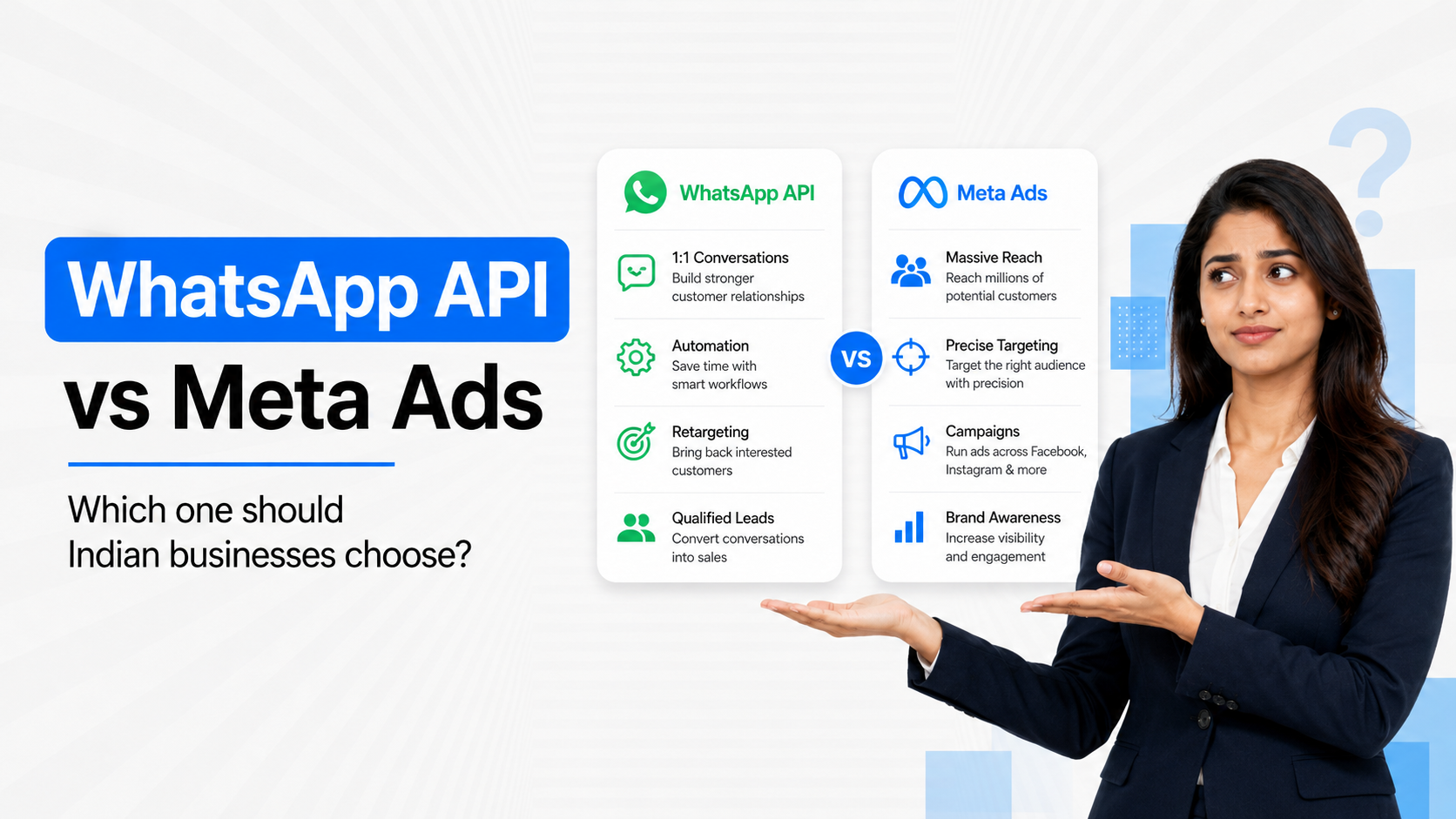
WhatsApp Business API and Meta Ads should not be compared as competing advertising channels. Meta Ads is primarily used to create reach, demand and customer acquisition across Facebook, Instagram and related placements, while WhatsApp Business API manages what happens after a customer enters a conversation. For Indian businesses in 2026, the stronger model is often Meta Ads for discovery and lead generation, followed by WhatsApp for qualification, sales follow-up, automation, support and conversion. Measure each channel according to its role, not the same budget metric.
WhatsApp API vs Meta Ads: What Is the Actual Difference?
The phrase WhatsApp API vs Meta Ads can be misleading because the two tools operate at different stages of the customer journey. Meta Ads helps businesses find and reach potential customers. WhatsApp Business API helps businesses communicate with customers after an interaction has begun or when an eligible customer relationship already exists.
A simple customer journey is:
Meta Ad → Customer Interest → WhatsApp Conversation → Qualification → Sales Follow-Up → Conversion
The distinction becomes clearer when each platform is given a specific job.
This is why asking whether WhatsApp Business API is cheaper than Meta Ads usually starts with the wrong comparison. They are not buying the same thing.
Meta Ads Owns Customer Acquisition
Meta Ads is designed to put a business in front of potential customers through paid distribution. Businesses can use Facebook and Instagram advertising to create:
Awareness: Introduce a brand, product or service to potential customers.
Traffic: Send users to websites, landing pages or other destinations.
Lead generation: Capture prospect information through supported lead-generation journeys.
Sales: Drive users towards ecommerce or other conversion actions.
Retargeting: Re-engage audiences based on eligible previous activity.
Click-to-message journeys: Move users directly from an advertisement into a messaging conversation.
The advertiser pays to compete for attention and reach through Meta's advertising ecosystem.
Campaign performance is therefore usually measured through metrics such as:
CPM
CPC
CTR
Cost per lead
Cost per acquisition
Conversion rate
ROAS
These are customer acquisition metrics.
WhatsApp should not automatically be judged using the same metrics because its role often begins after acquisition.
WhatsApp Business API Owns the Conversation After Acquisition
Once a customer starts a WhatsApp conversation, the business has a different problem.
The question is no longer:
How do we reach this person?
It becomes:
How do we move this customer towards the right next action?
That is where WhatsApp Business API becomes useful.
Businesses can use WhatsApp for:
Lead acknowledgement: Respond when a new enquiry reaches the business.
Lead qualification: Capture requirement, location, budget, product interest or another relevant qualifier.
Sales assignment: Route customers to the correct salesperson or team.
Appointment booking: Move qualified customers towards consultations, demos or visits.
Follow-up: Continue conversations where appropriate instead of depending only on calls and email.
CRM updates: Connect customer activity with lead records and pipeline stages.
Customer support: Route existing customers to the correct support workflow.
Retention: Continue relevant post-purchase communication according to applicable messaging and consent requirements.
For companies evaluating the broader platform, WhatsApp Business API should be viewed as the customer-conversation infrastructure, not an advertising replacement.
Where Click-to-WhatsApp Ads Connect Both Channels
Click-to-WhatsApp ads are where the Meta Ads and WhatsApp roles meet directly.
The ad creates the customer acquisition opportunity. The click moves the user into WhatsApp. The WhatsApp workflow then determines whether that click becomes a qualified lead, appointment, sale or support conversation.
A useful flow is:
Facebook or Instagram Ad → Click to WhatsApp → Immediate Response → Qualification → CRM → Salesperson → Conversion
This is particularly relevant for Indian businesses where customers often want to ask questions before buying.
Strong Click-to-WhatsApp use cases include:
Real estate: Project enquiry, budget qualification and site-visit scheduling.
Education: Course enquiry, eligibility, fee questions and counselling booking.
Healthcare: Service enquiry and appointment coordination.
Automotive: Vehicle enquiry, dealership routing and test-drive booking.
B2B: Business requirement capture and demo scheduling.
Local services: Service enquiry, location check and appointment booking.
Ecommerce: Product questions before purchase.
Emovur's current Starter plan includes a Click to WhatsApp Ads Manager alongside team inbox, broadcast scheduling, retargeting and WhatsApp Flows.
The 72-Hour Free Entry Point Matters to Cost Planning
There is also a pricing connection between the two channels.
Meta currently states that when a customer sends a business a message from an Ad that Clicks to WhatsApp or eligible Facebook Page call-to-action button, business messages during the following 72 hours are not charged.
This does not make the advertising itself free. The business still pays for the Meta ad campaign.
It changes the economics after the click.
A business can think about the cost as:
Meta Advertising Cost → Customer Starts WhatsApp Chat → 72-Hour Qualifying Messaging Window → Sales Outcome
This creates a useful reason to optimise what happens immediately after the customer clicks the ad.
If the lead waits six hours for a salesperson, much of the advantage is wasted.
Do Not Compare Meta Ad Spend With WhatsApp API Spend Directly
Suppose a business spends:
₹1,00,000 on Meta Ads
₹10,000 on WhatsApp platform and messaging
It would be wrong to conclude:
“WhatsApp is ten times cheaper than Meta Ads.”
The ₹1,00,000 was spent primarily to acquire or reach potential customers.
The ₹10,000 was spent to manage conversations after acquisition.
They perform different roles.
A better measurement model separates the funnel.
Meta Ads measurement
Ad Spend ÷ Leads Generated = Cost per Lead
WhatsApp measurement
WhatsApp Cost ÷ Qualified Leads Handled = Cost per Qualified Lead Processed
Combined funnel measurement
Meta Ads Cost + WhatsApp Cost ÷ Customers Acquired
More precisely:
Total Acquisition and Conversion Cost = Advertising + WhatsApp + Sales Processing Costs
This helps management understand whether the complete funnel is profitable.
Example: Why Channel Roles Matter More Than Budget
Consider a real-estate campaign.
Scenario 1: Meta Ads without structured WhatsApp follow-up
Meta Ads spend: ₹1,00,000
Leads generated: 400
Cost per lead: ₹250
Leads contacted successfully: 180
Site visits booked: 25
The campaign may appear inexpensive based on CPL, but more than half the leads fail to reach a meaningful conversation.
Scenario 2: Same advertising, stronger WhatsApp process
Meta Ads spend: ₹1,00,000
Leads generated: 400
WhatsApp operating cost: ₹10,000
Qualified conversations: 300
Site visits booked: 50
Total spend becomes ₹1,10,000.
The cost per initial lead increases from ₹250 to ₹275 if WhatsApp cost is allocated across all leads.
But site-visit cost changes dramatically:
Scenario 1: ₹1,00,000 ÷ 25 = ₹4,000 per site visit
Scenario 2: ₹1,10,000 ÷ 50 = ₹2,200 per site visit
WhatsApp increased total spend but improved the cost of the actual business outcome.
That is the comparison that matters.
Meta Ads Finds the Lead, WhatsApp Helps Convert It
This distinction is especially useful when evaluating WhatsApp ads in India.
Many businesses optimise only the advertising side:
Better creatives
New audiences
More campaign variations
New hooks
Lower CPL
But lead generation is only the beginning.
If the post-click process is weak, lower CPL can simply produce more poorly handled leads.
A stronger funnel looks at:
Ad Quality → Lead Intent → Response Speed → Qualification → Sales Handover → Conversion
WhatsApp primarily influences the middle of this chain.
For businesses that need a structured way to measure this, the WhatsApp API ROI framework explains how to connect WhatsApp cost with qualified leads, sales and operational value.
Where Meta Ads Should Stop and WhatsApp Should Start
Businesses often create unnecessary overlap between ad campaigns and WhatsApp follow-up.
A useful division of responsibility is:
Use Meta Ads for:
Finding new customers
Building awareness
Testing offers
Generating traffic
Creating leads
Retargeting eligible audiences
Starting Click-to-WhatsApp conversations
Use WhatsApp Business API for:
Responding to those conversations
Capturing requirements
Qualifying leads
Routing conversations
Booking appointments
Following up where appropriate
Connecting with CRM
Moving qualified leads to sales
Managing customer communication after conversion
This keeps paid-media strategy and customer communication connected without confusing their functions.
Which Metrics Should Be Shared Across Both Channels?
Some metrics should connect Meta Ads and WhatsApp because they show whether the full funnel is working.
Metrics such as CTR and message read rate are still useful, but neither should become the final business KPI.
Should You Spend More on Meta Ads or WhatsApp?
The answer depends on where the funnel is failing.
Increase Meta Ads investment when:
Lead handling is already strong.
Sales capacity is available.
Campaigns generate profitable customers.
Additional qualified demand is required.
Improve WhatsApp before increasing ads when:
Leads receive slow responses.
Salespeople miss enquiries.
Qualification is inconsistent.
Follow-up depends on manual memory.
Leads repeatedly ask the same questions.
Paid leads are generated but few reach appointments or sales.
A business should not solve a conversion problem by buying more traffic. If 500 monthly leads are already poorly handled, increasing the campaign to 1,000 leads may simply double the operational problem.
WhatsApp API Pricing Should Be Evaluated Separately
Meta currently charges applicable WhatsApp Business Platform messages on a per-delivered-message basis. Rates depend on recipient market and message category. Meta also lists marketing, utility, authentication and service as its four message categories.
The WhatsApp cost layer may also include:
Platform subscription
Provider markup
Automation requirements
Team access
CRM integrations
Managed services
For live Emovur rates and plans, use the WhatsApp Business API pricing page rather than storing rates inside this comparison article. Emovur currently lists Free Forever, Starter and Advanced plans, with Starter at ₹999/month and Advanced at ₹1,999/month at the time of this publish-day check.
For detailed cost modelling, use the WhatsApp API Cost Calculator for India.
When WhatsApp API Is Not Necessary for a Meta Ads Campaign
Not every Meta advertiser needs WhatsApp Business API.
A simple ecommerce campaign that sends users directly to checkout may not need WhatsApp in the acquisition journey.
A low-consideration purchase with little customer interaction may convert efficiently without a messaging layer.
WhatsApp becomes more useful when:
Customers have questions before purchasing.
Lead qualification is required.
Salespeople need to continue the conversation.
Appointment or demo booking is part of conversion.
The business sells high-consideration products or services.
Customer response speed affects sales.
Multiple agents need to handle incoming leads.
The channel should solve a real funnel problem.
Build Meta Ads and WhatsApp as One Funnel
For Indian businesses in 2026, the strongest comparison is not Meta Ads vs WhatsApp Business API.
It is:
Meta Ads + WhatsApp Business API vs a disconnected acquisition process.
Meta Ads can generate attention, clicks and enquiries. WhatsApp can turn those enquiries into structured conversations, qualification and sales actions.
The better operating model is:
Demand Generation → Click-to-WhatsApp → Conversation → Qualification → CRM → Sales → Revenue
Measure Meta Ads on how efficiently it brings suitable prospects into the funnel. Measure WhatsApp on how efficiently it helps those prospects progress. Then measure the combined system using cost per qualified lead, appointment, sale and revenue generated.
Businesses that want to connect Click-to-WhatsApp advertising with team inbox, lead qualification, WhatsApp Flows and automation can evaluate Emovur as part of that post-click process.
View Pricing / Calculate Cost only after defining the role WhatsApp will play in your Meta Ads conversion funnel.
TABLE OF CONTENTS