

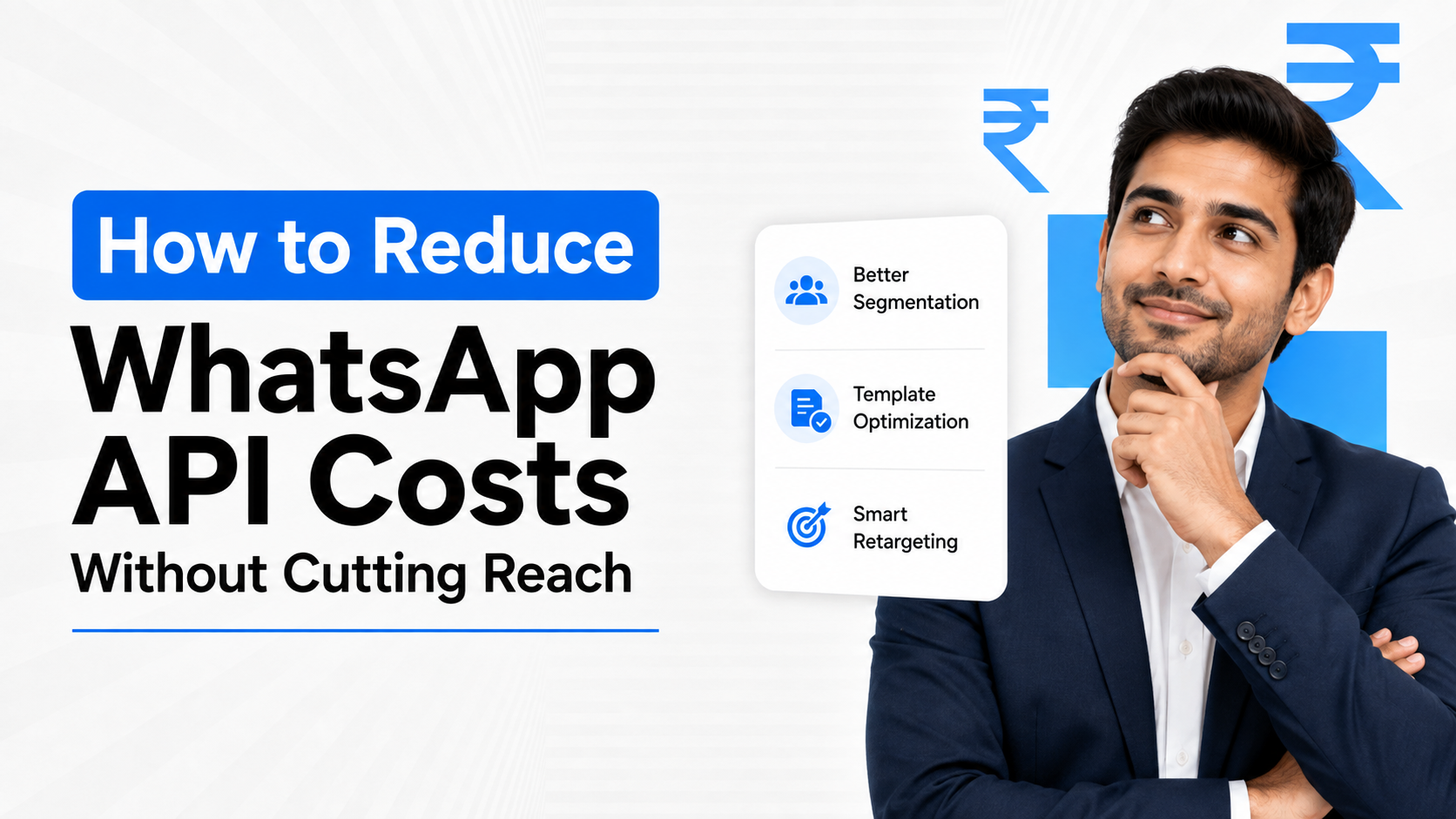
You can reduce WhatsApp API costs without shrinking your reachable audience by controlling what creates the bill, not by simply sending fewer messages. The biggest savings usually come from correct message categorisation, removing provider markup, using free entry-point windows where applicable, qualifying for Meta volume tiers, eliminating duplicate automation, improving template design and measuring cost per business outcome. For Indian businesses, the objective should be lower WhatsApp cost per customer reached, lead generated, transaction completed or support request resolved.
Where Does WhatsApp API Cost Actually Come From?
Before reducing WhatsApp Business API cost, separate the different parts of the bill. Meta currently charges businesses on a per-delivered-message basis, with pricing determined by the recipient market and message category. The four categories are marketing, utility, authentication and service. Meta also provides volume-tier pricing for eligible utility and authentication messaging.
Your total WhatsApp API pricing can include:
Meta message charges: The underlying cost of delivered WhatsApp messages.
Message category: Marketing message pricing, utility message pricing and authentication pricing can differ significantly.
WhatsApp API provider fees: Monthly or annual software subscription charged by the provider.
BSP markup: An additional provider percentage applied on top of Meta messaging charges.
Agent or user charges: Some platforms increase cost when more sales or support users are added.
Automation costs: Chatbots, workflows, drip campaigns or advanced automation may depend on the selected plan.
Integration costs: CRM, ecommerce, API or custom-development requirements can add operating cost.
The first cost-reduction step is therefore not cutting campaign reach. It is identifying which layer is unnecessarily increasing your bill.
1. Remove Provider Markup Before Reducing Message Volume
If your provider adds a percentage to Meta's messaging charges, that cost increases automatically as WhatsApp usage grows.
Suppose your monthly underlying messaging spend is ₹1,00,000. A hypothetical 10% markup adds ₹10,000 without increasing the number of customers reached, messages delivered or conversions generated.
This is one of the cleanest areas to optimise because removing markup does not require reducing reach.
Compare providers based on:
BSP markup: Check whether the provider adds a percentage to Meta charges.
Platform subscription: Separate software cost from messaging cost.
Agent pricing: Understand what happens when your team grows.
Add-ons: Check whether chatbots, APIs or integrations require separate payments.
Total annual cost: Small monthly differences become significant over 12 months.
Emovur's current WhatsApp Business API pricing lists its paid plans with 0% markup positioning on Meta messaging charges. Its pricing page should be checked when calculating current costs because rates and plan details can change.
2. Get the Message Category Right
Incorrect template categorisation can increase WhatsApp message charges and also make communication less relevant. Meta describes marketing messages as communication designed to create awareness, drive sales or retarget customers. Utility messages are typically triggered by a customer action and are non-promotional, while authentication messages are used for identity verification.
A business should not try to manipulate categories to reduce price. Instead, keep each message focused on its actual purpose.
For example:
Utility: “Your order has been dispatched and is expected tomorrow.”
Marketing: “Your order has been dispatched. Shop again today and get 20% off.”
Adding an offer changes the purpose of the communication.
For businesses sending high transaction volumes, maintaining clean utility workflows can improve both customer experience and cost control.
Use the detailed WhatsApp Utility Message Pricing in India guide for utility-specific calculations rather than duplicating all category rates here.
3. Use Free Entry Points Properly
Meta currently provides an important cost-saving opportunity when a customer starts a conversation through an Ad that Clicks to WhatsApp or a Facebook Page call-to-action button. According to Meta's pricing page, when a customer enters through one of these qualifying free entry points, messages sent during the following 72 hours are not charged. This can be useful for businesses already spending on lead generation because it reduces messaging cost without limiting lead reach.
A stronger journey could be:
Click-to-WhatsApp Ad → Customer Starts Chat → Qualification → Product/Service Information → Sales Handover → Follow-Up Within Relevant Window
To make the window useful:
Respond quickly: Do not waste the beginning of the customer journey.
Capture the requirement early: Ask only the information required to move the lead forward.
Route qualified leads: Move high-intent prospects to sales rather than extending unnecessary automation.
Avoid repetitive messages: Use the window for useful communication, not extra messages simply because they are free.
Connect the CRM: Preserve customer context after the initial conversation.
This reduces the cost per WhatsApp lead without reducing campaign visibility or audience size.
4. Use Meta Volume Tiers Where Your Message Mix Qualifies
Meta currently provides volume-tier pricing for utility and authentication messages. As message volumes increase, eligible businesses can unlock lower rates for messages falling within higher tiers.
This is particularly relevant for businesses sending large volumes of:
Order confirmations
Shipping updates
Appointment reminders
Payment notifications
Account alerts
Authentication OTPs
A business processing 1 lakh monthly transactions should not automatically assume its effective message rate will remain identical to a business sending only a few thousand.
For volume planning, track:
Monthly utility messages
Monthly authentication messages
Recipient market
Messages delivered, not only messages attempted
Effective average rate
Movement between volume tiers
This is one reason WhatsApp API cost calculation should use actual message mix instead of multiplying the complete message volume by one average rate.
5. Remove Duplicate Messages, Not Customers
One of the easiest ways to reduce WhatsApp automation cost without cutting reach is to remove messages that customers never needed in the first place. Automation can accidentally generate duplicate communication when several systems respond to the same event.
For example, an ecommerce workflow may send:
Order received
Order confirmed
Payment confirmed
Order accepted
Preparing your order
Five messages may be generated where two meaningful updates could provide the same customer value.
Audit workflows for:
Duplicate triggers: Two automations responding to the same CRM or ecommerce event.
Repeated reminders: Several follow-ups sent when one would be sufficient.
Overlapping campaigns: The same customer entering multiple audience segments.
Internal status noise: Customer notifications generated for operational changes they do not need to know.
Bot repetition: Automated replies repeating information already shown to the customer.
CRM duplication: Multiple customer records receiving the same campaign.
The objective is not to reduce WhatsApp reach. The same customers can remain reachable while each customer receives fewer unnecessary messages.
6. Improve Broadcast Segmentation Without Shrinking the Database
Segmentation is sometimes misunderstood as reducing reach. It should actually improve how much useful reach you get from the same customer database. Suppose a business has 1,00,000 opted-in contacts and four different offers. Sending all four campaigns to all 1,00,000 contacts creates 4,00,000 potential marketing messages.
If each offer is relevant to a different customer segment, the business can still communicate across the full 1,00,000-contact database during the month without sending every offer to every person.
Segment using information such as:
Product interest
Previous purchase
Customer lifecycle stage
Location
Lead status
Campaign engagement
Service requirement
Purchase frequency
This protects total audience coverage while lowering irrelevant WhatsApp broadcast costs. For campaign-specific pricing, see WhatsApp Marketing Message Pricing in India.
For businesses managing segmented campaigns, Emovur's WhatsApp Broadcast capability supports customer groups, scheduling, personalisation and retargeting.
7. Measure Delivered Messages, Not Messages Attempted
Meta states that businesses are charged when applicable messages are delivered, not simply sent.
That means campaign reporting should separate:
Messages attempted
Messages delivered
Messages failed
Messages read
Replies
Qualified leads
Conversions
This matters because a poorly maintained contact database may produce large numbers of failed attempts and inaccurate campaign planning.
Even where failed delivery itself does not create the same Meta message charge, poor contact quality wastes campaign preparation, automation capacity and reporting effort.
Improve database quality by:
Removing invalid phone numbers
Deduplicating contacts
Maintaining correct country codes
Respecting opt-outs
Merging duplicate CRM profiles
Preventing repeated imports of the same contact
Cleaner data improves WhatsApp campaign efficiency without reducing legitimate customer reach.
8. Reduce Cost Per Outcome, Not Just Cost Per Message
Businesses often focus too heavily on saving a few paise per message.
A cheaper message that produces no result is still wasted money.
A better measurement model is:
WhatsApp Spend ÷ Qualified Leads = Cost per Qualified Lead
For ecommerce:
WhatsApp Spend ÷ Orders Generated = Cost per Order
For healthcare or service businesses:
WhatsApp Spend ÷ Completed Appointments = Cost per Appointment
For support:
WhatsApp Operating Cost ÷ Cases Resolved = Cost per Resolution
Consider two campaigns:
Campaign B costs more in absolute terms but is significantly more efficient.
This is why reducing WhatsApp API cost should mean reducing the cost of the business outcome, not automatically reducing the invoice at any cost.
Use the WhatsApp API ROI Measurement Framework when you need to connect spend with revenue, conversions and operational savings.
9. Choose the Right Platform Plan for Your Actual Usage
Businesses can also overspend by choosing a WhatsApp API plan based on features they may need “someday”.
Compare your actual operating requirements.
Ask whether you currently need:
Unlimited agents
Advanced chatbot logic
Drip campaigns
Full developer APIs
CRM integration
Multiple inbox channels
Dedicated support
Enterprise throughput
Managed campaigns
The opposite problem also occurs. Choosing the cheapest plan can become more expensive if essential functionality requires several add-ons or substantial manual work.
Emovur's current pricing lists Free Forever, Starter at ₹999 per month and Advanced at ₹1,999 per month, with different messaging rates and feature access across the plans.
Do not choose a plan only because the subscription is lower. Calculate the total WhatsApp API cost at your real usage level.
10. Calculate Cost Before Scaling a Campaign
A campaign should have a cost model before it reaches 10,000 or 1,00,000 recipients.
Use:
Expected Delivered Messages × Applicable Message Rate + Platform Cost + Other Required Costs
Then calculate the expected business outcome.
For example:
Expected Campaign Cost ÷ Expected Qualified Leads = Planned Cost per Qualified Lead
This creates a threshold before money is spent. If the campaign is expected to cost ₹50,000 and generate 100 qualified leads, planned CPL is ₹500. If your business can profitably acquire similar leads only below ₹350, the campaign needs improvement before scale.
The WhatsApp API Cost Calculator for India provides a separate framework for estimating monthly message and platform costs.
A Practical WhatsApp Cost Optimisation Checklist
Reduce Waste While Keeping Customer Reach
The most effective way to reduce WhatsApp API cost in India is not to make your customer database smaller or stop communicating with valuable audiences.
Focus on the cost that does not improve reach:
Provider markup
Incorrect message structures
Duplicate automation
Poor database hygiene
Irrelevant repeated broadcasts
Unused software features
Weak campaign measurement
Then improve the value produced by every delivered message.
A useful framework is:
Keep Reach → Remove Waste → Improve Relevance → Measure Outcomes → Scale Efficiently
For current plan and messaging information, review WhatsApp Business API pricing. Meta pricing and provider plans can change, so calculations should always use the live rates available when the campaign is planned.
View Pricing / Calculate Cost before scaling your next WhatsApp campaign, then optimise for cost per customer outcome rather than simply cost per message.
TABLE OF CONTENTS