

Quick answer:
Use a WhatsApp broadcast when you need to send one message to many contacts at the same moment, such as a flash sale, an event reminder, or a policy update.
Use a WhatsApp drip campaign when your goal is to guide a contact through several messages over time, based on their behavior, onboarding, cart recovery, or lead nurturing.
In simple terms, broadcasts are best for reaching people now, while drip campaigns are better for guiding people through a journey. The right choice depends on your campaign goal, audience, and how much follow-up is required.
What Is a WhatsApp Broadcast?
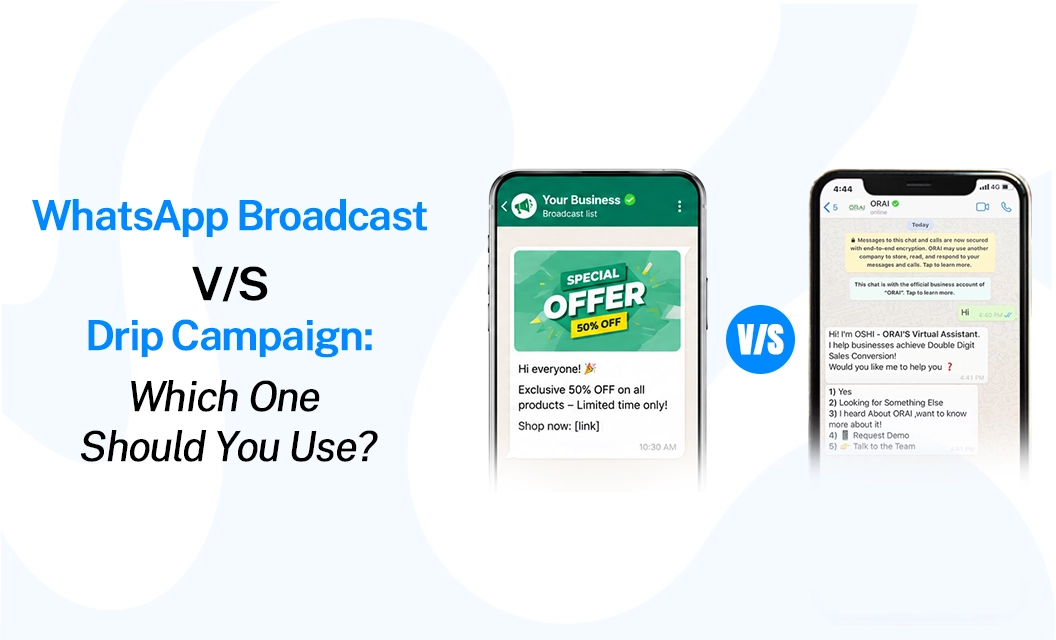
A WhatsApp broadcast sends a single approved template message to a list of opted-in contacts at one time. There's no sequencing logic—every recipient gets the same message on the same schedule, and replies land in your inbox individually rather than triggering an automated next step.
Broadcasts work well for:
Time-bound announcements (sales, webinars, service outages)
Reminders that apply to everyone equally (appointment day-before nudges, renewal notices)
Re-engagement blasts to a dormant segment
If your use case is "get this message to this list right now," WhatsApp broadcast and bulk messaging is the feature built for exactly that—list upload, template approval, and delivery tracking in one flow.
What Is a WhatsApp Drip Campaign?
A WhatsApp drip campaign is a pre-built sequence of messages sent automatically over a defined period, usually triggered by an action — someone joins a list, abandons a cart, or completes step one of onboarding. Each message in the sequence can branch based on whether the contact opened, clicked, or replied.
Drip campaigns work well for:
Multi-step onboarding (welcome → setup tips → check-in)
Lead nurturing across a longer sales cycle
Post-purchase sequences (order confirmation → usage tips → review request)
If the goal is a relationship that unfolds over days or weeks rather than a single blast, a WhatsApp drip campaign handles the scheduling and branching logic so you're not manually sending follow-ups.
WhatsApp Broadcast vs Drip Campaign: What's the Difference?
Both approaches help businesses communicate with multiple customers, but they solve different problems.
When to Use a Broadcast vs a Drip Campaign
1. When should you use a WhatsApp broadcast
A broadcast is a good fit when you have a time-sensitive offer, are announcing a new product, need to send an event reminder, are sharing an important business update, want to inform customers about a promotion, or need to communicate the same information to a defined audience. For businesses running larger campaigns, you can explore Emovur's WhatsApp broadcast workflow to understand how broadcast messaging can be used for structured customer communication.
Example: Suppose you are launching a new product on Friday; you don’t necessarily need five WhatsApp messages; a simple broadcast is enough.
2. When should you use a WhatsApp drip campaign?
A drip sequence is useful when the customer needs more than one interaction before taking action. Common examples include lead nurturing, new customer onboarding, course or training communication, product education, demo follow-ups, trial-user engagement, appointment follow-up, re-engagement, and sales journeys. You can explore Emovur's WhatsApp drip campaign if you want to see how a sequence can be structured around customer actions and timing.
WhatsApp Broadcast vs Drip Campaign: Use Cases Compared
What About WhatsApp Messaging Costs?
Before scaling either type of campaign, consider the cost of the messages involved.
A broadcast may involve one campaign message per recipient, while a drip campaign can involve several messages per customer. That means a drip sequence can create more messaging volume even when the audience size is the same.
For example:
1,000 customers × 1 message = 1,000 message deliveries
Whereas:
1,000 customers × 5-message sequence = up to 5,000 message deliveries
Actual WhatsApp Business Platform costs depend on the applicable pricing structure, message type, recipient market and current Meta rules. Don't use old articles that calculate costs using outdated conversation-based assumptions.
Before planning a campaign, check the latest WhatsApp API pricing and estimate the cost based on the actual sequence you intend to send.
Conclusion:
The choice between a WhatsApp broadcast vs a drip campaign comes down to the customer journey you are trying to create. If you need to announce an offer, share an update, or reach customers with one clear message, a broadcast is usually the simpler choice.
If customers need education, reminders, follow-ups, or several steps before they take action, a drip campaign makes more sense. You don't have to choose only one, either.
Frequently Asked Questions
Is a WhatsApp broadcast the same as a drip campaign?
No. A broadcast generally sends a message to a selected audience around a specific campaign or event. A drip campaign sends a planned sequence of messages over time, usually based on timing, customer actions or workflow conditions.
Which is better for WhatsApp marketing: broadcast or drip?
Neither is universally better. Use a broadcast when one message can achieve the goal, such as a sale announcement or event reminder. Use a drip sequence when customers need multiple touchpoints, such as onboarding, lead nurturing or product education.
Can a WhatsApp broadcast be automated?
Yes, depending on the business messaging setup. A campaign can be scheduled or triggered through business systems. However, automation of one broadcast does not make it a drip campaign. A drip campaign involves a sequence of messages and rules controlling what happens next.
How many messages should a WhatsApp drip campaign have?
There is no universal number. Start with the minimum sequence needed to achieve the objective. For a simple onboarding journey, three to five useful messages may be enough. Longer sequences should have a clear reason for every additional message and should stop when the customer completes the intended action.
Are WhatsApp drip campaigns more expensive than broadcasts?
They can be, because a drip campaign typically sends multiple messages per customer. For example, a five-step sequence can generate considerably more message volume than a one-time broadcast. The actual cost depends on the current WhatsApp Business Platform pricing rules and the messages being sent.
If you're ready to compare both approaches for your business, explore WhatsApp automation workflows to choose the workflow that matches your customer journey.
TABLE OF CONTENTS