

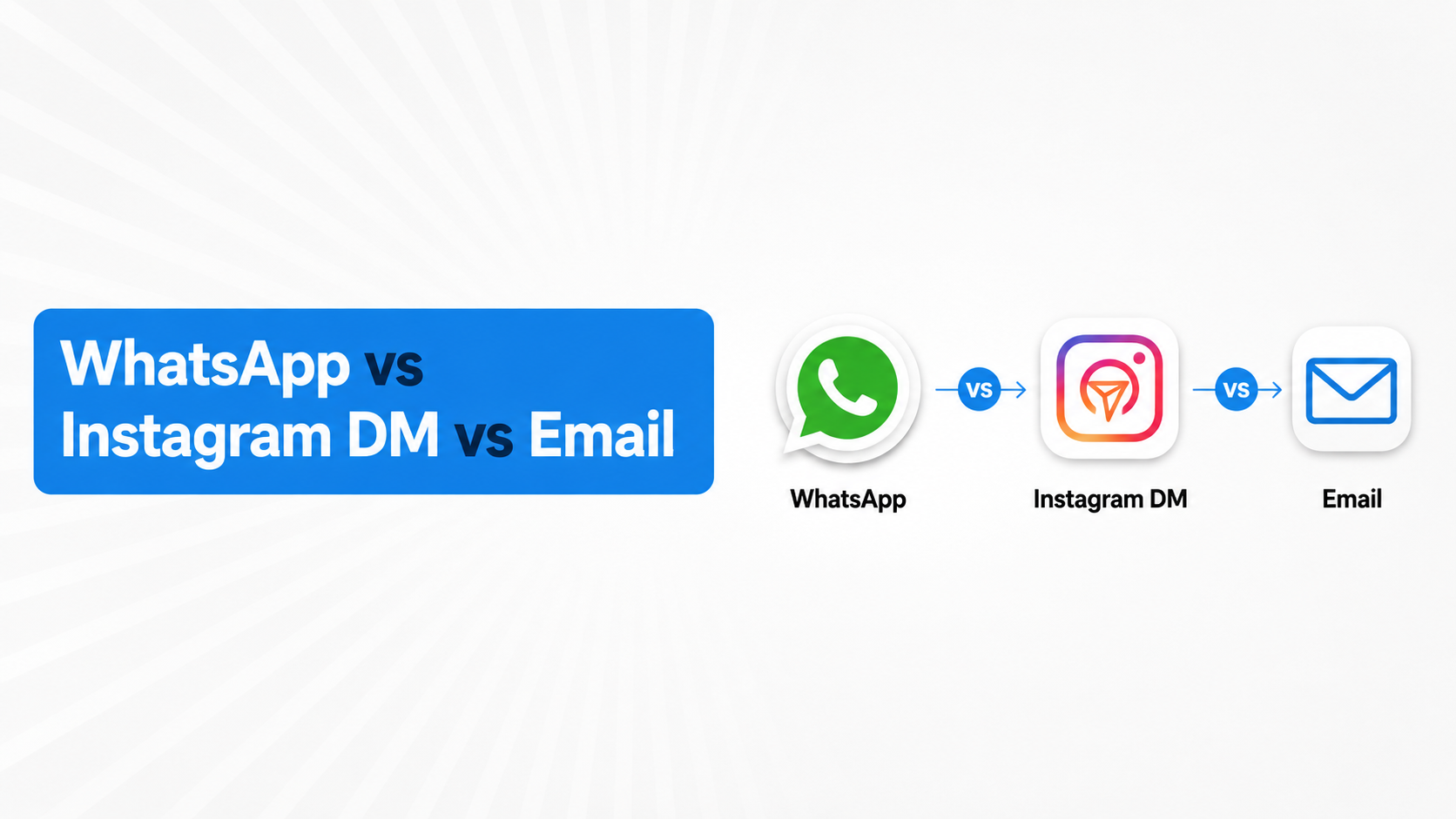
WhatsApp, Instagram DMs and email serve different customer intentions. WhatsApp is strongest when a customer wants a quick answer, qualification, booking, purchase assistance or ongoing service conversation. Instagram DMs work well when the interaction begins from content, creators, Reels, Stories or product discovery. Email remains valuable when communication needs more detail, documentation, longer explanations or less immediate follow-up. For Indian businesses in 2026, the better strategy is not choosing one channel. It is matching each channel to the response a customer is most likely to give there.
WhatsApp vs Instagram DM vs Email: The Main Difference
Businesses often compare these channels using open rates, response rates or cost. Those metrics matter, but they do not explain why a customer responds differently across channels.
The more useful question is: What is the customer trying to do when they open that channel?
There is no universal winner. Each channel becomes stronger when customer intent matches the way people naturally use it.
Use WhatsApp When the Customer Wants to Act
WhatsApp works particularly well when the customer has moved beyond passive discovery and wants something from the business.
Meta reported in 2026 that more than one billion active threads with businesses take place across WhatsApp, Messenger and Instagram every day. In India specifically, Meta cites a 2025 Kantar study stating that 91% of online adults chat with businesses weekly.
WhatsApp is a strong fit when customers want to:
Ask about price or availability: The customer already has a specific commercial question.
Check product details: Useful when purchase depends on clarification.
Book an appointment: The conversation can move directly towards scheduling.
Request a demo: B2B prospects can be qualified before sales assignment.
Track an order or booking: The conversation already has customer context.
Continue a previous enquiry: WhatsApp supports an ongoing conversational relationship.
Speak with sales or support: The interaction can move from automation to a human when necessary.
Meta's current Business AI rollout in India also focuses on answering customer questions, recommending products, capturing leads, booking appointments and helping businesses handle customer conversations inside WhatsApp.
This makes WhatsApp especially relevant to high-intent conversational marketing.
Use Instagram DMs When Intent Begins With Discovery
Instagram DMs often begin differently.
A customer may not have visited the platform intending to contact a business. They may have been watching a Reel, viewing a Story, following a creator, exploring a product or browsing a brand profile before deciding to send a message.
That makes Instagram Direct valuable closer to social discovery and interest formation.
Instagram DMs are particularly useful for:
Replies to Stories: Customers can react to content while interest is fresh.
Product questions from posts or Reels: The conversation starts from a visual discovery point.
Creator-led enquiries: Customers may DM after seeing influencer or creator content.
Fashion, beauty and lifestyle discovery: Visual context can trigger the conversation.
Community interaction: Followers may ask lightweight questions before becoming serious leads.
Social proof conversations: Prospects may enquire after seeing testimonials, comments or user-generated content.
Meta's February 2026 India retail research highlights the significant role social media, creators and short-form video now play in product discovery and purchase decisions.
The important distinction is that Instagram DM often captures emerging intent, while WhatsApp is well positioned to process stronger intent once the customer wants to move forward.
Use Email When the Customer Needs Depth
Email remains valuable because not every business conversation should happen through instant messaging.
Some communication is simply easier to understand, forward, search or review later when delivered through email.
Email remains useful for:
Detailed proposals: Especially B2B quotations and commercial documents.
Long explanations: Where the customer needs time to review information.
Contracts and documentation: Better suited to structured written records.
Reports: Analytics, statements and detailed updates.
Longer nurture sequences: Useful where purchase decisions take weeks or months.
Formal confirmations: Particularly when information may need to be referenced later.
Multiple stakeholders: Emails can be forwarded or include several recipients.
Content marketing: Newsletters, reports, research and educational material.
Google continues supporting business email use cases ranging from one-to-one email to branded bulk communications, while its sender requirements also demonstrate that large-scale email marketing has its own deliverability and unsubscribe requirements.
Email should therefore not be replaced just because WhatsApp produces faster conversations.
Compare the Channels by Response Intent
The easiest way to select a channel is to start with the response you need from the customer.
If You Need a Fast Reply
Prioritise WhatsApp or Instagram DM.
These environments are conversational and suitable for short exchanges.
Use them for:
Product questions
Availability
Lead qualification
Simple support
Appointment interest
Location questions
Price enquiries
If the conversation becomes detailed or requires documentation, move it to email where appropriate.
If You Need a Structured Customer Action
Prioritise WhatsApp.
This is useful when the response needs to move directly into a workflow.
Examples include:
Book appointment
Choose service
Select product
Confirm attendance
Submit preference
Request callback
Complete qualification
Check order status
The WhatsApp Business Platform is increasingly designed around these customer-service and conversion interactions, including automation and support for higher message volumes.
If You Need a Detailed Review
Prioritise email.
Examples include:
Proposal
Scope of work
Contract
Product specification
Detailed quotation
Performance report
Business case
Long educational resource
Trying to compress a 10-page proposal into WhatsApp messages does not make the buying process faster. It usually makes information harder to review.
WhatsApp vs Instagram DM for Lead Generation
Both channels can create leads, but the starting intent is often different.
An Instagram DM lead may originate from social content and still be exploring. A WhatsApp lead may arrive after clicking a WhatsApp CTA, scanning a QR code, visiting a website or already knowing what they want.
A practical distinction is:
Instagram DM = “I saw something interesting.”
WhatsApp = “I want to ask or do something.”
This is not an absolute rule, but it is useful when designing lead-routing logic.
Instagram DM may be better when:
The lead originates from Reels or Stories.
Visual discovery drives interest.
The customer is still exploring.
Community interaction matters.
Social content is your primary acquisition engine.
WhatsApp may be better when:
The customer asks about pricing.
Qualification is required.
A salesperson needs to follow up.
Appointments or demos need booking.
The business needs CRM-connected workflows.
The lead is already commercially interested.
Do not force every Instagram enquiry immediately onto WhatsApp. Move the conversation only when the next stage benefits from it.
WhatsApp vs Email for Sales Follow-Up
Sales teams often ask whether they should follow up through WhatsApp or email. In practice, the best choice depends on what the salesperson needs the prospect to do.
Use WhatsApp for shorter sales actions:
Confirm a meeting
Ask a qualification question
Check availability
Share a quick update
Request a callback
Continue an active conversation
Use email for deeper sales communication:
Send a proposal
Explain pricing structure
Share a detailed scope
Include several documents
Communicate with multiple decision-makers
Provide information requiring careful review
For high-value B2B sales, using both can be more effective than attempting to force every communication into one channel.
For example: WhatsApp confirms the demo → Email delivers the proposal → WhatsApp checks whether clarification is needed.
That is a channel handoff based on customer intent.
Which Channel Should Handle Customer Support?
Support intent also varies.
A customer asking “Where is my order?” probably does not want to create a long email thread. A business buyer disputing a detailed invoice may need a more structured written exchange.
WhatsApp fits support when:
The question is simple.
Fast response matters.
Order or appointment context can be retrieved.
Automation can resolve common questions.
Human takeover may be required.
Instagram DM fits support when:
The customer originally contacted the brand through Instagram.
The enquiry is simple.
The problem can be resolved quickly.
Moving channels would create unnecessary friction.
Email fits support when:
Multiple documents are involved.
The problem requires detailed investigation.
A formal written response is useful.
Several stakeholders need visibility.
The customer should not be moved between channels simply because the business has organised its departments that way.
The Best Channel Changes as Intent Gets Stronger
Customer journeys are not static.
Someone can discover a business on Instagram, ask a question through DM, continue qualification on WhatsApp and receive a detailed proposal through email.
A typical high-consideration journey could look like:
Instagram Content → Instagram DM → WhatsApp Qualification → Sales Call → Email Proposal → WhatsApp Follow-Up
For ecommerce:
Instagram Reel → Product DM → WhatsApp Product Help → Purchase → WhatsApp Order Update → Email Receipt
For education:
Instagram Content → DM Enquiry → WhatsApp Qualification → Counsellor Conversation → Email Course Documentation
For B2B:
LinkedIn/Website/Instagram Discovery → WhatsApp or Form Enquiry → Qualification → Email Proposal → WhatsApp Follow-Up
This is omnichannel customer engagement based on the next customer action, not simply publishing the same message everywhere.
Do Not Send the Same Marketing Message Across All Three Channels
Cross-channel marketing does not mean copying one campaign into WhatsApp, Instagram DMs and email.
Each environment needs a different communication style.
WhatsApp marketing should usually be:
Short
Relevant
Action-oriented
Segmented
Easy to respond to
Instagram communication should usually be:
Connected to social context
Conversational
Visual where relevant
Appropriate to the content that generated the enquiry
Email marketing can support:
Longer copy
Multiple sections
Detailed product information
Educational content
Newsletters
Stronger information hierarchy
The campaign idea can remain consistent while the message format and expected response change by channel.
Do Not Compare Open Rates Without Context
Generic claims such as “WhatsApp has a higher open rate than email” are not enough to select a customer communication channel.
A message can be opened and still produce no business result.
Instead, measure the action appropriate to each channel.
WhatsApp Metrics
Conversation started
Reply rate
Qualification completion
Appointment booked
CTA click
Conversion
Opt-out rate
Instagram DM Metrics
DMs generated from content
Reply rate
Qualified enquiries
Conversation-to-lead rate
DM-to-WhatsApp or website progression
Sales generated from social conversations
Email Metrics
Delivery
Click-through
Reply
Download
Lead progression
Conversion
Unsubscribe
Revenue attributed to email
Compare business outcomes, not vanity metrics across incompatible channels.
Match Channel Choice to Customer Urgency
Urgency is another useful signal.
The more immediate and conversational the customer requirement, the stronger messaging becomes. The more detailed and review-oriented the communication, the more useful email becomes.
Build Channel Handoffs Instead of Channel Silos
A common mistake is allowing the Instagram team, WhatsApp team and email team to operate independently.
The customer experiences one business, not three marketing departments.
Create rules for when conversations should move.
Instagram DM → WhatsApp when:
Qualification becomes necessary.
A salesperson needs to take over.
The customer wants ongoing support.
Booking or structured workflow is required.
WhatsApp → Email when:
A proposal needs to be reviewed.
Detailed documents are required.
Multiple decision-makers become involved.
Long technical information needs to be shared.
Email → WhatsApp when:
A quick decision is pending.
A meeting needs confirmation.
The customer asks for faster assistance.
An existing sales conversation needs a short follow-up.
Channel switching should reduce customer effort, not create it.
Where WhatsApp Business Marketing Fits
WhatsApp becomes particularly valuable after the business already understands the customer's relationship, preference or intent.
This is where segmented WhatsApp Business marketing can support:
Product launches
Relevant offers
Customer re-engagement
Event communication
Renewal reminders
Customer lifecycle campaigns
Purchase-related follow-up
WhatsApp is also increasingly being integrated with Meta's wider marketing ecosystem. Meta said in 2025 that Indian businesses could manage marketing across WhatsApp, Facebook and Instagram through Ads Manager, while using the WhatsApp Business Platform where greater message volume or automation is required.
For campaign execution, the supporting owner page is WhatsApp Broadcast and Bulk Messaging. This article intentionally does not repeat its broader broadcast features or campaign setup.
A Simple Response-Intent Framework
Before deciding between WhatsApp vs Instagram DM vs email, ask four questions.
Where did the intent start? Social content may favour Instagram, while an existing customer enquiry may favour WhatsApp.
How quickly does the customer need a response? Higher urgency generally favours messaging.
How much information must be exchanged? More complex information may favour email.
What is the next action? Qualification, booking and quick decisions often fit WhatsApp; detailed review often fits email.
A useful model is:
Discover → Instagram
Discuss and Act → WhatsApp
Review and Document → Email
The boundaries are not absolute, but the framework is far more useful than asking which channel has the highest open rate.
Use Each Channel for the Response It Is Best Positioned to Earn
The strongest WhatsApp vs Instagram DM vs email strategy in India in 2026 is not about eliminating two channels and selecting one winner.
Instagram can turn content and discovery into conversations. WhatsApp can turn customer intent into qualification, booking, support and sales actions. Email can carry the detailed information customers need to evaluate, document and revisit.
For many businesses, the better journey is therefore Instagram for discovery → WhatsApp for conversation → Email for depth → WhatsApp for timely follow-up.
When customer data, campaign eligibility and segmentation are already in place, use the supporting WhatsApp Broadcast and Bulk Messaging page to activate relevant WhatsApp audiences rather than duplicating the same campaign indiscriminately across every communication channel.
Start a Compliant Campaign by choosing WhatsApp when the customer response you need is conversational, relevant and action-oriented.
TABLE OF CONTENTS