

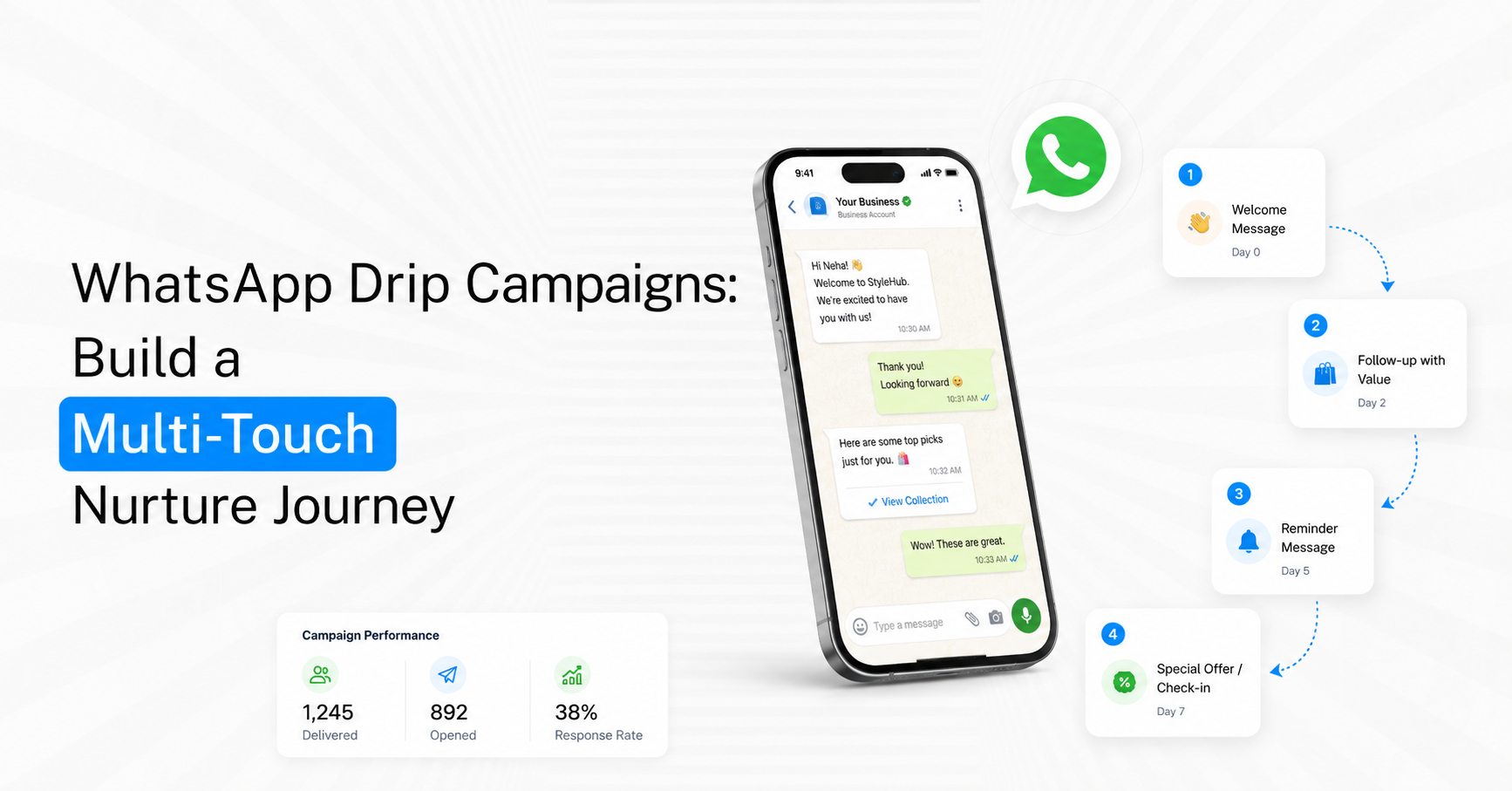
WhatsApp drip campaigns are automated multi-touch journeys that follow up with leads or customers based on time, behaviour and journey stage instead of relying on one broadcast or manual reminders. For Indian businesses in 2026, an effective WhatsApp drip campaign should have a clear entry trigger, a specific objective for every message, sensible delays, behaviour-based branches and immediate exit conditions when the customer converts, replies or becomes irrelevant to the sequence. The goal is not to send more messages. It is to send the next useful message at the right stage.
What Is a WhatsApp Drip Campaign?
A WhatsApp drip campaign is a predefined sequence of messages that progresses over time or changes according to customer behaviour. Unlike a one-time WhatsApp marketing campaign, a drip sequence manages several connected touchpoints across a lead or customer journey.
A typical nurture sequence can respond to events such as an enquiry, registration, purchase, missed appointment, incomplete application or another business-defined trigger. Emovur's current drip-campaign functionality supports multi-step sequences with delays, actions, conditions, behavioural branching and exit rules when customers take the desired action.
A drip journey usually contains five building blocks:
Entry trigger: The customer action that starts the sequence.
Message stages: The information or action delivered at each touchpoint.
Delay: How long the system waits before evaluating the next step.
Branching condition: What changes when a customer replies, clicks or completes an action.
Exit condition: The event that immediately removes the customer from the nurture sequence.
If any of these are missing, the campaign can quickly become a scheduled message series rather than genuine WhatsApp lead nurturing automation.
Step 1: Define One Conversion Goal for the Journey
Do not begin by deciding how many WhatsApp messages to send. Begin with the customer action the nurture journey should produce.
A drip campaign designed to book a demo requires a different sequence from one designed to recover an abandoned cart or complete customer onboarding.
Common WhatsApp drip campaign goals include:
Lead qualification: Move new enquiries towards a qualified sales conversation.
Demo booking: Turn interested B2B prospects into scheduled demos.
Appointment booking: Move service enquiries towards confirmed appointments.
Site visits: Nurture qualified property prospects towards a project visit.
Application completion: Remind customers to complete an unfinished process.
Customer onboarding: Guide new customers through the first important product actions.
Renewal: Engage customers approaching a renewal or expiry point.
Re-engagement: Reconnect with suitable inactive customers.
Write the goal before building the first message. Every touchpoint should either help the customer progress towards that goal or help the business determine that the sequence should stop.
Step 2: Choose the Right Entry Trigger
A good WhatsApp automation sequence starts because something meaningful happened. Avoid adding every database contact to the same generic drip campaign.
The trigger should indicate enough intent to justify the journey.
Useful drip-campaign triggers include:
Form submitted: Customer requested information through a website or landing page.
WhatsApp enquiry received: Prospect initiated a relevant conversation.
Demo requested: B2B prospect showed stronger buying intent.
Product viewed or cart created: Ecommerce customer reached a meaningful shopping stage.
Event registration: Customer joined a webinar, event or programme.
Appointment enquiry: Prospect requested a service or consultation.
Purchase completed: Customer becomes eligible for an onboarding sequence.
Lead stage changed: CRM status moves the customer into a new nurture journey.
The stronger the trigger, the easier it becomes to make subsequent messages relevant.
Step 3: Design the Journey Around Customer Stages
The biggest mistake in WhatsApp drip marketing is treating every follow-up as another reminder.
A multi-touch nurture journey should change purpose as the customer progresses.
For example, a B2B lead journey might contain:
Touch 1, Immediate: Confirm the enquiry and identify the requirement.
Touch 2, After qualification: Share the most relevant solution or use case.
Touch 3, Later: Address a common decision barrier.
Touch 4, High-intent stage: Invite the lead to book a demo.
Touch 5, Final follow-up: Give the prospect a simple option to continue or pause.
The customer should not receive five versions of "Are you still interested?"
Each touchpoint needs a different job.
Step 4: Give Every Message One Purpose
A drip message becomes difficult to act on when it contains several objectives.
Keep each touchpoint focused.
Useful message purposes include:
Acknowledge: Confirm that the customer's request was received.
Qualify: Collect one or two details required for the next stage.
Educate: Answer a question that commonly blocks progression.
Reassure: Provide useful proof, clarification or process information.
Prompt: Ask the customer to complete the next relevant action.
Remind: Bring attention back to an incomplete action.
Convert: Present the booking, purchase or sales handoff at the appropriate point.
For example, a real-estate nurture sequence should not put project overview, floor plans, financing information, location details and site-visit booking into the first WhatsApp message. Use the sequence to reveal information according to customer intent.
Step 5: Use Delays Based on Buying Context
There is no universal rule that says a WhatsApp drip campaign should send messages after 1 day, 3 days and 7 days.
Timing depends on customer urgency and buying cycle.
Consider shorter delays when:
The enquiry is high intent.
Customers expect quick assistance.
Availability changes rapidly.
Appointment slots matter.
A salesperson needs to intervene quickly.
Consider longer delays when:
The purchase decision is expensive.
Several stakeholders are involved.
The customer needs research time.
The product has a longer sales cycle.
The next message is educational rather than urgent.
A ₹500 ecommerce purchase and a ₹2 crore property purchase should not use the same WhatsApp nurture cadence.
Step 6: Branch the Sequence Based on Customer Behaviour
A true multi-touch journey should not force every customer through the same path.
Behaviour-based branching allows the sequence to respond differently when the customer shows stronger intent, weaker intent or completes an action. Emovur's current drip functionality supports conditional paths based on customer behaviour and can end a sequence after a defined customer action.
Useful branching signals include:
Customer replied: Pause automation and route the conversation where necessary.
CTA clicked: Move the customer towards the next relevant stage.
Form completed: Skip reminders for information already provided.
Appointment booked: End the booking sequence.
Purchase completed: Move into onboarding instead of continuing sales messages.
Lead qualified: Assign the prospect to sales.
Lead disqualified: Stop promotional follow-ups that no longer make sense.
No engagement: Reduce frequency or end the journey rather than continuing indefinitely.
Branching makes WhatsApp customer journey automation responsive instead of merely scheduled.
Step 7: Define Exit Conditions Before Launch
Every drip campaign needs a clear stopping point.
Without exit conditions, customers can continue receiving nurture messages after purchasing, booking, replying or speaking with a salesperson.
Common exit conditions include:
Purchase completed
Appointment booked
Demo scheduled
Application submitted
Salesperson takes ownership
Customer replies with a defined intent
Lead marked won or lost
Customer opts out
Maximum nurture duration reached
One of the most important automation rules is simple: conversion should stop conversion-focused reminders.
A customer who booked a demo this morning should not receive a message tomorrow saying, “Still interested in booking a demo?”
Step 8: Add Human Handoffs at High-Intent Moments
Automation should not become a barrier between a ready buyer and the sales team.
Some customer behaviours should immediately trigger human involvement.
Good handoff signals can include:
Asking for pricing
Requesting a quotation
Requesting a demo
Choosing a high-value product
Confirming purchase timeline
Asking a complex question
Requesting a callback
Selecting an appointment or site visit
For sales-led businesses, a useful journey is often Automation → Qualification → Intent Signal → Human Handoff, not automation from the first message to the final sale.
Step 9: Use CRM Stages to Control the Journey
A WhatsApp drip campaign becomes more useful when the automation understands the customer's current CRM stage.
Instead of building one long sequence, create journeys around lifecycle transitions.
For example:
New Lead: Initial response and qualification.
Qualified Lead: Relevant information and sales scheduling.
Demo Completed: Decision support and follow-up.
Proposal Sent: Clarification and decision-stage reminders.
Customer: Onboarding rather than acquisition messages.
Dormant Opportunity: Controlled re-engagement where appropriate.
This prevents a customer from receiving top-of-funnel messages after reaching a deeper sales stage.
Emovur currently describes CRM and ecommerce integrations as ways to trigger follow-ups using available customer and order data within its WhatsApp drip-campaign workflows.
Step 10: Keep Personalisation Useful
Adding the customer's first name to every message does not create a personalised nurture journey.
Strong WhatsApp drip campaign personalisation changes the message according to information that affects customer relevance.
Use fields such as:
Product interest: Show information connected to what the customer requested.
Location: Route customers to the correct branch, property or service area.
Customer stage: Change the CTA according to journey progress.
Purchase history: Avoid introducing products the customer already owns.
Budget or requirement: Prioritise relevant options.
Previous action: Continue from what the customer has already completed.
Personalisation should reduce irrelevant communication, not simply insert {{name}} into generic copy.
Step 11: Do Not Build Drip Campaigns Around Repeated Promotions
A nurture sequence is not five promotional broadcasts scheduled several days apart.
A useful sequence can combine different message roles.
A balanced multi-touch journey might include:
Touch 1: Confirmation and next step.
Touch 2: Helpful information.
Touch 3: Qualification or preference capture.
Touch 4: Relevant proof or objection handling.
Touch 5: Conversion opportunity.
Touch 6: Final controlled follow-up if necessary.
The exact number depends on the customer journey. Some flows may need only two or three touches.
Stop adding steps when an additional message does not create meaningful value.
Step 12: Build Different Journeys for Different Intent Levels
Not all leads deserve the same nurture sequence.
Segment entry into the drip campaign based on initial intent.
High-Intent Leads
Customers requesting pricing, demos, appointments or direct sales assistance may need:
Immediate response
Fast qualification
Human handoff
Shorter automation
Medium-Intent Leads
Customers requesting information may benefit from:
Helpful explanation
Qualification
Relevant use case
Conversion CTA
Low-Intent Leads
Customers entering through educational content or broad campaigns may need:
Longer spacing
More educational content
Fewer direct sales prompts
Clear exit if engagement remains low
This prevents aggressive follow-up from being applied to every lead equally.
Step 13: Respect Messaging Eligibility Throughout the Journey
Automation does not remove WhatsApp's messaging requirements.
WhatsApp states that businesses should obtain opt-in in advance, clearly identify the business customers are agreeing to receive messages from and comply with applicable local requirements. Its current policy also recommends setting expectations around the categories of messages customers may receive and providing clear opt-out mechanisms.
For drip-campaign operations:
Check eligibility before entry: Do not treat every CRM contact as nurture-ready.
Match the journey to expected communication: The sequence should reflect why the person engaged.
Stop on opt-out: Suppression should override every future drip step.
Control message category: Use the appropriate approved template where required.
Avoid surprise transitions: A service interaction should not silently become an unrelated promotional sequence.
The drip logic should sit on top of a clean customer-messaging foundation.
Example: B2B WhatsApp Lead Nurture Journey
Consider a software company where a prospect submits a demo enquiry.
Stage 1: Immediate Response
Confirm the enquiry and capture company size or primary requirement.
Stage 2: Qualification
Use the response to identify the relevant solution or salesperson.
Stage 3: Relevant Information
Send one useful use case or capability connected to the customer's stated problem.
Stage 4: Demo Conversion
Invite qualified prospects to select a demo slot.
Stage 5: Handoff
Once the demo is booked, exit the nurture sequence and assign the prospect to sales.
Possible branches:
Replies immediately: Route to salesperson.
Completes qualification: Move to solution-specific path.
Books demo: Exit campaign.
Does not respond: Send controlled follow-up.
Opt-outs: Suppress immediately.
The journey is short because the desired outcome is clear.
Example: Real-Estate WhatsApp Nurture Journey
Property decisions usually require more consideration, so the sequence can reflect a longer journey.
Touch 1: Confirm project enquiry and collect location/configuration preference.
Touch 2: Share the most relevant project information based on preference.
Touch 3: Capture budget or buying timeline if still unknown.
Touch 4: Address a common decision factor such as connectivity, possession or configuration.
Touch 5: Offer site-visit scheduling to qualified prospects.
Useful exits include site visit booked, salesperson takes over, prospect selects an incompatible requirement or customer requests no further communication.
The sequence should help sales identify intent, not attempt to replace the entire property consultation.
Example: Ecommerce WhatsApp Nurture Journey
Ecommerce journeys can usually move faster.
For an abandoned purchase:
First touch: Remind the customer about the incomplete purchase.
Second touch: Provide relevant information if product uncertainty is common.
Third touch: Final reminder where appropriate.
Purchase detected: Exit immediately.
Do not continue cart reminders after the order is completed.
Likewise, post-purchase communication should become a separate customer journey rather than another step inside the cart-recovery sequence.
Measure Progression, Not Only Message Performance
A drip campaign contains multiple stages, so reporting only total delivery or read rate hides where customers stop progressing.
Track metrics across the journey.
Useful WhatsApp drip campaign metrics include:
Journey entry volume: Customers entering the sequence.
Step progression: Percentage moving from one stage to another.
Response rate by touch: Which message generates conversation.
Branch distribution: Which paths customers take.
Qualification rate: Customers reaching the defined intent threshold.
Conversion rate: Customers completing the final objective.
Time to conversion: How long the journey takes.
Human handoff rate: Percentage requiring sales or support.
Exit reason: Converted, opted out, disqualified, inactive or manually stopped.
Drop-off stage: Where customers most commonly stop progressing.
These metrics show whether the multi-touch nurture journey is moving customers forward rather than merely delivering messages.
Optimise the Weakest Step First
When a drip campaign performs poorly, do not redesign the entire sequence immediately.
Find the stage causing the loss.
Strong entry, weak qualification: Reduce questions or improve relevance.
Good qualification, weak CTA response: Rework the conversion step.
High response, slow sales handoff: Fix routing rather than copy.
High early engagement, later drop-off: Reduce sequence length or improve message value.
Conversions happen before later steps: Shorten the journey.
Many customers exit after one message: Review audience eligibility and expectations.
Each improvement should solve an observed funnel problem.
A Practical WhatsApp Drip Campaign Blueprint
Before activating a new sequence, document these elements:
Journey objective: What final action defines success?
Entry trigger: What customer event starts the drip?
Audience: Which customers qualify?
Touchpoint purpose: Why does every message exist?
Delay: When should the next evaluation happen?
Branch: Which customer actions change the journey?
Human handoff: When should automation stop and sales take over?
Exit condition: What removes the customer permanently from the sequence?
CRM update: Which customer fields change during progression?
Success metric: How will conversion and drop-off be measured?
If the team cannot explain one of these before launch, the automation logic probably needs more work.
Build a Nurture Journey, Not a Message Schedule
The strongest WhatsApp drip campaigns in India in 2026 behave differently as customer intent changes. They start from a meaningful trigger, give every message a specific purpose, use delays appropriate to the buying cycle, branch according to customer actions and stop immediately when the sequence is no longer relevant.
Think in terms of Trigger → Understand → Nurture → Detect Intent → Handoff or Convert → Exit.
That model is more effective than scheduling five generic follow-up messages and calling it automation.
Emovur's WhatsApp Drip Campaign product currently supports visual multi-step journey building, delays, conditional branching, trigger-based automation, campaign controls and performance tracking for nurture, onboarding and re-engagement workflows.
For businesses ready to implement the journey described here, review the Emovur WhatsApp Drip Campaign feature page for the platform capabilities, then build the sequence around your actual sales or customer lifecycle rather than around a fixed number of messages. WhatsApp Drip Campaign
Book an Automation Demo when you have a clear trigger, customer journey and conversion event that should be automated.