

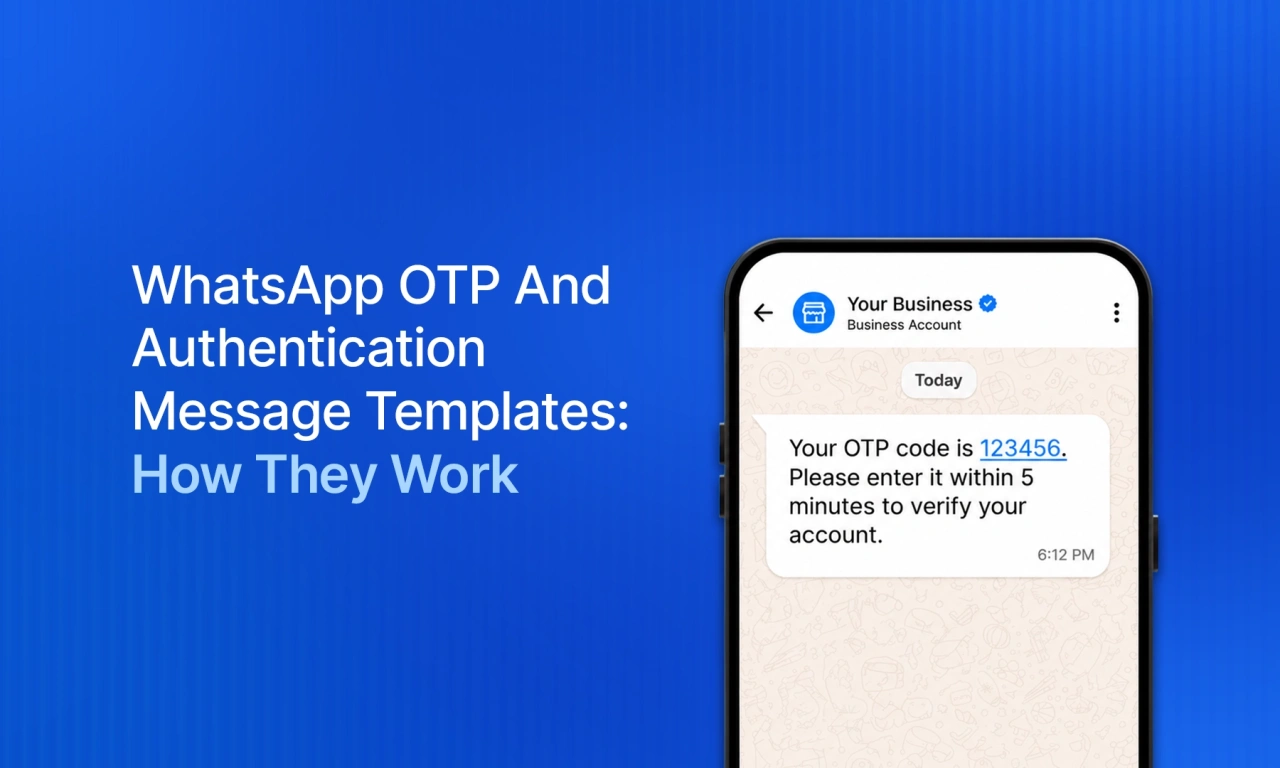
WhatsApp OTP and authentication messages go out through one fixed Meta template. In India, each delivered code costs about ₹0.115 before 18% GST. You cannot edit the message text, and you choose one of three delivery types: copy code, one-tap autofill or zero-tap.
If you want to go live fast, start with copy code. It needs no app changes and works on every phone.
Below you get the numbers, the setup order and the mistakes that quietly break autofill or inflate your bill.
The data drop: WhatsApp OTP and authentication at a glance
What you want to know | The number or rule |
Cost per OTP in India | About ₹0.115 per delivered message, before 18% GST (roughly ₹0.136 with GST) |
Cost of 10,000 codes | About ₹1,150 before GST |
Cost of 500,000 codes a month | About ₹57,500 before GST (roughly ₹67,850 with GST) |
Message text | Fixed by Meta. Only the code changes |
Header, media or extra variables | Not allowed |
Delivery types | 3: copy code, one-tap autofill, zero-tap |
One-tap and zero-tap | Android only. Other devices get copy code |
One-tap handshake window | 10 minutes by default |
Sending to Indian numbers from a WhatsApp account registered outside India | Billed at the authentication-international rate, more than 20 times the domestic rate |
These are Meta's list rates for India as of November 2026. Your provider's fee is charged on top. For the full picture, see WhatsApp API pricing in India.
What a WhatsApp authentication template actually contains
Meta writes the message body for you. A WhatsApp OTP has four parts:
The code line: "[code] is your verification code."
An optional security line: "For your security, do not share this code."
An optional expiry line: "This code expires in X minutes."
One button: copy code, autofill, or none for zero-tap
There is no header, no image and no custom text. The only variable you pass is the code.
This category is for OTPs only. Order updates and payment alerts belong in utility templates, and anything with a promotional element becomes marketing. If you are unsure where a message fits, our guide to WhatsApp template categories shows the split, and these order utility message examples show what utility looks like in practice. For the wider picture, see WhatsApp message templates.
Because Meta controls the wording, authentication is the most restricted category and usually the quickest to get approved.
Copy code, one-tap or zero-tap: which delivery type should you use?
Copy code | One-tap autofill | Zero-tap | |
What the user does | Taps Copy code, pastes it in your app | Taps Autofill, code lands in your app | Nothing. Code is passed to your app |
What you need | Nothing in your app | Android package name, app signature hash, handshake | Android app integration and Meta's eligibility checks |
Works on | All devices | Android. Others get copy code | Android. Falls back to copy code |
Best for | Fastest launch, website logins, iPhone users | Android app logins | Android apps where you want zero friction |
How a WhatsApp OTP gets from your app to your customer
- The customer asks for a code: in your app or on your website.
- One-tap and zero-tap only: your Android app performs a handshake with WhatsApp. Do this just before sending, and within 10 minutes of the send (or within the expiry set on your template). Meta now recommends its OTP Android SDK for this, since the older PendingIntent method is being deprecated.
- Your system generates the code: and sends the authentication template through the WhatsApp Business API, passing the code as the only variable.
- WhatsApp delivers it: and shows the right button. If the handshake is missing or the app details do not match, it shows copy code.
- The customer enters the code: Your server checks it and marks it used.
Delivery status comes back through webhooks, so you can see sent, delivered and failed per code. Our guide to API message status explains each state.
What WhatsApp OTP costs in India, with a worked example
Meta bills authentication per delivered message, and the rate depends on the recipient's country. For India that is about ₹0.115 before GST.
10,000 codes a month: about ₹1,150 before GST
500,000 codes a month: about ₹57,500 before GST
Every delivered code is billed. A login form with no rate limit can turn into a bill. Cap OTP requests per number per hour.
WhatsApp account location matters. If your WhatsApp Business Account is registered outside India and you send to Indian numbers, Meta applies the much higher authentication-international rate. Check your account's country before you launch.
Meta also applies volume tiers to authentication messages, so the rate drops as your monthly volume grows. Use the WhatsApp API cost calculator to model your own numbers, and read how Meta's per-message pricing change shifted the math.
For comparison, SMS OTPs in India usually run about ₹0.12 to ₹0.20 per message on DLT-registered routes, depending on the provider. The per-message cost is close, so cost alone rarely decides the channel. Delivery and login completion matter more.
Two cost traps to plan for:
Next step: test WhatsApp OTP on your own login flow
Start with copy code on one login journey, track delivery and login completion for two weeks, then decide whether one-tap is worth the Android work.
If you want to see what your OTP volume will cost, check out Emovur’s whatsapp business api pricing. If you would rather walk through your login flow with someone, book a demo.
Frequently asked questions?
What is a WhatsApp authentication template?
It is Meta's fixed template for sending one-time passcodes on WhatsApp. Meta writes the message text, and you only supply the code. It is meant for logins, sign-ups and verifications, not for alerts or promotions.
How much does a WhatsApp OTP cost in India?
Meta charges about ₹0.115 per delivered authentication message in India, before 18% GST. Your provider's fee comes on top. Volume tiers lower the rate as you send more each month.
Can I edit the text of a WhatsApp OTP message?
No. Meta controls the body, and headers, media and custom variables are not allowed. You can switch the security line and the expiry line on or off, and you can change the button text.
Does one-tap autofill work on an iPhone?
No. One-tap and zero-tap work on Android only. On iPhone, and on any Android phone that fails the checks, WhatsApp shows a copy code button instead.
Is WhatsApp OTP better than SMS OTP?
It depends on your users. WhatsApp needs an internet connection and the customer to be on WhatsApp, while SMS reaches any phone. Many teams send on WhatsApp first and keep SMS as the backup.
People Also look for?
Best WhatsApp API Provider in India
WhatsApp API Compliance Checklist for Marketing Teams
WhatsApp Marketing Messages: Rules, Examples, Templates
WhatsApp Templates: support Guide for the growing business