

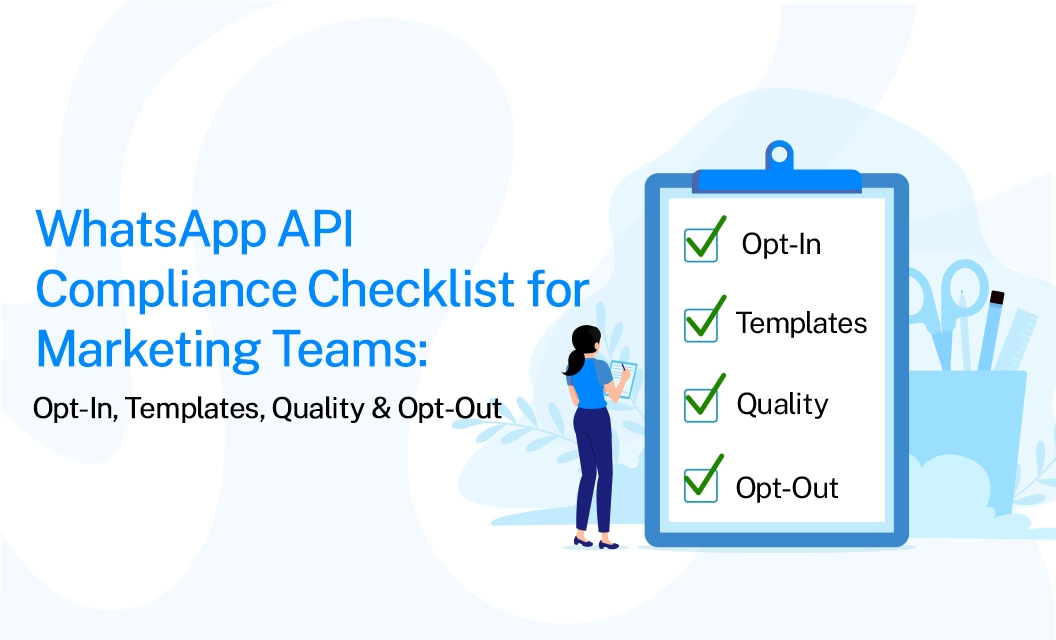
WhatsApp API Compliance Checklist for Marketing Teams: Opt-In, Templates, Quality & Opt-Out
WhatsApp marketing compliance in 2026 is not only about avoiding bans. It is about building a clean, consent-based WhatsApp audience; sending the right message category, respecting unsubscribe requests; controlling campaign frequency; monitoring quality signals; and using official WhatsApp Business API workflows.
WhatsApp is one of the most direct customer communication channels, but users can quickly block or report businesses that send irrelevant, unexpected, or too-frequent messages. That means every WhatsApp campaign should be planned around user consent, message relevance, frequency capping, unsubscribe handling, approved templates, and customer experience.
In this guide, you’ll learn the core WhatsApp API compliance rules that matter in 2026, from opt-ins and templates to quality ratings and message practices.
WhatsApp Opt-In Rules: What Actually Counts as Valid Consent
Meta's opt-in requirement is the foundation of WhatsApp marketing compliance, and it applies to every business-initiated message sent outside the 24-hour customer service window, this includes marketing, utility, and authentication templates alike. Meta's developer documentation on getting opt-in sets out two conditions a business must meet before contacting someone: the person must have given their phone number, and the business must have received a clear opt-in confirming they want to receive messages or calls.
Two disclosure requirements sit underneath that:
The opt-in must clearly state that the person is agreeing to receive communications from your business.
The opt-in must clearly state your business's name, so the person knows who will be messaging them.
Meta updated this policy in November 2024: an opt-in no longer has to name WhatsApp specifically. A general marketing opt-in collected on any channel can satisfy Meta's platform rule, provided the underlying method still meets the two conditions above and complies with local law.
What is WhatsApp Marketing Compliance
WhatsApp marketing compliance means running campaigns in a way that follows WhatsApp Business Platform policies while giving customers control over the messages they receive. For marketing teams, compliance is not just about whether a template gets approved. It covers the complete campaign lifecycle:
How the customer gave permission to receive WhatsApp messages
What type of message you are sending
Whether the correct WhatsApp template is being used
Whether the content matches the approved template and applicable policies
How frequently customers are contacted
How customers can stop receiving marketing messages
How the team monitors blocks, reports, read rates, and other quality signals
What happens when a customer withdraws permission
Important: This checklist describes WhatsApp/Meta platform requirements and operational best practices. It is not legal advice. Your business should separately review applicable privacy, marketing, consumer-protection, and messaging laws with qualified legal counsel where necessary.
WhatsApp Template Rules: Categories, Approval, and Compliant Copy
Use a clear action from the customer to collect consent, such as checking a box, replying with a keyword, or submitting a website form. Never use a pre-checked box or assume consent just because someone made a purchase or messaged you first.
Also, keep a record of when, where, and how the customer gave consent, along with the exact message they saw. This can help if Meta reviews your account or rejects a template.
1. Check WhatsApp Opt-In Before You Send
A WhatsApp opt-in is permission from a customer to receive messages or calls from your business on WhatsApp. Meta requires businesses to have the customer's phone number and opt-in permission before contacting them. Businesses are responsible for determining how the opt-in is collected and ensuring that the process complies with applicable laws.
Must follow opt-in formality by every business:
The customer has actively opted in to receive WhatsApp communications.
The customer has provided a valid mobile number.
The opt-in clearly identifies your business.
The customer understands what type of messages they will receive.
Promotional messages are covered when you intend to send marketing content.
The opt-in process does not rely on assumptions simply because a customer purchased from you or shared their number.
Your team can identify when and where the opt-in was collected.
Opt-out instructions are available and understandable.
Withdrawn opt-ins are removed from future marketing audiences.
Important: Meta has a separate clause for opt-in policy, in order to protect the interest of customers, and it also recommends every business making the customer’s expectation clear and, where appropriate, using separate opt-ins for different message categories.
2. Review Your WhatsApp Templates Before Launch
Every business-initiated message sent outside the customer service window must use a pre-approved WhatsApp template. Meta groups templates into three categories: marketing, utility, and authentication.
Choosing the right category is important because it can affect pricing, approval, and messaging rules. For example, marking a promotional message as a utility template can lead to rejection or the template being recategorized later.
A compliant WhatsApp template should:
Use the correct category: Promotional messages should be marked as marketing, not utility.
Use clear variables: Avoid vague placeholders that could be filled with unrelated content later.
Identify your business: Make it clear who is sending the message and include an opt-out option for marketing messages.
Follow Meta’s policies: Avoid any content that is restricted or prohibited under Meta’s messaging and commerce policies.
For a step-by-step guide for creating, submitting, and managing WhatsApp templates, including naming, formatting variables, and resubmitting rejected templates, check out our WhatsApp templates guide.
3. Protect Your WhatsApp Quality Rating
Compliance does not end when a template is approved. Your team should continuously monitor how recipients respond to your messages. WhatsApp provides template-level performance information such as delivery, read rate, top block reasons, and template quality signals through its business tools.
Meta also emphasizes that businesses should create relevant, valuable marketing messages and use customer feedback and performance signals to improve the quality of conversations.
Monitor these signals:
According to Meta’s messaging limits documentation, your messaging limit can increase when you consistently use a good portion of your current limit while maintaining high message quality. Meta reviews this regularly. If your quality stays low for about seven days, your messaging limit may also be reduced.
4. Build a Clear WhatsApp Opt-Out Process
Businesses must respect requests from people who want to block, discontinue, or opt out of WhatsApp communications. Meta's policy specifically states that these requests must be honored whether they are made on or off WhatsApp.
Your marketing team should therefore treat an opt-out as an operational event, not simply a customer-service message. A compliant setup typically includes the following:
Give customers an easy way to opt out: Add a clear option like “Stop promotions” or a STOP button in your marketing messages.
Automatically process opt-outs: Your system should recognize replies like “STOP” or “UNSUBSCRIBE” and stop sending marketing messages to that customer.
Check your suppression list before every campaign: Make sure opted-out customers are removed before each broadcast.
Require fresh consent to opt back in: If a customer opts out, send them marketing messages again only after they actively give permission.
Note: Failing to honor opt-out requests quickly is one of the fastest ways to generate block and spam reports. Opt-out handling and opt-in hygiene should be treated as one connected system, not two separate checkboxes.
5. Review the Broadcast Campaign Before Sending
When sending WhatsApp messages in bulk, the same opt-in and template rules apply. However, large campaigns can create additional risks, such as sending messages to contacts without valid consent, using the wrong template category, or exceeding your messaging limit.
Before scheduling a WhatsApp broadcast, make sure your contact list has valid and recorded opt-ins, the template category matches the message, and the broadcast size stays safely within your current messaging limit.
Pre-send WhatsApp compliance checklist:
Audience: Everyone in the campaign has an appropriate WhatsApp opt-in.
Permission: The permission covers the type of communication being sent.
Source: Your team can identify where the contact and opt-in originated.
Template: The correct approved template is being used.
Category: The template category matches the intended communication.
Content: The message is clear, relevant and consistent with the campaign.
Variables: Personalization fields contain accurate information.
Links: All URLs have been tested.
Frequency: The audience is not being unnecessarily overloaded with messages.
Segmentation: The offer is relevant to the selected audience.
Opt-out: Customers have a clear way to stop marketing communication.
Suppression: Previously opted-out contacts are excluded.
Monitoring: Someone is responsible for checking campaign quality after launch.
Escalation: There is a process for responding to negative feedback or policy concerns.
6. Connect Compliance With Your WhatsApp Campaign Workflow
Your marketing team should also maintain a central record of:
WhatsApp Marketing Compliance vs. Legal Compliance
WhatsApp policy compliance and legal compliance are related, but they are not the same thing. WhatsApp's Business Messaging Policy requires opt-in, requires businesses to honor opt-out requests, and prohibits communications that deceive, defraud, mislead, spam, or surprise users.
Separately, your business may have legal obligations concerning privacy, consent, advertising, consumer protection, data handling, and telecommunications.
Therefore, avoid treating a WhatsApp template approval as proof that a campaign satisfies every legal requirement.
For compliance-sensitive campaigns, have the relevant consent language, privacy practices, audience rules, and promotional claims reviewed by your legal or compliance team where appropriate.
Conclusion:
Before launching your campaign, confirm four things: documented opt-in for every recipient, a template whose category matches its content, a quality rating healthy enough to support the volume, and a working, honored opt-out path.
Local privacy law (GDPR, CCPA, and similar) may require more than Meta's platform policy alone. This article describes platform and policy requirements, not legal advice; have consent language and data-handling practices reviewed by legal counsel for your specific markets.
Frequently Asked Questions?
Does a WhatsApp opt-in need to mention WhatsApp by name?
Not necessarily under Meta's current platform policy—since a November 2024 update, a general marketing opt-in collected on any channel can satisfy Meta's rule, as long as it clearly names your business and states what the person is agreeing to. Local law may still expect more specificity, so this is a floor, not a safe harbor.
Can I message someone who bought from me without a separate opt-in?
A transaction or inbound message isn't the same as marketing consent. Utility and authentication templates tied to that transaction operate under different rules than promotional content, but marketing messages still need their own documented opt-in — not an assumption based on purchase history.
What's the difference between a marketing template and a utility template?
Marketing templates cover promotions, offers, and announcements; utility templates cover transactional, account-related updates like order or appointment confirmations. Category must match content—labeling promotional copy as utility to bypass marketing review is a compliance risk, not a workaround.
How quickly does a dropped quality rating affect my sends?
A sustained Low (Red) quality rating can move your number's status to Flagged and, if it doesn't recover within about a week, step your messaging limit down a tier. Meta reviews messaging limit eligibility on a recurring cycle, so both damage and recovery can happen faster than the old "wait a few days" assumption.
Do I need a lawyer to be WhatsApp compliant?
Meta's opt-in, template, and quality rules are platform requirements, not legal advice, and they don't automatically satisfy regional privacy laws like GDPR or CCPA. Have your consent flows, data handling, and retention practices reviewed by legal counsel familiar with the markets you're messaging into.
Use the checklist above as your team's pre-send control, then explore Emovur's WhatsApp Business API to build a more structured and scalable messaging workflow. …