

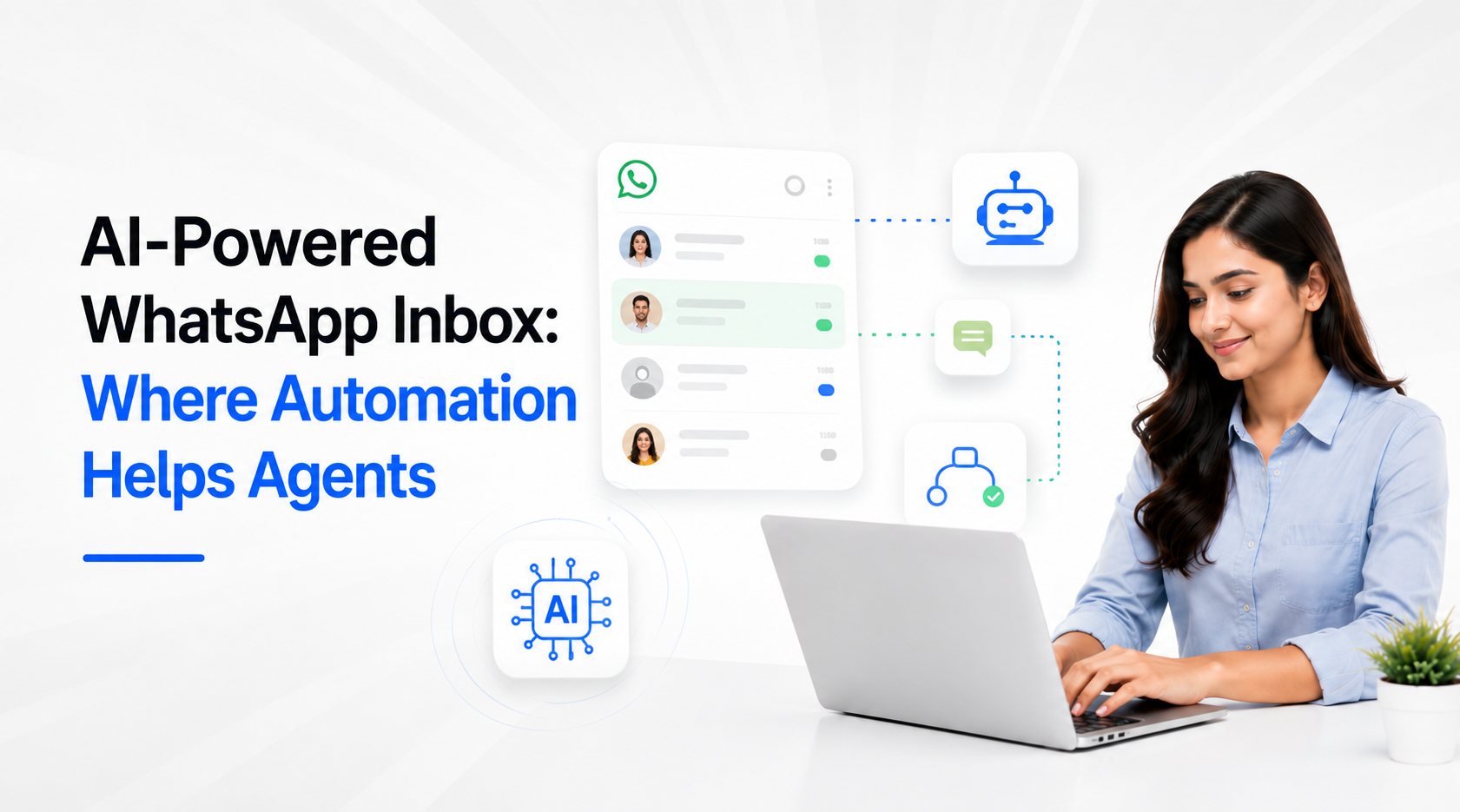
An AI-powered WhatsApp inbox should make human agents faster and better informed, not simply replace them with automated replies. The most useful AI sits around the agent workflow: prioritising incoming conversations, summarising long histories, retrieving approved business information, suggesting responses, identifying customer intent and reducing repetitive after-chat work. Human agents remain responsible for conversations that require judgement, negotiation, exceptions or relationship management. For growing sales and support teams, the real value of inbox AI is therefore increased agent capacity without sacrificing conversation context or control.
Meta's direction in 2026 reflects this broader shift. Meta Business Agent can answer customer questions independently, but Meta is also introducing agent-assistance capabilities such as briefings that summarise missed conversations and surface insights from customer threads. Businesses can decide when employees should step into conversations, reinforcing the idea that AI and human teams can operate together rather than as separate systems.
AI Should Reduce Agent Work Before It Replaces Agent Conversation
The traditional WhatsApp team inbox solves an operational problem: several employees can work from one business number, see customer histories, assign conversations and maintain clear ownership. Once conversation volume grows, however, simply putting more people into the inbox does not solve the next bottleneck.
Agents still need to open conversations, understand what happened previously, identify what the customer wants, search for information, compose an answer, update notes and decide what happens next.
An AI-powered WhatsApp inbox should reduce this cognitive and administrative workload.
The most useful distinction is between customer-facing automation and agent-assist automation.
Customer-facing AI answers the customer directly. Agent-assist AI works behind the agent by preparing information, recommendations or actions that make the human response faster.
For example, instead of automatically answering a customer's complex pricing question, AI might provide the agent with the customer's current plan, previous conversation summary, relevant pricing policy and a suggested response. The salesperson reviews that information and decides what to send.
That is particularly useful in sales, account management and complex support, where the final answer may depend on context that cannot safely be reduced to a chatbot rule.
Emovur Shared Team Inbox combines multi-agent conversation management with assignment, previous customer context, automation and AI-assisted responses. Emovur also positions its AI Copilot specifically around reducing the time agents spend reading histories, searching for information and repeatedly writing similar answers.
Use AI to Triage the Inbox Before an Agent Opens the Chat
One of the most useful automation opportunities occurs before the conversation is assigned.
A growing WhatsApp inbox might receive new sales enquiries, existing customer questions, billing issues, technical support requests, order questions and urgent complaints at the same time. If every conversation enters the same queue, employees spend part of their day manually deciding which team should handle each chat.
AI can analyse the incoming conversation and help classify it according to business-defined categories.
A practical triage layer might identify:
Customer intent: Sales enquiry, support request, billing question, renewal issue, order update or another known category.
Customer status: New prospect, qualified lead, active customer, existing account or previous customer where connected records are available.
Priority: Routine question, time-sensitive buying signal, unresolved support issue or conversation requiring immediate review.
Required team: Sales, customer support, billing, implementation, account management or another department.
Known context: Product, campaign source, language, current CRM stage or previous conversation ownership.
This classification can then support routing rather than allowing AI to handle the whole conversation.
For example:
“We need WhatsApp API for 70 sales agents and want it integrated with Zoho before next month.”
The system could recognise a B2B sales enquiry, identify enterprise-scale intent, detect CRM integration requirements and route the conversation to the appropriate sales team.
Another message such as:
“My invoice shows the wrong billing amount.”
should follow an entirely different route.
Emovur's Shared Team Inbox supports smart conversation assignment and routing rules designed to send customer chats to appropriate teams rather than relying entirely on manual assignment.
The value here is not simply faster routing. Correct triage means that the employee opening the conversation is more likely to be the person capable of resolving it.
Summarise Long Conversations Before Agents Take Over
Conversation history is valuable, but reading it can become expensive.
A customer may have exchanged dozens of messages with automation, another salesperson or the support team before reaching the current agent. Asking employees to reread every message creates unnecessary response delays, particularly when shifts change or a conversation moves between departments.
This is one of the strongest uses for AI inside a WhatsApp inbox.
Instead of presenting only the complete transcript, the inbox can prepare a concise summary such as:
Customer: ABC Technologies
Requirement: WhatsApp API for approximately 70 sales agents
Current CRM: Zoho
Primary need: Lead assignment and automated follow-up
Timeline: Wants implementation next month
Previous action: Pricing overview shared
Outstanding question: Whether Zoho integration requires custom development
Next recommended action: Technical sales review
The agent still has access to the actual conversation, but no longer needs to reconstruct the customer's situation from scratch.
This becomes particularly useful during:
Agent-to-agent transfers
AI-to-human takeover
Sales-to-technical handoff
Support escalation
Shift changes
Returning conversations after several days
Account-manager involvement
Emovur's AI Copilot currently includes conversation summarisation alongside knowledge retrieval and suggested responses. Meta's June 2026 Business Agent announcement also introduced an AI briefing concept that can catch businesses up on conversations missed overnight and surface insights from customer threads.
The purpose of summarisation is not to hide conversation history. It is to give agents an accurate starting point before they decide whether deeper review is necessary.
Retrieve the Right Business Knowledge While the Agent Is Replying
Agents frequently lose time switching between WhatsApp and other systems.
A customer asks about a feature, and the agent opens the product documentation. Another asks about a policy, and the employee searches an internal knowledge base. A prospect asks about pricing, and the salesperson searches the latest plan document.
An AI-powered WhatsApp inbox can bring approved knowledge closer to the conversation.
The AI can use controlled sources such as:
Product documentation
Website information
Internal FAQs
Current pricing documents
Service policies
Implementation guides
Knowledge-base articles
Approved sales material
Product catalogues
Then, when a customer asks a question, AI can retrieve the relevant information and prepare it for the employee.
For example, if someone asks:
“Can five people use the same WhatsApp number?”
the agent should not need to manually search the product website. The AI assistant can retrieve the relevant shared-inbox capability and prepare the answer.
This differs substantially from allowing a generic language model to generate an answer from memory. Business-specific AI should operate from approved knowledge wherever factual accuracy matters.
Meta's Business Agent is similarly designed to learn from business-controlled sources such as websites, catalogues and price lists, while businesses can provide instructions and refine how the AI responds.
Emovur AI Copilot follows this model by allowing organisations to connect websites, documents, FAQs and other business knowledge before enabling AI assistance inside the team inbox.
Knowledge retrieval is therefore most useful when AI helps agents find the approved answer faster, rather than encouraging them to trust whatever response the model generates first.
Suggest Replies, but Keep the Agent Responsible for the Message
Suggested replies can save substantial time because customer-service and sales teams repeatedly answer similar questions.
However, the best implementation is not necessarily:
Customer Message → AI Automatically Sends Answer
For many conversations, a safer workflow is:
Customer Message → AI Drafts Response → Agent Reviews → Agent Edits if Needed → Agent Sends
This keeps human judgement in the process while reducing writing time.
The advantage becomes larger when the AI suggestion uses both business knowledge and conversation context.
A basic canned response might say:
“Yes, we support CRM integrations.”
A better context-aware suggestion might recognise that the customer already mentioned Zoho and respond specifically to that requirement.
Agents can then adjust tone, add commercial context or ask a follow-up question before sending.
Suggested replies are especially useful for repetitive but context-dependent interactions such as explaining product capabilities, summarising next steps, answering common policy questions, confirming information already discussed or drafting a response after a customer asks several related questions.
Emovur's AI Copilot is designed to generate relevant reply suggestions within the WhatsApp team inbox while leaving employees in control of the conversation.
AI assistance becomes less appropriate when the message involves an unusual commercial commitment, important exception or decision requiring authority. In those situations, writing the answer faster is less important than making the correct decision.
Automate the Work Around the Conversation
Some of the biggest AI productivity gains happen after the reply is sent.
Agents often perform administrative tasks such as adding tags, updating lead status, writing internal notes, setting follow-up reminders, assigning another department or entering information into CRM.
Individually these tasks are small. Across thousands of conversations, they consume substantial operating time.
AI can assist by extracting useful information from the conversation and suggesting structured updates.
After a B2B sales conversation, for example, the inbox might identify:
Company Size: 50-100
CRM: HubSpot
Use Case: Lead Management
Buying Stage: Evaluating Providers
Timeline: 1-3 Months
Next Action: Demo Requested
Instead of making the salesperson manually enter every field, the system can suggest these values for confirmation or pass them through an approved workflow.
For support, AI might identify the issue category, product involved, urgency and resolution status.
For account management, it may detect renewal risk, expansion interest or an unresolved implementation blocker.
The pattern is:
Conversation → AI Extracts Signal → Structured Update Suggested → Business System Updated
This is where an AI inbox can improve not only response time but also the quality of CRM and operational data.
The important safeguard is that extraction confidence and business impact should determine whether the update happens automatically or requires review. Incorrectly classifying an internal tag is different from incorrectly changing an opportunity stage or issuing a financial commitment.
Know Which Decisions Should Stay With the Agent
An AI-powered inbox should not maximise the number of decisions made without people.
It should automate or assist where the probability and consequence of error are acceptable.
Routine information retrieval, summarisation, classification and suggested replies are usually strong candidates for assistance. Decisions involving authority, commercial negotiation or unusual customer circumstances require more control.
Human agents should normally remain directly involved when conversations include pricing exceptions, contract or policy exceptions, complex complaints, refunds requiring discretion, unusual technical problems, sensitive account decisions, negotiation, important promises, relationship-risk situations or high-value sales discussions.
Meta's Business Agent provides businesses with controls over when AI should operate and when conversations should be handed to people. Businesses can define topics the AI should avoid and manually take over conversations where necessary.
This creates a more useful operating model than treating human intervention as evidence that automation failed.
Sometimes the AI's correct action is:
“This conversation needs a person.”
The article on human-AI handoff should own the detailed transfer architecture. Inside the inbox, the key principle is simply that agents need visibility and authority over what AI is doing.
Design Different AI Assistance for Sales and Support Agents
A single AI configuration may not serve every department equally well.
Sales agents and support agents may work from the same shared inbox but have different objectives.
For a sales team, useful AI assistance may include recognising buying intent, summarising qualification, retrieving product information, suggesting discovery questions, identifying next actions and preparing CRM updates.
For a support team, the AI may focus on issue classification, retrieving troubleshooting knowledge, summarising previous cases, identifying repeated problems and suggesting resolution steps.
For an account-management team, relevant assistance could include account summaries, renewal context, previous issues, expansion signals and upcoming actions.
The underlying AI technology may be shared, but knowledge sources, instructions, permissions and performance metrics should reflect the employee's role.
This becomes particularly important in larger organisations where incorrect information can result from one department's AI instructions being applied to another department's conversation.
An inbox architecture might therefore look like:
Incoming Conversation → Intent Classification → Correct Team → Team-Specific AI Assistance → Human Agent → CRM/Workflow Update
AI should adapt to the work being performed rather than forcing every department into one generic assistant.
Measure Whether AI Is Actually Helping Agents
The wrong way to measure an AI-powered WhatsApp inbox is simply:
“How many AI responses were generated?”
High AI usage does not automatically mean better operations.
Measure the employee workflow before and after AI assistance.
Useful metrics include:
Emovur's Shared Team Inbox includes conversation analytics around response times, resolution and team performance, which can provide part of this operational measurement layer.
AI-specific monitoring should go further.
If agents reject or heavily rewrite most suggested replies, the problem may be the knowledge base or AI instructions. If routing accuracy is poor, classification logic needs refinement. If handling time drops but reopened conversations increase, the AI may be helping agents answer quickly rather than helping them resolve correctly.
The goal is better agent productivity with stable or improved customer outcomes.
Improve the AI by Improving the Knowledge and Feedback Loop
An AI inbox is not finished when the feature is switched on.
Business information changes. Product capabilities evolve. Prices are updated. Policies change. Agents discover questions that were not included in the original knowledge base.
The quality of AI assistance therefore depends heavily on maintenance.
A practical improvement cycle is:
Review Weak Suggestions → Identify Missing or Incorrect Knowledge → Update Approved Sources → Test AI Response → Release Updated Behaviour → Monitor Agent Feedback
Meta's current Business Agent tools allow businesses to test responses, provide feedback and refine answers, while business-controlled sources determine much of what the AI knows about the organisation.
Agent feedback should be treated as valuable training input.
If several employees repeatedly correct the same answer, investigate the source rather than asking every agent to keep making the same correction manually.
If agents frequently search for a document the AI cannot retrieve, add or improve that knowledge source.
If AI consistently misclassifies a specific type of sales enquiry, adjust the routing logic.
An effective AI-powered WhatsApp inbox becomes more useful as real agent behaviour reveals where the system still creates work instead of removing it.
Build AI Around the Agent Workflow
The strongest AI inbox does not try to automate every WhatsApp conversation from beginning to end.
It places AI at the points where agents lose the most time:
Incoming Chat → AI Triage → Correct Queue → Conversation Summary → Relevant Knowledge → Suggested Response → Human Decision → Structured Notes/CRM Update
This keeps the agent at the centre of conversations where judgement matters while allowing automation to handle repetitive information processing around them.
Meta's 2026 Business Agent direction increasingly combines autonomous customer assistance with human controls, business knowledge and agent-facing insights. Emovur applies the same agent-assist principle through its Shared Team Inbox and AI Copilot, where AI can retrieve knowledge, summarise conversations and suggest replies while employees retain conversation ownership.
For businesses evaluating an AI-powered WhatsApp inbox, the most useful question is therefore not:
“How many agents can AI replace?”
It is:
“Which parts of every agent's workload can AI remove so the team spends more time on the customer decisions that actually require a person?”
That is where inbox automation creates the strongest operational value.