

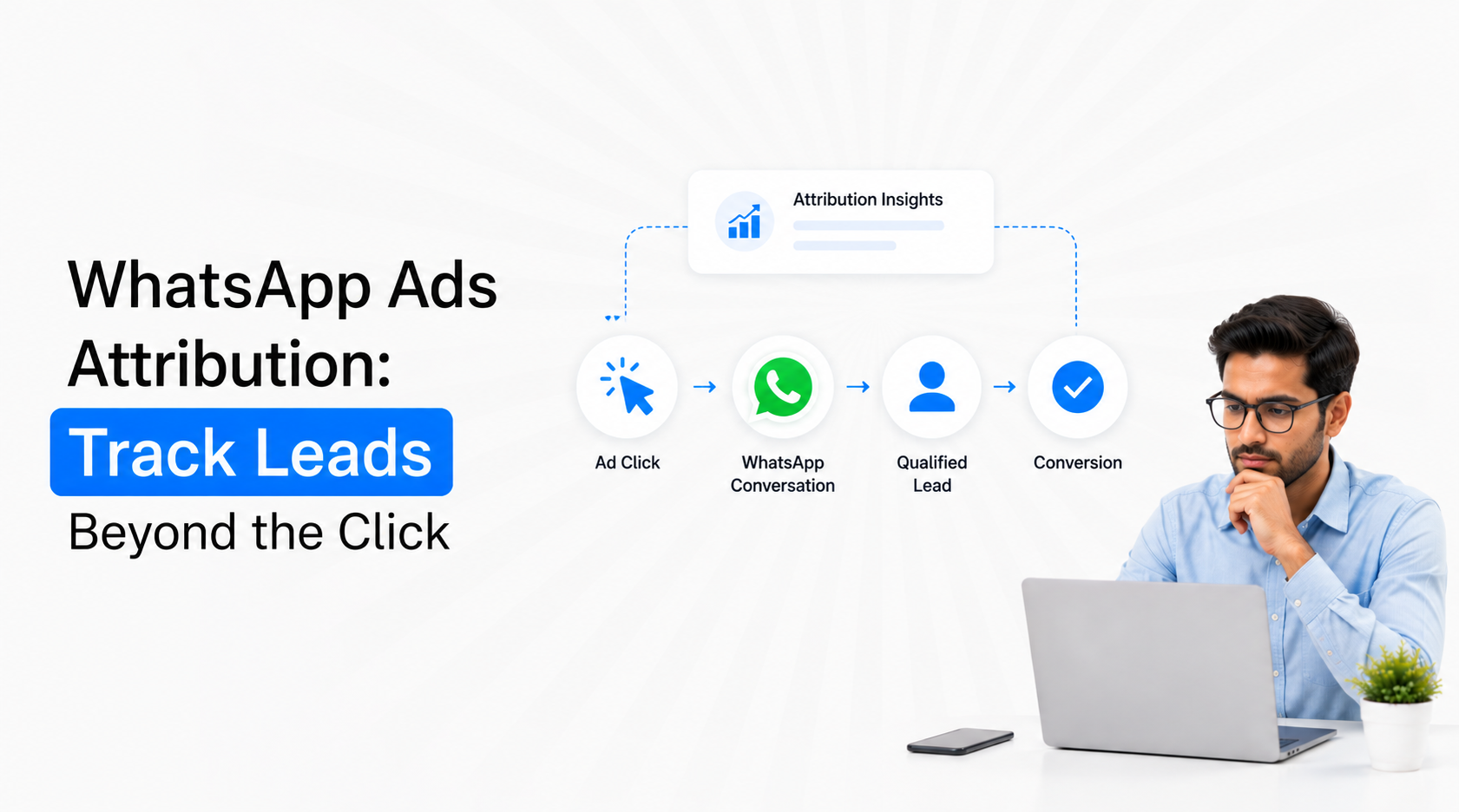
WhatsApp Ads attribution should not stop when Meta reports that someone clicked an ad or started a WhatsApp conversation. For businesses using Click-to-WhatsApp Ads, the real attribution challenge is connecting that conversation with the lead, qualification outcome, opportunity, appointment, purchase and eventual revenue. In 2026, a stronger attribution model combines campaign-source data, CRM records and downstream conversion events so marketing can identify which WhatsApp ads generate business outcomes, not simply the most chats.
Why Clicks and Conversations Are Not Enough
A Click-to-WhatsApp campaign can generate hundreds of conversations, but those conversations may have very different commercial value. One person may ask a basic question and disappear. Another may become a qualified opportunity and close three weeks later.
Meta itself positions CTWA measurement beyond the initial conversation and lists Meta Pixel, Conversions API and Offline Conversions among the tools businesses can use to measure outcomes after a messaging interaction.
A useful WhatsApp Ads attribution model should therefore distinguish:
Ad click: Customer responds to paid media.
Conversation: WhatsApp interaction begins.
Lead: Enough information exists to create a usable lead record.
Qualified lead: The prospect meets defined commercial criteria.
Opportunity: Sales determines there is a realistic buying opportunity.
Conversion: Appointment, purchase, demo, site visit or another defined outcome occurs.
Revenue: The resulting commercial value is connected back to the originating campaign.
The further attribution can reliably travel through this sequence, the more useful the advertising data becomes.
1. Define the Conversion Events Before Building Attribution
Do not begin with dashboards. Begin by defining which events represent meaningful progress.
The right event hierarchy depends on the business model.
For real estate:
WhatsApp conversation
Qualified property enquiry
Site visit booked
Site visit completed
Opportunity
Booking/sale
For B2B:
Conversation
Qualified lead
Demo booked
Demo completed
Opportunity created
Contract won
For education:
Enquiry
Eligible prospect
Counselling booked
Application started
Enrolment
For ecommerce:
Product enquiry
Product selected
Checkout
Purchase
Revenue
Meta's current CTWA guidance similarly separates the initial chat from meaningful conversion points such as appointments and purchases.
Your attribution model should record those stages independently rather than labelling every WhatsApp conversation a conversion.
2. Preserve the Original Ad Source Inside the Lead Record
The first requirement for reliable WhatsApp Ads attribution is source persistence.
When the customer moves from Facebook or Instagram into WhatsApp, the business needs to retain enough campaign information to understand where the conversation originated. That source should remain attached when the lead moves into CRM and sales systems.
Useful attribution fields can include:
Source: Meta Ads / CTWA
Campaign: Campaign responsible for the interaction
Ad set: Audience or delivery grouping
Ad/creative: Specific advertisement that generated the conversation
Product or offer: Commercial proposition being promoted
Conversation timestamp: When the WhatsApp interaction began
Lead ID or CRM ID: Internal identifier that connects future activity
Sales owner: Person responsible for the opportunity
Current stage: Qualification, opportunity, won, lost, etc.
The critical rule is that the source must survive after the lead leaves WhatsApp.
If Meta knows which ad created the chat but the CRM only shows Source = WhatsApp, meaningful attribution has already been lost.
The WhatsApp CRM Integration Guide covers the broader CRM connection. For attribution specifically, the CRM should act as the bridge between ad source and eventual sales outcome.
3. Connect the WhatsApp Conversation to One Customer Record
Attribution becomes unreliable when the same person creates several disconnected customer records.
A prospect might:
Click a CTWA ad today.
Return through the website next week.
Speak with sales.
Visit the store or office.
Purchase later through another channel.
If those interactions create separate customer identities, marketing may fail to associate the final conversion with the originating WhatsApp campaign.
Create one primary customer or lead record wherever reasonably possible.
Useful matching signals can include:
WhatsApp/mobile number
CRM customer ID
Email where legitimately collected
Order/customer reference
Existing account identifier
Internal opportunity ID
Do not depend solely on the conversation transcript as the record of attribution.
Emovur's Click-to-WhatsApp Ads environment supports CTWA lead capture, CRM connection and campaign-performance tracking, which can form part of this source-to-lead structure.
The aim is to create a traceable relationship:
Ad → WhatsApp Conversation → Customer/Lead ID
Everything that happens afterwards can then attach to that same identifier.
4. Record Qualification as an Attribution Event
One of the biggest improvements in WhatsApp Ads attribution is separating a conversation from a qualified lead.
Meta's lead optimisation for CTWA is specifically intended to move advertisers beyond people who merely open chats towards people more likely to become genuine leads. Meta says this provides greater measurement precision around which ads actually generate leads.
That means qualification should become a measurable event.
For example:
Conversation Started = 1,000
Qualification Completed = 600
Qualified Leads = 280
Now marketing can calculate:
Conversation-to-Qualified-Lead Rate = 280 ÷ 1,000 = 28%
More importantly, it can compare qualification by ad.
Creative A generated the most conversations but the weakest lead quality.
That insight disappears when Ads Manager reporting stops at messaging conversations.
5. Send Downstream Outcomes Back Through Conversions API
Meta's Conversions API for Business Messaging was developed specifically to help businesses connect downstream information from WhatsApp, CRM systems, websites, apps and stores with Meta measurement.
Meta describes Conversions API as enabling businesses to measure leads and sales generated by Click-to-WhatsApp and other click-to-message ads beyond the initial conversation.
A simplified architecture is:
Meta Ad → WhatsApp Lead → CRM Outcome → Server/Business Data → Conversions API → Meta Measurement
Useful downstream events may include:
Lead
Qualified lead
Appointment
Purchase
Sale
Other supported business outcome appropriate to the implementation
This creates two benefits.
Measurement: Marketing gets a clearer view of which campaigns produce deeper outcomes.
Optimisation: Eligible Meta campaign configurations can use stronger downstream signals rather than optimising only towards conversations.
This is why attribution should be designed before the campaign reaches significant scale.
6. Include Offline Conversions When the Sale Happens Outside WhatsApp
Many CTWA conversions happen offline.
Real-estate buyers may complete a site visit and book later. Automotive customers may visit a showroom. Education prospects may speak with a counsellor. B2B deals may close through proposals and contracts.
If attribution stops because the customer left WhatsApp, much of the actual business result becomes invisible.
Meta explicitly includes Offline Conversions among its tools for measuring CTWA results beyond conversations.
A practical process is:
Lead originates through CTWA.
CRM retains Meta/WhatsApp source.
Sales updates opportunity stage.
Offline appointment or sale occurs.
Conversion is recorded against the same customer or opportunity.
Eligible conversion information is passed back to Meta through the appropriate measurement setup.
Meta's February 2026 India retail research highlighted the importance of connecting in-store sales data with Meta advertising through Conversions API. Meta reported substantial ROAS and incremental-sales improvements among participating businesses, although those figures vary significantly by business and should not be treated as guaranteed results.
The broader lesson is more important: offline revenue should not disappear from digital attribution simply because the final transaction occurred outside WhatsApp.
7. Keep Attribution and Campaign ROI Separate
Attribution answers:
Which ad or campaign influenced this lead or sale?
ROI answers:
Was the resulting economic value worth the investment?
They are related but different.
For example:
Campaign A
100 qualified leads
12 sales
₹12 lakh attributed revenue
Campaign B
80 qualified leads
15 sales
₹18 lakh attributed revenue
Attribution identifies how much outcome belongs to each campaign under your chosen methodology. ROI then compares the resulting value with campaign and operational costs.
Do not put cost calculations inside the attribution model before you can reliably connect leads with outcomes.
Use the separate WhatsApp Campaign ROI Metrics framework when moving from attribution into commercial performance analysis.
8. Do Not Give the Last WhatsApp Message All the Credit
A high-consideration customer journey may involve several interactions:
Instagram Ad → WhatsApp Chat → Website Visit → Sales Call → Email Proposal → WhatsApp Follow-Up → Offline Sale
Attributing 100% of the revenue to the final WhatsApp follow-up would oversimplify the customer journey.
Likewise, attributing everything to the original Meta click can ignore later influences.
Define which attribution perspective your reporting is using.
Useful views can include:
Source attribution: Which acquisition source created the lead?
Campaign attribution: Which CTWA campaign originated the opportunity?
Assist attribution: Which later channels contributed?
Sales attribution: Which salesperson or process converted the opportunity?
Revenue attribution: Which originating source is associated with eventual commercial value?
You do not need a complicated multi-touch model from day one. You do need consistent rules.
9. Track Attribution Loss as a Data-Quality Problem
Not every lead will be successfully connected to revenue.
Measure the percentage that loses attribution.
For example:
1,000 CTWA leads generated
850 successfully linked with CRM records
720 maintain campaign source
600 reach a final sales stage
The loss between each step indicates a measurement problem.
Common attribution breaks include:
Campaign source is overwritten.
Sales creates a new CRM contact instead of updating the existing one.
WhatsApp number formats do not match CRM records.
Offline sales are not linked to original leads.
Sales outcomes are not consistently updated.
Duplicate customer records exist.
Campaign naming changes unpredictably.
Conversion events have different definitions across teams.
Create an attribution completeness rate:
Leads With Usable Source + Outcome Data ÷ Total Relevant Leads × 100
Improving this number can make reporting more accurate without changing advertising performance at all.
10. Build a CTWA Attribution Dashboard Around Business Stages
A useful dashboard should allow management to move from spend to revenue without manually combining several spreadsheets.
Track by campaign:
Then add breakdowns for:
Campaign
Ad set
Creative
Product
Geography
Sales owner
Lead stage
Conversion type
The objective is to answer which WhatsApp ads create commercially valuable customer journeys.
11. Use Attribution Data to Improve Meta Optimisation
Attribution should not remain a reporting exercise.
Once reliable qualified-lead or purchase information exists, it can become feedback for advertising optimisation where Meta supports the relevant setup.
Meta's current CTWA documentation describes lead and purchase optimisation as downstream optimisation options designed around outcomes beyond initial conversations.
That creates a feedback loop:
Ad Generates Conversation → Business Qualifies Lead → CRM Records Outcome → Conversion Data Returns → Meta Learns From Better Signal
This is fundamentally stronger than:
Ad Generates Conversation → Meta Optimises for More Conversations
Learnwise provides an Indian example of why deeper outcome tracking matters. The Kerala education business used WhatsApp Flows with CTWA and reported 4X more qualified leads and a 31% reduction in cost per qualified lead compared with its previous approach during the test period. Results are self-reported and not guaranteed.
The meaningful optimisation target was qualified leads, not chat starts.
Build WhatsApp Ads Attribution From Lead to Revenue
The strongest WhatsApp Ads attribution model treats the initial click and conversation as the beginning of measurement, not the end.
Start by defining the business events that matter. Preserve campaign source inside the customer record. Connect the WhatsApp conversation with a CRM lead, record qualification separately, maintain the relationship as the opportunity progresses and feed eligible downstream outcomes into Meta through tools such as Conversions API and Offline Conversions.
A practical architecture is:
Meta Ad → WhatsApp Conversation → Lead ID → Qualified Event → CRM Opportunity → Online/Offline Conversion → Revenue → Meta Feedback
Meta's own Business Messaging documentation positions Conversions API around exactly this challenge: measuring Click-to-WhatsApp outcomes such as leads and sales beyond conversations started.
Once this connection exists, marketing can stop asking “Which ad generated the most WhatsApp chats?” and start answering the more valuable question:
“Which WhatsApp ads generated qualified opportunities and revenue?”
TABLE OF CONTENTS