

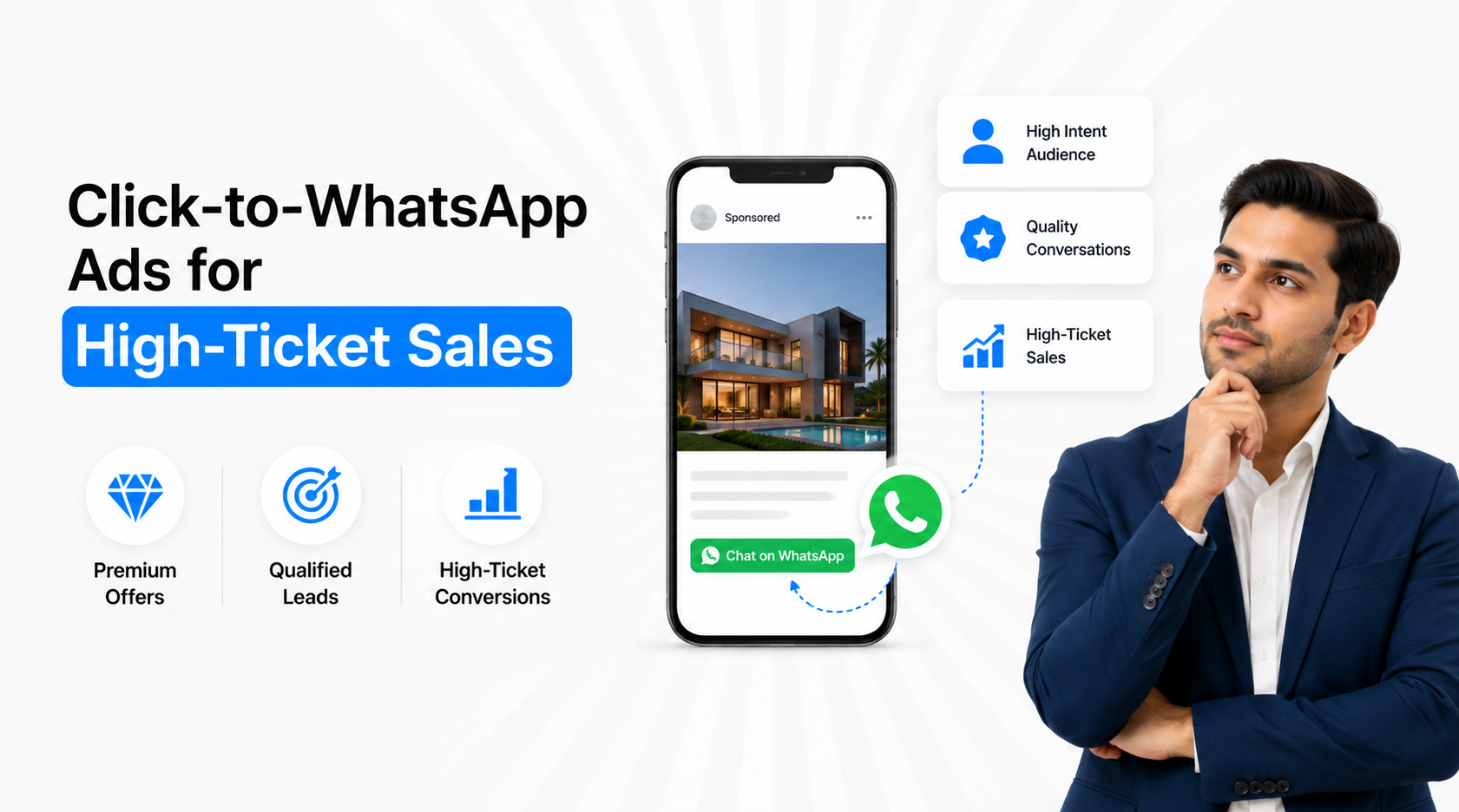
Click-to-WhatsApp Ads for high-ticket sales work best when the product requires consultation, qualification and human confidence before purchase. Instead of sending an expensive lead to a generic landing page, CTWA moves the prospect directly from Facebook or Instagram into a WhatsApp conversation where the business can understand requirements, answer buying questions and identify serious intent. For Indian businesses selling real estate, automobiles, education, B2B solutions or premium services, success should be measured through qualified opportunities, appointments, proposals and sales, not the cheapest WhatsApp conversation.
Why High-Ticket Sales Need a Different CTWA Strategy
High-ticket buyers rarely make a decision after seeing one advertisement. They compare options, evaluate risk, ask detailed questions and often need to involve another person before committing.
That changes the role of Click-to-WhatsApp Ads for high-ticket sales. WhatsApp should not function as an instant checkout channel. It should reduce the distance between initial interest and a serious sales conversation.
CTWA is particularly useful when:
The purchase needs consultation: Customers need someone to understand their requirement.
The buying cycle is longer: The decision may take days or weeks instead of minutes.
Several questions affect fit: Budget, configuration, location, integration or timeline may matter.
Trust influences conversion: Customers want confidence before committing significant money.
The next step is offline or assisted: Demo, site visit, consultation, showroom visit or sales call.
Lead quality matters more than volume: One qualified opportunity can be worth far more than dozens of casual enquiries.
WhatsApp's current guidance for ads that click to WhatsApp explicitly distinguishes high-quality leads from people who simply start a chat. It recommends using qualifying questions around areas such as budget, timeline and service interest before moving prospects towards appointments, quotes or purchases.
1. Define the High-Ticket Conversion Before Running the Ad
For an ecommerce impulse purchase, the conversion may be an order. With a high-ticket campaign, the first meaningful conversion is usually deeper in the funnel.
Define that event before campaign setup.
Depending on the business, it could be:
Real estate: Qualified site visit.
Automotive: Test drive or showroom appointment.
B2B SaaS: Qualified demo.
Education: Counselling appointment with an eligible prospect.
Premium interiors: Design consultation.
Enterprise services: Discovery call or qualified opportunity.
High-value healthcare service: Appropriate consultation booking where relevant.
This matters because Meta now supports lead optimisation for eligible CTWA campaigns, designed to find people more likely to become actual leads rather than merely initiate conversations. Meta reports that in a large experiment, campaigns optimised for leads produced an average 24% lower cost per lead than conversation-optimised CTWA campaigns. Results will vary by advertiser.
For Click-to-WhatsApp Ads for high-ticket sales, the advertising KPI should move as close as possible to the real sales event.
2. Make the Ad Specific Enough to Filter Casual Interest
High-ticket CTWA creative should reduce ambiguity before the click. A vague ad can generate large numbers of inexpensive conversations from people who are nowhere near the target customer.
The creative should communicate enough commercial context for prospects to self-qualify.
Useful qualifiers can include:
Starting price: Particularly useful when affordability is a major filter.
Product tier: Premium, enterprise, luxury or another genuine positioning.
Location: Essential for property, automotive and local premium services.
Customer type: For enterprise teams, working professionals, investors or another relevant group.
Core requirement: Minimum team size, project scope or eligibility where appropriate.
Primary outcome: Explain what the customer is actually considering buying.
Next action: Site visit, consultation, demo, quote or recommendation.
Compare:
“Luxury apartments in Bengaluru. Chat now.”
with:
“Premium 3 & 4 BHK residences in North Bengaluru from ₹1.8 Cr. Message us for current availability and site-visit options.”
The second may reduce raw chat volume, but that is acceptable if the proportion of commercially relevant conversations improves.
Meta's current CTWA guidance similarly recommends stating clearly what is being offered, who it is for and what the customer gets by starting the WhatsApp conversation.
3. Use WhatsApp to Discover Fit Before Sales Takes Over
High-ticket qualification should not feel like a 15-question form. The objective is to collect enough context to decide whether the opportunity deserves deeper sales attention.
A practical high-ticket WhatsApp lead qualification process can focus on four or five decision variables.
For real estate:
Preferred project/location
Configuration
Budget
Purchase timeline
Site-visit intent
For B2B:
Business requirement
Company/team size
Current solution
Integration requirement
Implementation timeline
For education:
Programme interest
Current background
Career objective
Joining timeline
Counselling readiness
If structured data needs to be captured, WhatsApp Flows can be used for defined qualification fields rather than asking customers to type every answer individually.
The principle is qualify enough to prioritise, then allow sales to sell.
WhatsApp's Learnwise case study provides a useful Indian example. The Kerala-based education platform used WhatsApp Flows with CTWA to build structured learner profiles and identify high-intent prospects. Learnwise reported 4X more qualified leads, a 60% reduction in employee qualification time and a 31% lower cost per qualified lead compared with its previous approach. These are self-reported results and should not be treated as universal benchmarks.
4. Route High-Intent Signals to a Human Quickly
High-ticket sales usually require human judgement. Automation should identify the right moment for that involvement instead of attempting to complete the entire sale.
Strong human-handoff signals include:
Customer asks for detailed pricing.
Prospect requests a quotation.
Site visit, showroom visit or demo is requested.
Customer matches the core qualification criteria.
Financing or commercial terms become important.
Prospect asks comparison or decision-stage questions.
Purchase timeline becomes immediate.
Multiple stakeholders need to be involved.
At this stage, automation should package the context and move the conversation to the appropriate salesperson.
A Shared Team Inbox can help assign high-value WhatsApp leads while preserving customer history and conversation ownership.
For Click-to-WhatsApp Ads for high-ticket sales, response quality after qualification often matters more than adding another automated message.
5. Give the Salesperson the Buying Context
High-ticket customers should not be asked to restart the discussion after being transferred.
The salesperson should receive a concise lead summary containing the information already collected.
Useful context includes:
Campaign and ad source
Product or project interest
Budget or commercial range
Location
Purchase timeline
Questions already answered
Qualification status
Previous assets shared
Customer's stated next action
Relevant CRM history
Connect this information to a CRM rather than leaving it inside the WhatsApp transcript. The WhatsApp CRM Integration Guide covers the integration layer for connecting conversations with lead stages, ownership and sales records.
The customer experience should feel like one continuous consultation from the ad through to the salesperson.
6. Use WhatsApp to Support the Decision, Not Overload the Buyer
A high-ticket WhatsApp conversation should help the prospect evaluate the purchase without turning the chat into a document repository.
WhatsApp can be useful for selectively sharing:
Relevant product images
Project brochures
Short videos
Location information
Product specifications
Selected case studies
Appointment details
Quotations or next-step documents where appropriate
Meta's CTWA guidance highlights the use of catalogues, images, videos and PDFs to help customers make decisions within the conversation.
However, do not send every brochure, testimonial and product specification immediately after the customer says “Hi”.
Share content according to the question being answered.
Customer asks about location → share location information.
Customer asks about configuration → share relevant configuration.
Customer asks about implementation → share the relevant implementation material.
High-ticket selling benefits from relevance more than information volume.
7. Design for a Longer Decision Cycle
Click-to-WhatsApp Ads for high-ticket sales often produce opportunities that will not close during the first conversation.
The WhatsApp journey therefore needs to preserve the lead's current sales stage.
A typical sequence may move through:
New Enquiry → Qualified → Consultation/Demo → Proposal → Decision → Won/Lost
Each stage should change how the business communicates.
New enquiry: Understand fit.
Qualified lead: Move towards consultation.
Consultation complete: Address decision requirements.
Proposal stage: Handle clarification, not repeated promotion.
Decision stage: Follow the agreed buying timeline.
Won: Stop acquisition messaging and move to onboarding.
The important point is not to run every prospect through the same automated sequence regardless of what has happened.
For opportunities that need structured follow-up, the Automated WhatsApp Sales Follow-Up playbook can be used to build stage-based follow-up rather than generic reminders.
8. Trust Signals Matter More as Ticket Size Increases
The more expensive the purchase, the more customers evaluate the credibility of the business.
Before asking for a large commitment, make it easy for the prospect to verify who they are dealing with.
High-ticket CTWA journeys should maintain consistency across:
Facebook or Instagram ad
WhatsApp business identity
Website
Product or project information
Salesperson communication
Pricing or commercial documentation
Offline appointment experience
Avoid abrupt changes in business name, pricing claims or offer details between the ad and the WhatsApp conversation.
For high-ticket buyers, these inconsistencies create more friction than a slightly longer qualification process.
9. Use AI Carefully in High-Ticket Conversations
AI can improve high-ticket lead handling, but its role should be controlled.
Good uses include:
Identifying customer intent
Answering approved FAQs
Collecting basic qualification data
Matching customers with relevant options
Summarising conversation history
Routing the lead
Assisting the salesperson with context
Avoid allowing AI to independently negotiate complex pricing, promise exceptions or provide information outside approved business knowledge.
Kavak, a high-value automotive marketplace, provides a relevant example of conversational qualification. Its WhatsApp Business Agent experience gathered shopper preferences and then transferred qualified prospects with context to its sales process. Kavak reported that one in three shoppers who started a conversation from an ad became a qualified lead during its test. These are self-reported case-study results.
The purpose of AI in high-ticket WhatsApp selling should be to make salespeople better prepared, not remove them from the decision stage.
10. Measure Opportunity Economics, Not Cheap Chats
High-ticket campaigns should tolerate a higher initial lead cost if the resulting opportunities are materially better.
Suppose:
Campaign A appears better if judged only by cost per conversation. Campaign B is commercially stronger at every deeper stage.
For Click-to-WhatsApp Ads for high-ticket sales, track:
Conversation-to-qualified-lead rate
Cost per qualified lead
Qualified lead-to-appointment rate
Demo/site-visit rate
Opportunity creation rate
Proposal rate
Sale conversion rate
Cost per acquisition
Revenue or gross contribution
Average sales-cycle length
Vaishali Honda's India case study illustrates this deeper measurement model. Meta reports that the dealership used geo-targeted CTWA advertising and recorded 5X more qualified enquiries and 12X more test drives versus its business-as-usual approach. The results are advertiser-specific, but the important lesson is that it measured qualified enquiries and test drives rather than chat volume alone.
Where Click-to-WhatsApp Ads Fit Best for High-Ticket Sales
CTWA is particularly suitable when a meaningful conversation improves the probability of the next sales action.
Strong categories can include:
Premium and luxury real estate
Automotive sales
Higher education and professional programmes
B2B software and enterprise solutions
Interior design and renovation
Premium professional services
High-value equipment or machinery
Franchise or dealership enquiries
It is less compelling when the customer's purchase journey requires almost no consultation and the website already converts efficiently without sales assistance.
The question is not whether the product is expensive enough for WhatsApp. The question is whether conversation reduces uncertainty before purchase.
Build CTWA Around Opportunity Quality
The strongest Click-to-WhatsApp Ads for high-ticket sales strategy is designed to produce a smaller number of better sales opportunities rather than the maximum possible number of chats.
Use the ad to establish commercial context. Let WhatsApp capture the few pieces of information needed to understand fit. Transfer qualified prospects to the right salesperson with their context intact. Use CRM stages to preserve the longer buying journey and measure performance through appointments, opportunities and closed revenue.
A practical high-ticket model is:
Specific Ad → WhatsApp Conversation → Minimum Qualification → High-Intent Detection → Senior Sales Handoff → Consultation → Opportunity → Sale
WhatsApp itself describes successful CTWA lead generation in similar terms: the ad creates the entry point, the conversation builds trust and qualification, and the customer is guided towards a meaningful conversion such as an appointment, quote or purchase.
For high-ticket sales, fewer conversations with the right buyers can be considerably more valuable than thousands of inexpensive chats with no realistic path to purchase.