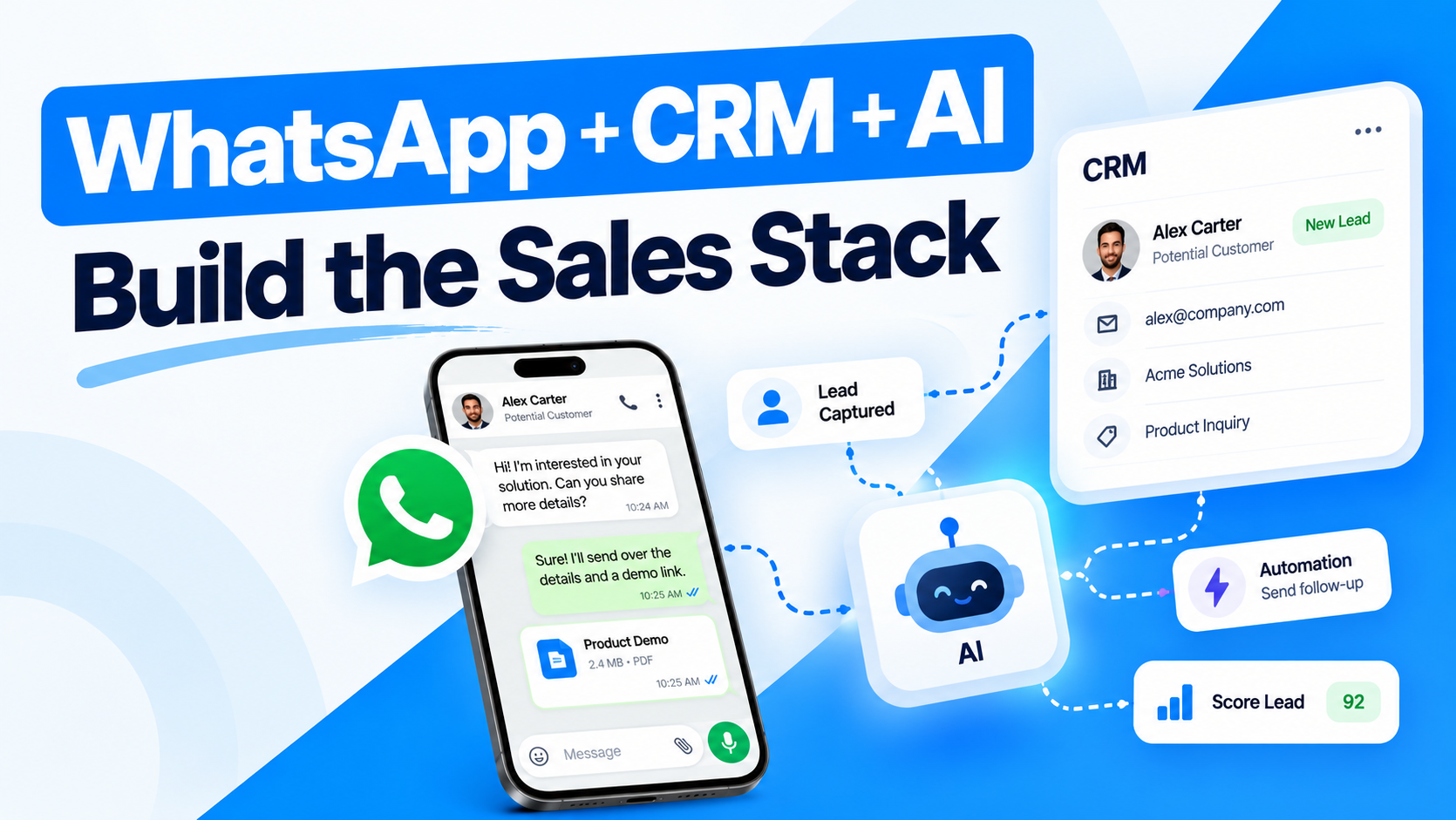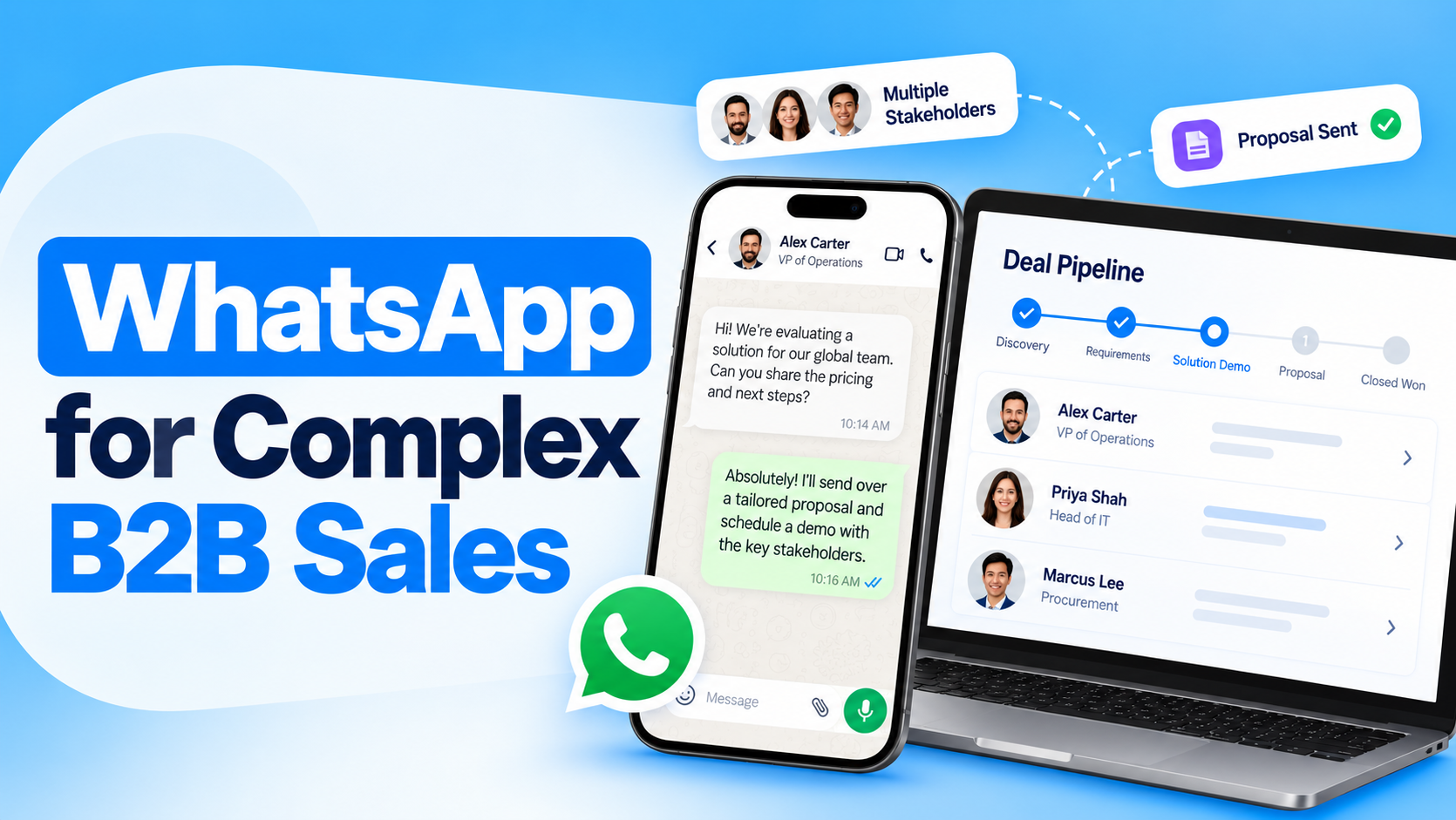


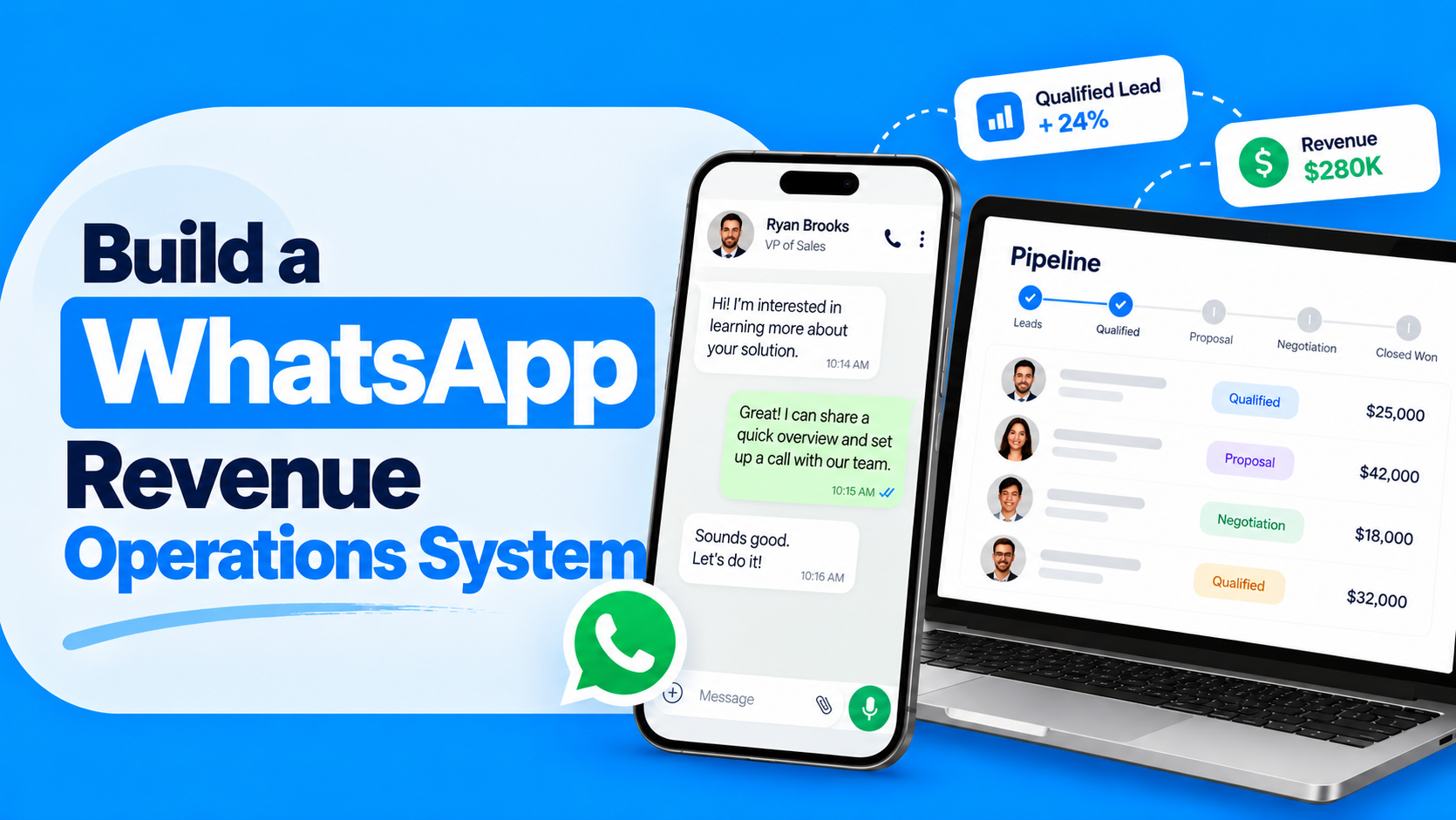
WhatsApp can generate leads, support sales conversations and improve follow-ups. But when marketing, sales and customer data operate separately, businesses still struggle to understand what actually drives revenue.
A WhatsApp Revenue Operations system connects lead generation, conversations, CRM data, sales ownership, follow-ups and revenue tracking into one structured workflow.
The goal is not to add more tools. It is to make sure every WhatsApp lead moves through a measurable process from first conversation to conversion.
Quick Answer
A WhatsApp Revenue Operations system connects marketing, sales and CRM workflows around WhatsApp so teams can track where leads come from, who owns them, what stage they are in and whether they eventually generate revenue.
A strong system should connect:
Lead source
WhatsApp conversation
Lead qualification
Sales ownership
CRM record
Follow-up activity
Pipeline stage
Revenue outcome
This gives teams a clearer view of the complete customer journey instead of measuring WhatsApp only through messages or lead volume.
What Is WhatsApp Revenue Operations?
Revenue Operations, or RevOps, aligns marketing, sales and customer processes around shared data and revenue outcomes.
In a WhatsApp-driven business, RevOps means connecting conversations with the systems that manage leads and opportunities.
Instead of:
Ad → WhatsApp Chat → Manual Follow-Up → Spreadsheet
the workflow becomes:
Lead Source → WhatsApp → Qualification → CRM → Sales Owner → Follow-Up → Opportunity → Revenue
A connected WhatsApp CRM integration is an important part of this because conversations should contribute to the customer record rather than remain isolated inside chat.
Start With Lead Source Tracking
Revenue operations starts before the conversation begins.
The business should know where each WhatsApp lead came from.
Common sources include:
Click-to-WhatsApp Ads
Google Ads
Website forms
Landing pages
QR codes
Organic traffic
Referral campaigns
Offline marketing
Tracking the source allows marketing and sales teams to compare not only lead volume but also lead quality and revenue contribution.
For example:
Campaign A: 200 leads, 5 customers
Campaign B: 80 leads, 12 customers
Campaign A may appear stronger when measuring only lead volume, while Campaign B may generate more valuable business.
This is why WhatsApp RevOps should connect acquisition data with the final sales outcome.
Build Qualification Into the Workflow
Not every WhatsApp enquiry should move directly to the sales team.
Basic qualification can help identify whether a prospect fits the business before sales resources are used.
Useful qualification criteria can include:
Requirement
Budget
Location
Company size
Product interest
Purchase timeline
Decision-making authority
Businesses can use WhatsApp Flows for B2B lead qualification to collect structured information before handing the conversation to sales.
The objective is not to create unnecessary friction.
It is to provide the salesperson with enough context to understand the opportunity quickly.
Define Lead Ownership Clearly
Every qualified lead should have a clear owner.
Without ownership, leads can remain unanswered, receive duplicate follow-ups or move between team members without accountability.
A good RevOps workflow should define:
Who receives new leads
How leads are assigned
When reassignment happens
Who owns the next action
When a manager should intervene
For example:
New Lead → Qualification → Territory Check → Sales Rep Assigned → Follow-Up Date Created
Lead ownership should always answer one question:
Who is responsible for moving this opportunity forward?
Connect WhatsApp With the Sales Pipeline
A conversation is not the same as an opportunity.
Sales teams need clear stages to understand where each lead stands.
A simple pipeline might include:
New Lead
Contacted
Qualified
Demo Scheduled
Proposal Sent
Follow-Up
Negotiation
Won
Lost
The CRM should reflect these stages while WhatsApp supports the conversations required to move the opportunity forward.
This gives sales managers visibility into:
Number of active opportunities
Deals stuck at a stage
Leads waiting for follow-up
Conversion by sales representative
Revenue generated from WhatsApp leads
Build a Follow-Up System
Revenue is often lost after the initial conversation.
A prospect may show interest, request pricing and then stop responding. Without a structured follow-up process, the opportunity can disappear.
A RevOps system should help teams identify:
Follow-ups due today
Overdue opportunities
Leads without a next action
Prospects inactive for a defined period
Deals requiring re-engagement
Automated WhatsApp sales follow-up can support repetitive follow-up tasks, while salespeople handle conversations that require judgement.
The goal is consistency without turning every customer interaction into automation.
Measure Revenue, Not Just WhatsApp Activity
Message volume, response rates and conversations can be useful operational metrics, but they do not show whether WhatsApp contributes to revenue.
A WhatsApp Revenue Operations system should connect activity with business outcomes.
Important metrics can include:
Leads by source
Qualified lead rate
Response time
Lead-to-demo rate
Proposal rate
Sales conversion rate
Revenue by lead source
Revenue by campaign
Average sales cycle
Lost opportunity reasons
For campaign-level measurement, WhatsApp campaign ROI metrics can help teams understand which metrics matter beyond clicks and messages.
What Should a WhatsApp RevOps Workflow Look Like?
A practical system does not need to be complicated.
A strong workflow can be:
Lead enters through WhatsApp
Lead source is captured
Qualification data is collected
CRM record is created or updated
Salesperson is assigned
Opportunity stage is tracked
Follow-up task is created
Conversation continues on WhatsApp
Revenue outcome is recorded
Marketing source is linked back to conversion
The important part is that data moves with the customer.
Marketing should understand what happens after the lead is generated, and sales should understand where the lead originally came from.
Build Around Revenue, Not Conversations
A WhatsApp Revenue Operations system should not be designed around sending more messages.
It should be designed around moving opportunities through a measurable revenue process.
The strongest system connects:
Marketing acquisition
WhatsApp conversations
Lead qualification
Sales ownership
CRM data
Follow-up
Pipeline management
Revenue reporting
When these elements work together, WhatsApp becomes more than a communication channel.
It becomes part of the revenue infrastructure.
Businesses that want to connect WhatsApp conversations with structured lead management, sales workflows and CRM visibility can explore EMOVUR WhatsApp CRM.
Book a CRM demo to see how the workflow can fit your revenue operations process.