

Sales teams often use WhatsApp, a CRM and AI tools at the same time. The problem is that these systems are frequently added separately, with different data, different workflows and no clear ownership between them.
A better sales stack defines a specific role for each layer.
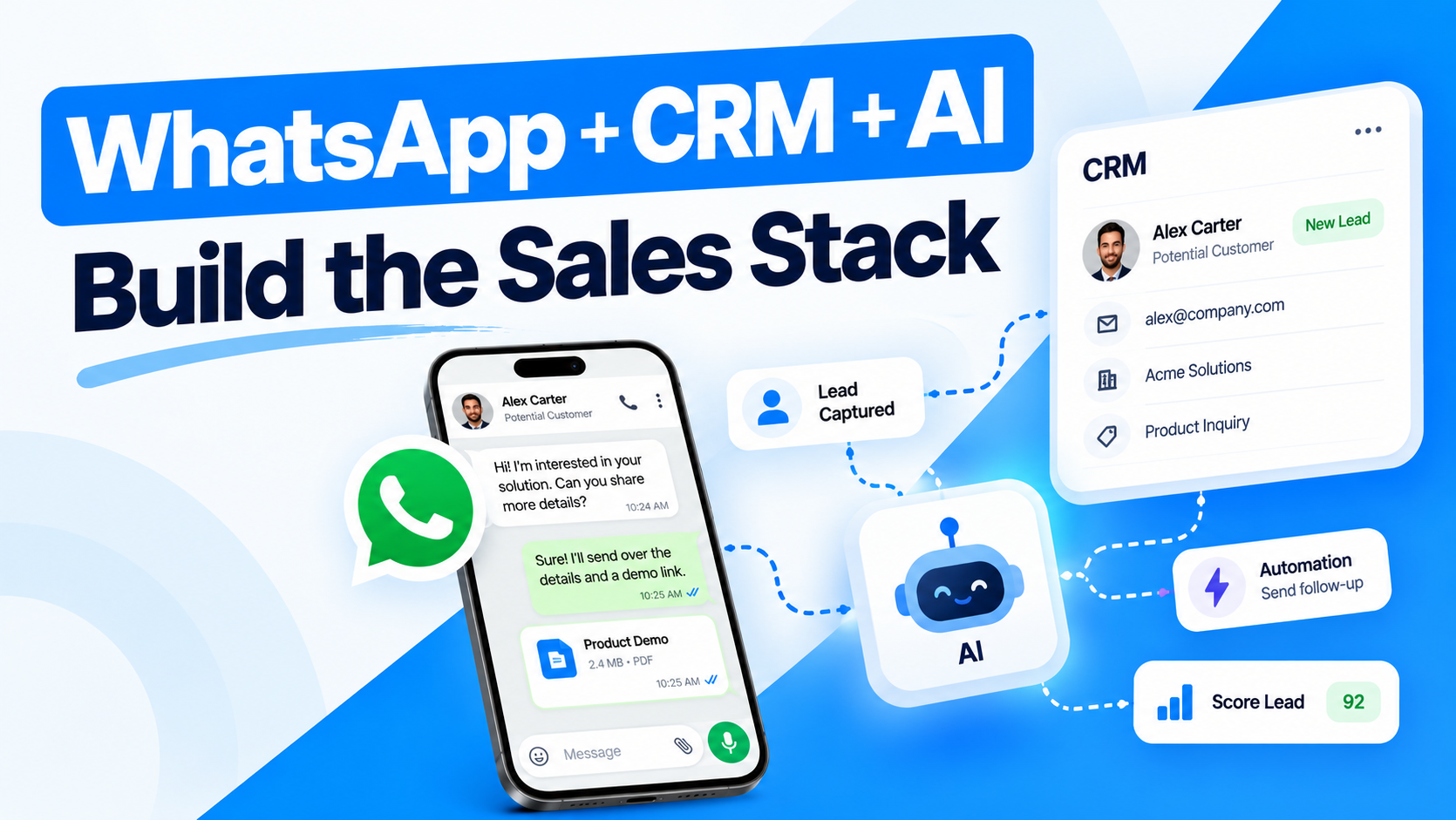
WhatsApp manages the conversation. CRM manages the customer and opportunity. AI helps interpret, assist and automate.
The value comes from connecting these three layers without creating duplicate work or conflicting data.
Quick Answer
A strong WhatsApp + CRM + AI sales stack should work as one connected system:
WhatsApp captures and continues customer conversations
CRM stores structured lead and opportunity data
AI analyses context, supports actions and reduces repetitive work
The most important design principle is simple: each system should have a clear job, and information should move between them automatically wherever possible.
Start by Defining the Role of Each Layer
Many sales stacks become complicated because the same information is stored in multiple places.
The first step is to decide what each system should own.
WhatsApp should own the conversation: customer messages, responses, media and real-time communication.
CRM should own the record: contact details, account information, opportunity stage, owner, value and sales history.
AI should support decisions: summarisation, intent detection, suggested actions, classification and assistance.
This separation prevents the team from using WhatsApp as a CRM or treating an AI assistant as the source of truth.
What Data Should Move From WhatsApp to the CRM?
The CRM does not need every message copied into multiple fields. It needs structured information that helps the sales team manage the opportunity.
Useful data to capture includes:
Contact and company details
Product or service interest
Lead source
Qualification answers
Assigned sales owner
Important conversation summary
Meeting or demo status
Next action
Opportunity stage
A proper WhatsApp CRM integration should reduce manual updating while keeping the CRM accurate.
The objective is not to move everything.
It is to move the information that changes a sales decision.
Where Should AI Sit in the Stack?
AI should not be treated as a separate destination where salespeople have to move data manually.
It should sit across the stack and assist when context is available.
For example, AI can help:
Summarise a long WhatsApp conversation
Identify the customer's main requirement
Extract important details from messages
Suggest a next action
Detect when a lead needs human attention
Draft a relevant response for salesperson review
Categorise conversations
Highlight missing information
This makes AI an assistance layer, rather than another tool employees need to manage.
Avoid Building Three Separate Sources of Truth
One of the biggest mistakes in a modern sales stack is allowing different systems to hold conflicting versions of the same customer.
For example:
WhatsApp says the lead wants Product A
CRM still shows Product B
AI is analysing an outdated conversation summary
This creates bad automation and poor sales decisions.
A cleaner architecture follows one rule:
The CRM should remain the structured source of truth, while WhatsApp provides live conversation context and AI works from the most current available data.
That helps prevent duplicate records, stale lead information and inconsistent handoffs.
Design Events, Not Just Integrations
Connecting two tools is not enough.
The stack should define what happens when an important event occurs.
Examples include:
New WhatsApp enquiry: create or match the CRM contact
Qualification completed: update selected CRM fields
Demo requested: create the next sales action
Conversation becomes inactive: flag it for review
Opportunity stage changes: adjust the communication workflow
Customer replies after a long gap: reopen the sales task
Salesperson takes control: pause unnecessary automation
Thinking in events makes the stack more reliable than simply syncing everything continuously.
Decide What Should Be Automated
A connected stack can automate many operational steps, but automation should be selective.
Good candidates include:
Contact creation
Data extraction
Conversation summaries
Task creation
Lead routing
Internal alerts
Meeting confirmations
Status updates
Follow-up reminders
Activities that still need human judgement include:
Complex pricing discussions
Negotiation
Strategic objections
Account-specific recommendations
Sensitive customer issues
High-value deal decisions
A strong stack removes repetitive work without removing accountability.
Use AI Where Context Is Rich Enough
AI performs better when it has meaningful context.
For example, an AI assistant working only from the latest WhatsApp message may produce a weak recommendation.
An AI assistant that can use:
Recent conversation history
Account details
Current opportunity stage
Previous sales activity
Product interest
Relevant notes
can produce a much more useful output.
This is where stack design matters.
The quality of AI assistance depends not only on the model, but on the quality and availability of the business context around it.
What Should the Final Sales Experience Look Like?
From the salesperson's perspective, the stack should feel simple.
They should be able to understand:
Who the customer is
What the customer wants
What has already happened
What the current opportunity stage is
What action should happen next
without manually checking multiple tools.
That is the practical test of whether the stack is working.
If the salesperson still has to search across WhatsApp, CRM notes, spreadsheets and AI tools to understand one opportunity, the stack is not truly integrated.
Build the Stack Around Clear Ownership
The best WhatsApp + CRM + AI sales stack is not the one with the most automation.
It is the one with the clearest system ownership.
WhatsApp owns the conversation
CRM owns the structured customer and opportunity record
AI assists with interpretation and action
Automation moves information between the layers
Salespeople remain responsible for important decisions
When these roles are clear, the stack becomes easier to manage, easier to scale and far more useful to the sales team.