

Recruitment often slows down because candidate communication is fragmented across calls, emails, job portals and spreadsheets.
Candidates may miss interview emails, recruiters may struggle to follow up quickly, and shortlisted applicants can lose interest when the hiring process goes silent for several days.
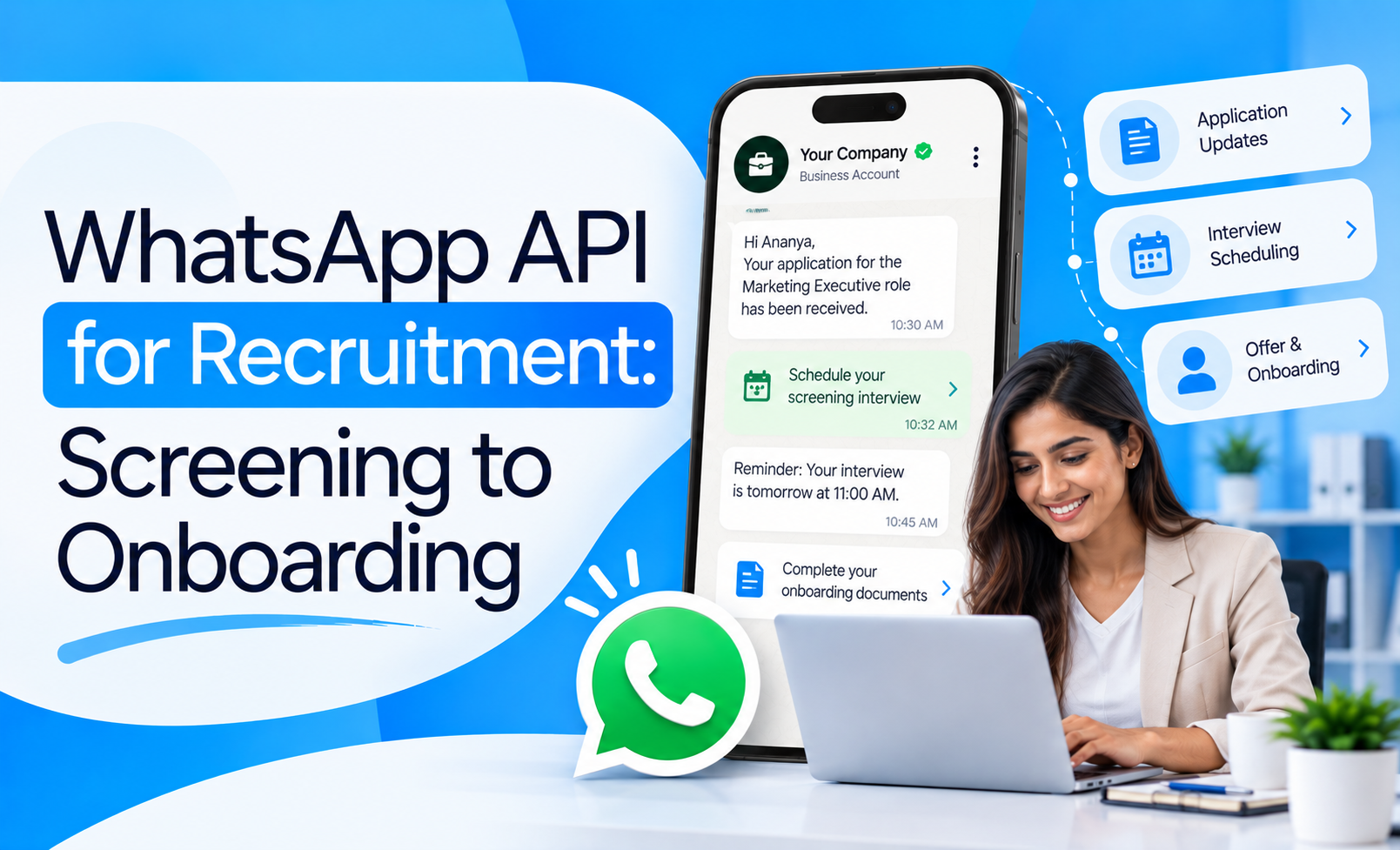
The WhatsApp API for recruitment can help HR and talent teams create a more responsive candidate journey. It can support screening, interview coordination, application updates, offer communication and onboarding reminders without replacing the recruiter.
The objective is to make recruitment communication faster, more consistent and easier for candidates to follow.
Quick Concept
A practical WhatsApp recruitment journey can support:
Candidate screening: Collect basic eligibility and role-fit information.
Interview scheduling: Confirm available slots without repeated calls.
Application updates: Keep candidates informed about progress.
Recruiter handoff: Move qualified candidates to a human recruiter with context.
Offer communication: Notify selected candidates and guide the next step.
Onboarding reminders: Help new hires complete joining requirements on time.
The strongest use case is not mass messaging. It is reducing friction between important recruitment stages.
Use WhatsApp for Initial Candidate Screening
Recruiters often spend time speaking with applicants who do not meet basic role requirements.
WhatsApp can help collect essential screening information before a recruiter starts a detailed conversation.
A short screening flow can capture:
Role interest: Confirm which position the candidate is applying for.
Experience: Ask for relevant years or type of experience.
Location: Check whether the candidate can work in the required location or format.
Notice period: Understand joining availability.
Salary expectations: Collect a reasonable range where needed.
Basic eligibility: Ask role-specific questions that can be answered clearly.
The screening flow should remain short. Asking for too much information at this stage can increase candidate drop-off.
For structured data collection, WhatsApp Flows for consent-based data collection can help businesses collect candidate responses in a more organised format.
Move Qualified Candidates to Recruiters With Context
Automation can help with basic screening, but hiring decisions still require human judgement.
Once a candidate passes the first stage, the recruiter should receive enough context to continue the conversation without asking the same questions again.
A useful handoff should include:
Candidate name
Role applied for
Screening responses
Experience summary
Location
Availability
Important recruiter notes
This creates a smoother transition from automated screening to human recruitment.
The candidate should feel that the process is continuing naturally rather than restarting from the beginning.
Simplify Interview Scheduling
Interview coordination can become one of the most repetitive parts of recruitment.
WhatsApp can reduce back-and-forth communication by making scheduling more structured.
A useful interview workflow can include:
Share available slots: Give the candidate a small number of options.
Confirm the selected slot: Send date, time and interview mode clearly.
Send meeting details: Add the office location or online meeting link where relevant.
Send a reminder: Reduce missed interviews with a timely notification.
Allow rescheduling: Give candidates a clear option if they cannot attend.
Businesses can adapt the logic used in WhatsApp Flows for appointment booking for interview scheduling without creating long message exchanges.
Keep Candidates Updated During the Hiring Process
Silence is one of the biggest causes of poor candidate experience.
Even when a final decision is not ready, applicants benefit from knowing what is happening.
Useful application updates can include:
Application received: Confirm that the profile has entered the process.
Shortlisted: Tell the candidate what happens next.
Interview completed: Confirm that feedback is under review.
Additional round required: Explain the next stage clearly.
Decision pending: Let the candidate know when they can expect an update.
Application closed: Communicate the outcome respectfully.
The objective is not to send frequent messages.
It is to avoid leaving candidates uncertain for long periods.
Use WhatsApp for Offer-Stage Communication
Once a candidate is selected, communication becomes more time-sensitive.
Candidates may be considering multiple offers, discussing notice periods or waiting for documentation.
WhatsApp can help support the offer stage by keeping next steps clear.
A structured process can include:
Selection confirmation: Inform the candidate that they have been selected.
Offer-document notification: Tell them when and where the official offer can be reviewed.
Acceptance reminder: Follow up when the decision deadline is approaching.
Joining-date confirmation: Reconfirm the agreed start date.
Document checklist: Explain which documents are required before joining.
Formal offer letters and contracts should remain in the appropriate document or HR system.
WhatsApp should support the communication around them, not replace the official process.
Reduce Candidate Drop-Off Before Joining
A candidate accepting an offer does not guarantee that they will actually join.
The period between offer acceptance and joining is often where recruitment teams lose candidates.
WhatsApp can help maintain useful contact during this gap.
Relevant pre-joining communication may include:
Joining-date reminder: Reconfirm the date before the first day.
Document reminder: Notify candidates about incomplete joining requirements.
Location or login details: Share practical instructions required for Day 1.
Point-of-contact information: Tell the candidate whom to contact if they need help.
Welcome communication: Provide a simple introduction to what they should expect.
The communication should remain useful rather than turning into constant follow-ups.
Use WhatsApp During Early Onboarding
Once the candidate becomes an employee, WhatsApp can still support basic onboarding coordination where appropriate.
Useful onboarding communication can include:
Orientation schedule
Reporting time
Office or remote-login instructions
Pending document reminders
Training-session reminders
HR contact information
Sensitive employee records, payroll data or confidential HR information should stay inside secure HR systems rather than being managed casually through chat.
The role of WhatsApp is to help the employee know what happens next, not to become the HR database.
Know What Should Stay Human
Recruitment includes decisions that should not be delegated entirely to automation.
Human recruiters should remain responsible for:
Candidate evaluation
Interview judgement
Compensation discussions
Sensitive rejection conversations
Role-fit decisions
Negotiation
Complex candidate questions
Automation should reduce administrative work so recruiters can spend more time on these higher-value conversations.
Measure Recruitment Outcomes, Not Message Volume
The success of a WhatsApp recruitment workflow should be measured by hiring outcomes rather than the number of messages sent.
Useful metrics include:
Screening completion rate
Qualified candidate rate
Interview booking rate
Interview attendance rate
Candidate response time
Offer acceptance rate
Pre-joining drop-off rate
Joining rate
For example, sending more interview reminders is not useful if candidates still fail to attend.
The better question is:
Did WhatsApp make the hiring process easier for both the candidate and recruiter?
Build WhatsApp Around the Candidate Journey
A strong WhatsApp API strategy for recruitment should connect the major communication stages:
Application → Screening → Shortlisting → Interview → Selection → Offer → Joining → Onboarding
Each stage should have a clear purpose and next action.
When WhatsApp is used this way, it becomes a practical recruitment communication layer that reduces delays, improves candidate experience and helps recruiters spend less time on repetitive coordination.
Businesses that want to build structured messaging and workflow automation can explore the WhatsApp Business API as the underlying communication layer.