

Automotive customer journeys rarely end with one enquiry. A buyer may ask about a model, compare variants, request pricing, schedule a test drive, postpone the visit, return later, complete the purchase and then come back months later for service.
For dealerships, this creates dozens of communication points across sales and after-sales teams.
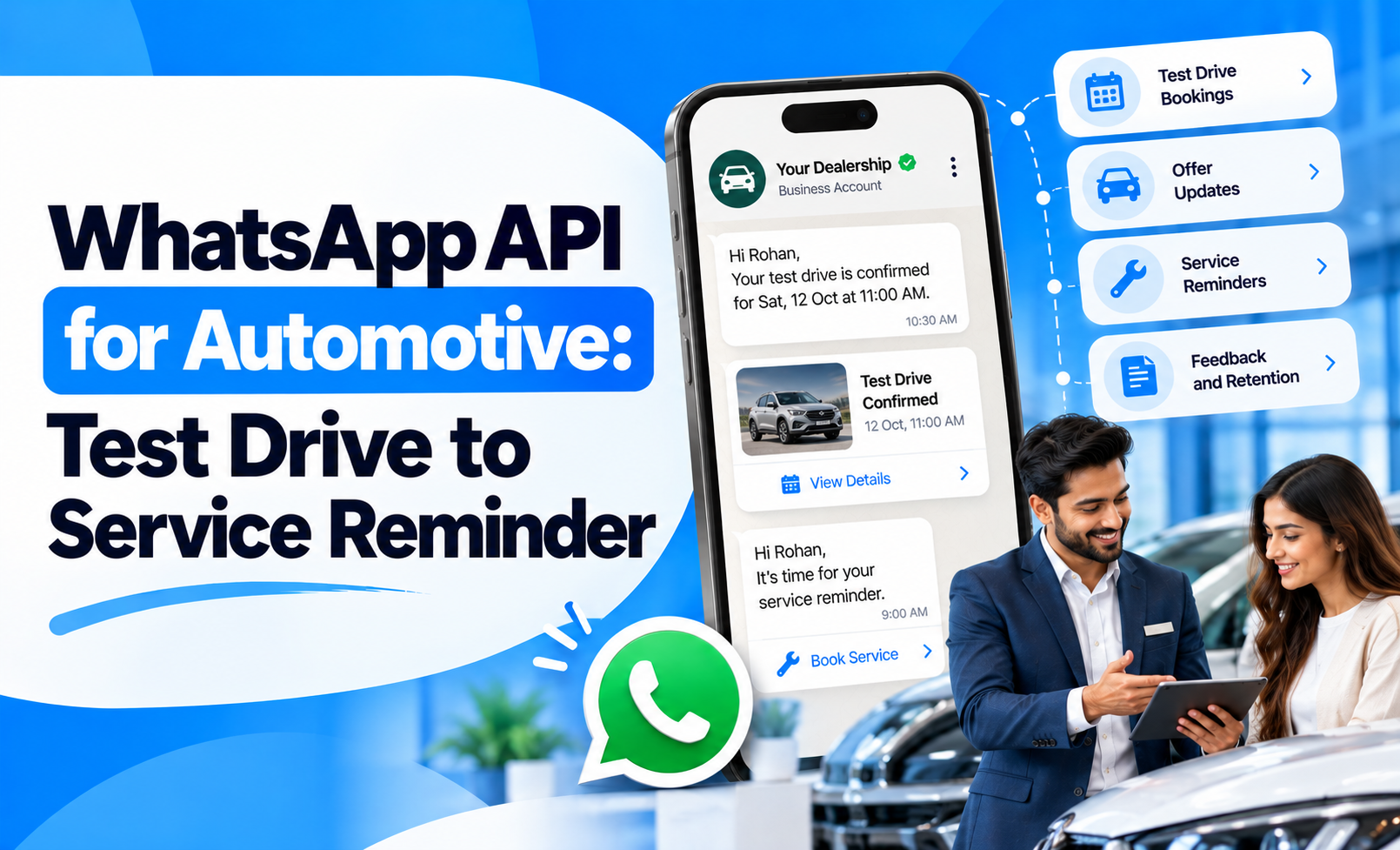
The WhatsApp API for automotive businesses can connect these stages through structured messaging, reminders and customer support. Instead of relying only on calls or disconnected follow-ups, dealerships can use WhatsApp to keep the customer informed from the first test-drive request to future service reminders.
The objective is not to automate the entire dealership experience. It is to remove avoidable communication gaps.
Quick Concept
A practical automotive WhatsApp journey can support:
Vehicle enquiry: Understand the customer’s preferred model, variant and location.
Test-drive booking: Confirm dealership, date and time.
Sales follow-up: Continue the conversation after the drive without relying only on calls.
Booking and delivery updates: Keep customers informed as the purchase progresses.
Ownership communication: Share relevant post-delivery updates.
Service reminders: Bring customers back for scheduled maintenance.
The strongest system keeps sales and after-sales communication connected while giving customers a clear next action at every stage.
Turn Vehicle Enquiries Into Test-Drive Bookings
An automotive enquiry is more valuable when the dealership quickly converts interest into a physical or scheduled interaction.
Instead of asking the customer to call the dealership, WhatsApp can guide the next step.
A useful enquiry flow can collect:
Model interest: Identify the vehicle or category the customer wants to explore.
Variant preference: Understand whether they are comparing specific trims or features.
Preferred dealership: Route the enquiry based on customer location.
Test-drive preference: Ask for a suitable date or time window.
Contact confirmation: Ensure the correct customer details are available before scheduling.
The flow should remain short. Asking too many questions before confirming a test drive can create unnecessary friction.
Make Test-Drive Communication More Reliable
A booked test drive can still become a missed appointment if confirmation and reminders are weak.
WhatsApp can make the appointment easier to manage for both the customer and dealership.
A structured test-drive journey can include:
Immediate confirmation: Send the vehicle model, dealership, date and time after booking.
Pre-visit reminder: Remind the customer before the scheduled slot so they can confirm or reschedule.
Location guidance: Share the dealership location or relevant arrival instructions.
Reschedule option: Give customers an easy way to move the appointment instead of simply not showing up.
Salesperson information: Where useful, tell the customer who will assist them at the dealership.
This reduces unnecessary coordination calls while giving the sales team a clearer view of expected visits.
For appointment-based workflows, WhatsApp Flows for appointment booking can support structured scheduling without requiring a long back-and-forth chat.
Follow Up Differently After the Test Drive
Post-test-drive follow-up should not begin with a generic promotional message.
The customer has already experienced the vehicle, so the conversation should reflect that context.
Useful follow-up actions include:
Capture immediate interest: Ask whether the customer wants pricing, finance information or another variant.
Address specific questions: Continue discussions around features, availability or model comparison.
Schedule the next action: This may be another showroom visit, finance discussion or booking conversation.
Avoid repetitive calls: Use WhatsApp when a short clarification can move the opportunity forward.
Keep follow-up relevant: Someone who is still comparing models should not receive the same communication as someone ready to book.
A relevant follow-up feels like continuation of the showroom conversation rather than another lead-nurture campaign.
Use WhatsApp During Booking and Delivery
Once a customer books a vehicle, communication changes from sales persuasion to purchase confidence.
At this stage, customers want clear updates.
Useful WhatsApp touchpoints can include:
Booking confirmation: Confirm vehicle, variant and relevant booking details.
Documentation status: Notify the customer when specific paperwork or action is pending.
Payment updates: Confirm successful transactions without exposing unnecessary sensitive information.
Vehicle status: Share meaningful updates where dealership processes allow.
Delivery scheduling: Confirm the agreed handover date and dealership location.
Delivery reminder: Send final instructions so the customer knows what to expect.
Customers should not have to repeatedly call the salesperson simply to ask what is happening with their booking.
Keep the Relationship Active After Delivery
The delivery should not be the last meaningful WhatsApp interaction.
After-sales communication can improve the ownership experience when it remains timely and useful.
Relevant post-delivery communication may include:
Ownership check-in: Ask whether the customer needs help with a dealership-related question.
Documentation updates: Notify customers when pending documents or dealership processes are complete.
Accessory or support communication: Share information only when it is relevant to the purchased vehicle.
Service onboarding: Explain when the customer should expect the next service-related communication.
The goal is to smoothly move the relationship from sales to ownership without making the customer feel that the dealership disappeared after delivery.
Use Service Reminders to Bring Customers Back
Service retention is one of the strongest automotive WhatsApp use cases because the customer already has an established relationship with the dealership.
A service-reminder flow can be built around:
Upcoming service due: Notify the customer before the recommended service window.
Booking option: Allow them to request a convenient slot directly.
Service confirmation: Send workshop, date and time once booked.
Pre-service reminder: Reduce missed appointments with a timely reminder.
Completion update: Notify the customer when the vehicle is ready where the dealership process supports it.
Future reminder: Continue the ownership cycle based on the next scheduled service.
The communication should be based on vehicle and service context, not generic monthly promotions.
Connect Sales and After-Sales Instead of Treating Them Separately
A common automotive communication problem is that sales and service teams operate as separate customer journeys.
WhatsApp can help create continuity.
For example:
Vehicle Enquiry → Test Drive → Booking → Delivery → Ownership → Service
The customer should not feel like a completely new contact every time they move to another department.
Businesses that want a broader automotive workflow can also review WhatsApp automation for automotive dealers for additional dealership automation use cases.
Measure the Journey, Not Just the Messages
Automotive teams should evaluate WhatsApp based on operational and commercial outcomes.
Useful metrics include:
Test-drive booking rate
Test-drive attendance rate
Post-drive follow-up completion
Booking conversion rate
Delivery-related enquiry reduction
Service booking rate
Service reminder response rate
Repeat workshop visits
A high message-delivery rate does not necessarily mean the workflow is effective.
The better question is whether WhatsApp helps customers move more smoothly through the dealership lifecycle.
When structured correctly, the WhatsApp API for automotive businesses becomes a communication layer connecting the customer from first interest to long-term vehicle ownership.