

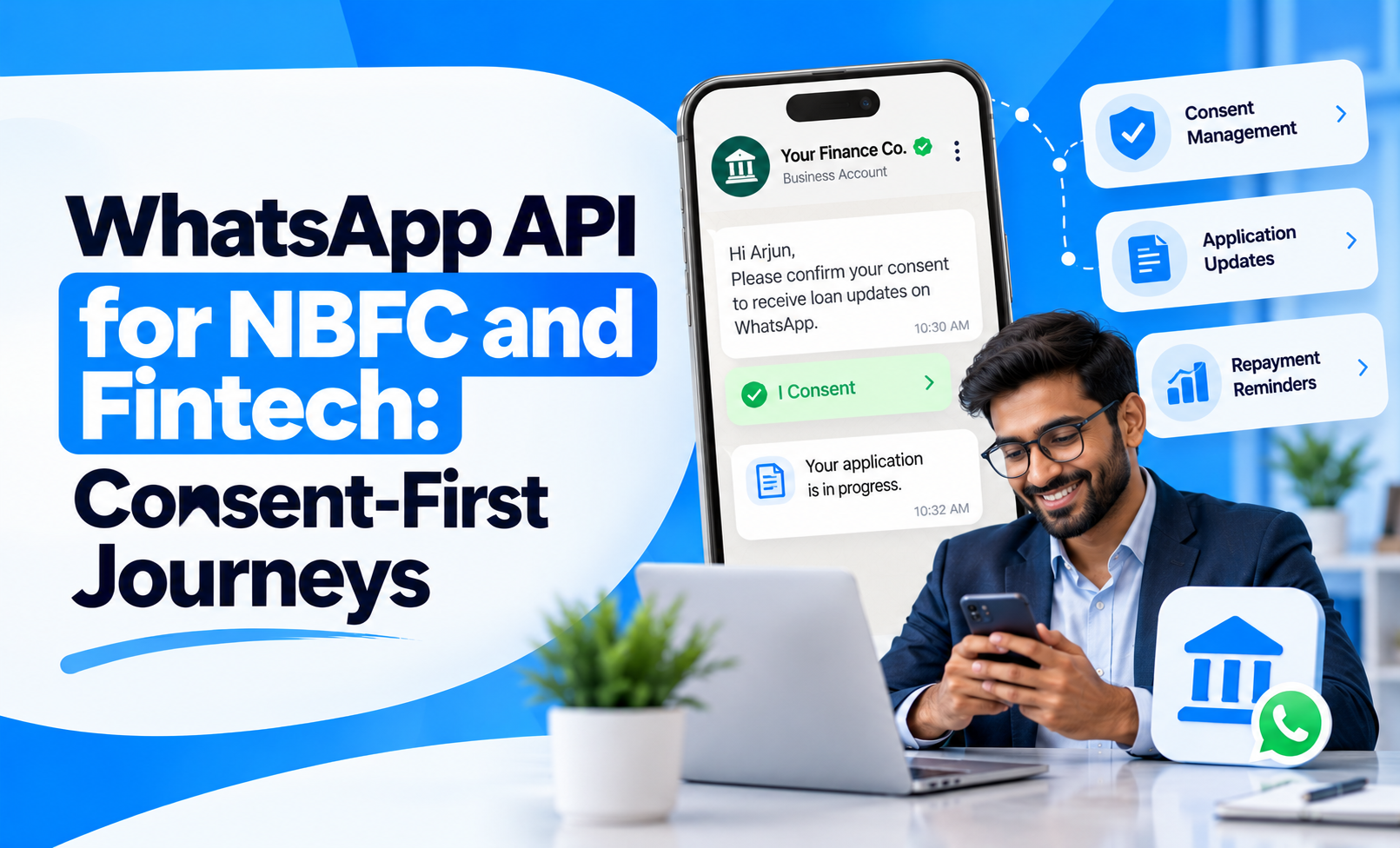
WhatsApp can make financial customer journeys faster, but speed cannot come at the cost of consent.
For NBFCs and fintech companies, customer conversations may involve loan enquiries, application updates, document requests, repayment reminders, service communication and support. Each stage can involve personal or financial information, which makes consent and purpose limitation especially important.
A WhatsApp API for NBFC and fintech should therefore be designed around a simple principle: collect only what is required, explain why it is required and communicate only within the purpose the customer has agreed to.
The result is not just a more compliant journey. It is also a clearer customer experience.
Quick Concept
A consent-first WhatsApp journey means the customer understands who is contacting them, why they are being contacted, what information is being requested and how they can stop or change that communication.
For NBFCs and fintechs, the journey should be designed around:
Clear purpose: Explain why information or permission is being requested.
Explicit customer action: Do not treat silence or inactivity as consent.
Minimum necessary data: Collect only information relevant to the specific financial journey.
Purpose separation: Loan servicing, support and marketing should not be treated as one blanket permission.
Withdrawal and opt-out: Give customers a practical way to stop communication or withdraw applicable consent.
RBI's digital-lending framework requires need-based data collection with prior and explicit borrower consent and an audit trail, while borrowers must be able to deny specific data use and revoke previously granted consent.
Start the WhatsApp Journey With Clear Context
A financial message should never leave the customer wondering why an NBFC or fintech is contacting them.
The opening interaction should establish context before requesting additional information.
A clear journey can include:
Identify the business: Use the actual NBFC, fintech or regulated entity identity rather than an unclear campaign name.
Explain the trigger: Tell the customer whether the conversation follows a loan enquiry, application, repayment event or service request.
State the purpose: Make it clear what the conversation will help the customer complete.
Give a clear choice: Customers should understand whether they can continue, decline or use another support channel.
For example, a loan enquiry initiated by the customer can continue into qualification, but that should not automatically become consent for unrelated promotional campaigns.
Separate Service Consent From Marketing Consent
One of the most important design choices is separating necessary customer communication from promotional messaging.
A customer may expect updates about an application without expecting new credit offers every week.
Businesses should distinguish between:
Application communication: Status updates, missing-information requests and next steps related to an existing application.
Loan servicing: Repayment confirmations, due-date information and account-related updates.
Customer support: Communication initiated to resolve a service request or complaint.
Marketing communication: New offers, cross-sell campaigns or promotional messages that serve a different purpose.
WhatsApp also requires businesses using marketing messaging to secure the necessary rights, permissions and opt-ins and to honour requests to stop receiving such messages.
This separation prevents a service relationship from becoming an unlimited marketing permission.
Collect Only the Data Needed at That Stage
A consent-first journey should avoid asking for every possible customer detail at the beginning.
Instead, collect information progressively based on the current task.
For example:
Initial enquiry: Product interest, basic eligibility information and preferred next step.
Application stage: Information genuinely required to continue the lending process.
KYC stage: Direct the customer into the approved verification workflow instead of collecting unnecessary documents inside chat.
Servicing stage: Use verified account context rather than repeatedly asking the customer to reshare personal information.
RBI requires data collection by digital lending apps and lending service providers to be need-based. It also restricts unnecessary access to mobile-phone resources and requires explicit consent where specific access is necessary for onboarding or KYC.
Make Consent Specific and Understandable
Consent is weaker when the customer is presented with one broad statement covering everything the business might ever do.
A better approach is to connect permission to a clear purpose.
Good consent design should:
Name the purpose: Tell customers what their data will be used for.
Keep the language simple: Avoid burying important information inside legal-heavy messaging.
Separate unrelated purposes: Do not combine loan processing, third-party sharing and future promotions into one vague choice.
Record the action: Maintain evidence of the customer’s affirmative response where required.
Respect withdrawal: Ensure operational systems can respond when customers change their choice.
India's Digital Personal Data Protection Act states that consent should be free, specific, informed, unconditional and unambiguous, based on clear affirmative action and limited to data necessary for the specified purpose.
Design Application Updates Around the Customer’s Existing Journey
Once a customer has started an application, WhatsApp can reduce unnecessary calls and uncertainty.
Relevant updates can include:
Application received: Confirm that the request has entered the process.
Information required: Clearly identify what action is still needed.
Application status: Communicate meaningful changes without exposing unnecessary sensitive information.
Next-step notification: Direct the customer to the appropriate secure process.
Completion update: Confirm when the relevant application stage has finished.
The message should provide enough context to be useful without placing unnecessary financial or identity data inside the conversation.
Businesses building structured messaging and automated customer journeys can use the WhatsApp Business API as the communication layer while keeping core financial processing within appropriate systems.
Keep Sensitive Actions Outside Casual Chat
WhatsApp can initiate or support a financial journey, but not every action belongs directly inside the conversation.
Higher-risk activities should move customers into secure, purpose-built systems.
This can include:
Identity verification
Detailed KYC submissions
Loan agreement execution
Sensitive financial-data access
Authentication
Account credential changes
Detailed financial disclosures
WhatsApp should tell the customer what to do next and why, while the secure financial system handles the sensitive transaction.
Build Opt-Out Into the Journey
Consent management should not end once permission is obtained.
Customers need practical control over future communication.
A well-designed journey should allow them to:
Stop promotional communication
Change messaging preferences
Decline optional data collection
Request human support
Understand where to raise a grievance
Withdraw applicable consent where the law or workflow allows
This is especially important for financial businesses because customer trust can be damaged quickly when messages continue after a customer has clearly indicated they do not want them.
Consent Should Shape the Journey, Not Sit Under It
For NBFCs and fintech companies, consent should not be a checkbox added after the WhatsApp workflow has already been designed.
It should determine the workflow itself.
A strong consent-first model asks at every stage:
What does the customer expect here?
What information is actually required?
What permission applies to this purpose?
What should remain inside WhatsApp?
What should move to a secure system?
How can the customer stop or change the interaction?
When these questions guide the journey, WhatsApp becomes a useful communication layer without turning convenience into over-collection or unwanted messaging.
That is the foundation of a sustainable WhatsApp API strategy for NBFCs and fintechs.