

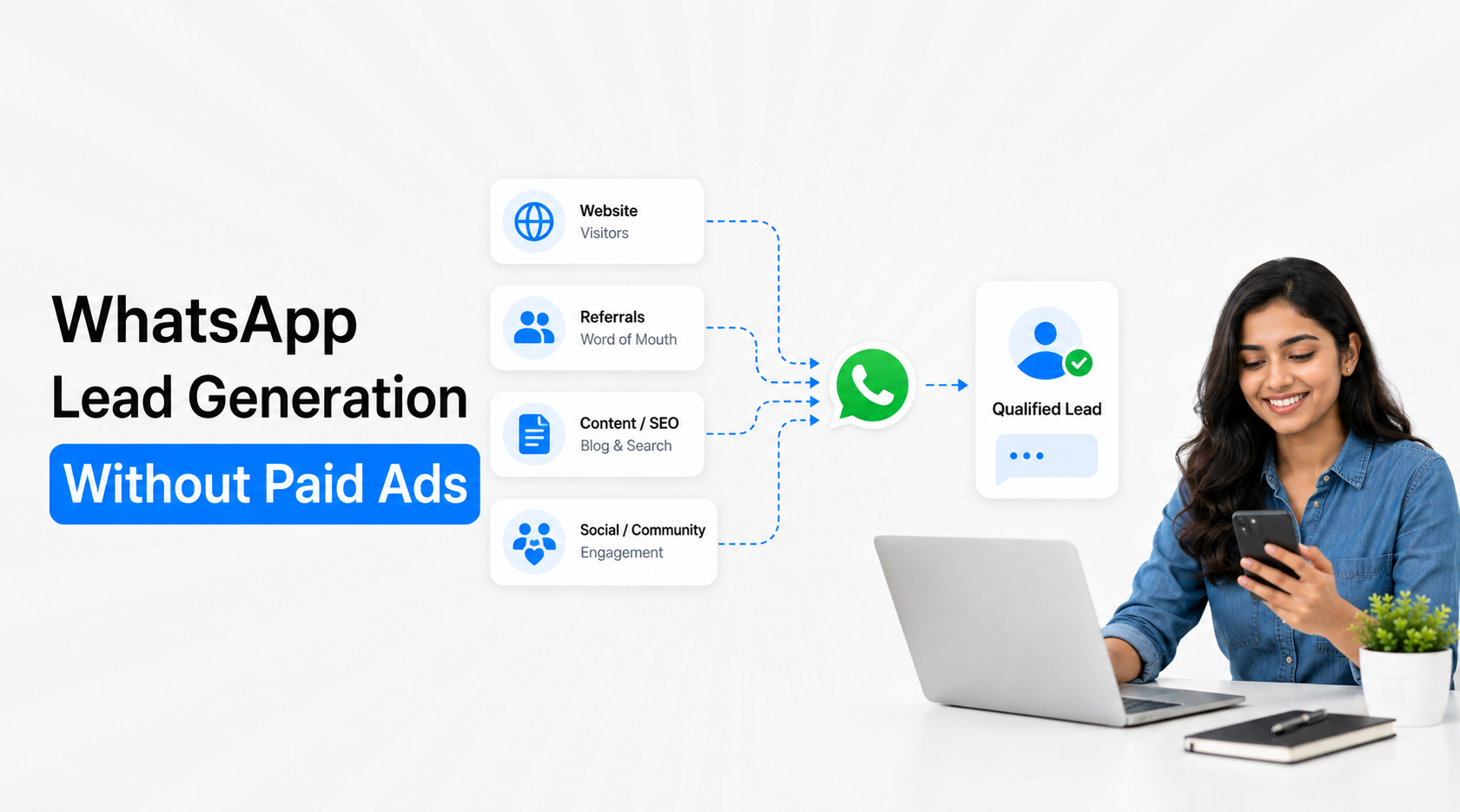
WhatsApp lead generation without paid ads works by turning existing organic traffic, search visibility, social audiences, offline interactions, referrals and owned channels into WhatsApp conversations. Instead of paying Meta for every new enquiry, businesses can place WhatsApp entry points across websites, Google-search journeys, Instagram profiles, QR codes, email, events, product packaging and customer referrals. The strongest organic strategy does not simply publish a WhatsApp number everywhere. It gives prospects a specific reason to start a conversation and moves those enquiries towards qualification, booking or sales.
Where Can Organic WhatsApp Leads Come From?
WhatsApp itself does not need to be the original discovery channel. A prospect can discover the business elsewhere and choose WhatsApp as the easiest next step.
Meta's current WhatsApp Business Platform documentation specifically recommends using off-WhatsApp channels such as websites, storefronts and customer communications to create organic awareness, while native entry points such as website buttons and QR codes can make it easier for customers to start conversations.
Common sources of WhatsApp lead generation without paid ads include:
Organic search: People discover a service page, product page or blog through Google and move into WhatsApp.
Website traffic: Existing visitors use a WhatsApp CTA instead of completing a traditional contact form.
Instagram and Facebook profiles: Organic followers move from social content into a business conversation.
WhatsApp QR codes: Offline visitors scan from stores, events, packaging or printed material.
Short links: A direct WhatsApp entry point can be placed across owned digital assets.
Email audiences: Existing subscribers can move into WhatsApp when a conversation is more appropriate.
Customer referrals: Existing customers share a WhatsApp contact or referral link.
Events and webinars: Attendees start conversations after sessions or offline interactions.
WhatsApp Channels and Status: Organic content can create interest that later becomes a direct enquiry.
Meta currently lists QR codes, short links, Facebook Page action buttons and Instagram profile entry points among free ways businesses can attract customers into WhatsApp.
The acquisition cost may be lower than paid advertising, but organic lead generation still requires traffic, content, positioning and a good conversion journey.
1. Turn Website Traffic Into WhatsApp Enquiries
Your website is usually the highest-control organic source because visitors have already searched for the business, product or problem.
Do not place the same generic “Chat on WhatsApp” button on every page without considering visitor intent.
Match the CTA to the page.
Examples:
Pricing page: Ask About Pricing
Product page: Check Availability
Service page: Discuss Your Requirement
Course page: Speak With a Counsellor
Property page: Check Current Availability
Clinic page: Ask About Appointment Availability
B2B page: Discuss Your Use Case
The WhatsApp conversation should inherit that context.
A visitor coming from a Data Analytics course page should not enter a generic menu asking which course they are interested in. A visitor coming from a specific property page should not be asked which project they want information about if the source page already answers that question.
Useful website placements include:
Hero CTA
Service/product sections
Sticky mobile button
Pricing section
Contact page
FAQ section
Exit-intent or high-intent sections
Blog CTAs where commercial intent naturally appears
For businesses using the API at scale, WhatsApp Business API can provide the messaging infrastructure behind these website-generated conversations.
2. Use SEO Pages to Generate High-Intent WhatsApp Leads
Organic WhatsApp lead generation becomes much stronger when the website attracts search queries with commercial intent.
A user searching “data science course in Bangalore” has different intent from someone searching “what is data science?” The first page deserves a stronger WhatsApp conversion path.
Map WhatsApp CTAs to search intent.
Commercial Search Pages
Use CTAs such as:
Get Fee Details
Check Availability
Speak With an Expert
Request a Quote
Book Consultation
Comparison Pages
Use:
Help Me Choose
Compare Options With an Advisor
Ask Which Plan Fits
Local SEO Pages
Use:
Check Appointment
Ask for Directions
Talk to This Branch
Check Service Availability
Informational Blogs
Avoid forcing a sales conversation on every visitor. Introduce WhatsApp only where the user reaches a logical commercial next step.
This gives SEO-to-WhatsApp lead generation an important advantage: the search keyword already provides context about what the prospect wants.
3. Use Free WhatsApp Entry Points Across Social Profiles
Meta currently supports free WhatsApp entry points including short links and action buttons from Facebook and Instagram profiles.
That means organic social content can generate WhatsApp enquiries without boosting every post.
The key is to connect content with a conversational action.
For example:
An Instagram Reel explaining a home-interior transformation could end with:
“Planning your own renovation? Message us on WhatsApp with your room type.”
A B2B post could use:
“Not sure which setup fits your sales team? Send your team size on WhatsApp.”
An education post could use:
“Confused between Data Analytics and Data Science? Ask a counsellor on WhatsApp.”
These CTAs work better than repeatedly publishing “DM us for details” because the prospect understands what will happen after entering WhatsApp.
Use different organic content themes to generate different conversation intents:
Educational content → clarification
Product content → availability
Customer proof → consultation
Comparison content → recommendation
Event content → registration
Demonstration content → demo request
The social post creates interest. WhatsApp captures the commercial conversation.
4. Make QR Codes Generate Measurable Leads
WhatsApp QR codes are useful because they connect offline attention directly with a digital conversation. Meta identifies QR codes as a native WhatsApp entry point businesses can use to help customers start chats.
Do not print one generic QR code everywhere without knowing why customers scanned it.
Use different entry contexts where possible.
QR code placements can include:
Retail counter
Product packaging
Restaurant table
Exhibition stall
Event backdrop
Brochure
Business card
Clinic reception
Property site
Training seminar
Invoice or receipt
Give each QR code a specific purpose.
Weak: Scan to WhatsApp Us
Better: Scan to Check Product Availability
Better: Scan to Book a Site Visit
Better: Scan to Get the Course Curriculum
Better: Scan for Installation Support
A labelled QR code creates better intent before the conversation begins.
Where your workflow permits source identification, store the QR location or campaign source inside CRM so you know which offline placements actually create leads.
5. Convert Existing Enquiries With Structured WhatsApp Journeys
Getting someone into WhatsApp is only the beginning. Organic traffic becomes valuable when the conversation reaches a meaningful business action.
A simple organic journey might be:
Website Visitor → WhatsApp → Requirement → Qualification → Consultation
or:
Instagram Content → WhatsApp → Product Question → Recommendation → Purchase
or:
QR Scan → WhatsApp → Service Selection → Appointment
Avoid asking every organic lead a long list of questions. Use only the information required for the next action.
Where structured qualification is needed, WhatsApp Flows can collect selections such as location, product interest, appointment preferences or qualification information without requiring a long sequence of text questions.
The best organic lead journey is usually shorter because the acquisition source already provides some customer context.
6. Build Referral-to-WhatsApp Journeys
Customer referrals are often overlooked because businesses rely on customers manually forwarding phone numbers.
Make the referral action easier.
For example, after a successful service or purchase, provide a simple way for customers to share the business's WhatsApp entry point with someone who may genuinely need the service.
Referral opportunities include:
Post-purchase communication
Customer success milestones
Service completion
Alumni communities
Existing B2B customers
Loyalty programmes
Professional networks
The referred customer should still enter a normal qualification journey. Do not assume every referral is automatically sales-ready.
Track Referral separately from Website, Social, QR and other organic sources so you can measure which source produces better customer value.
7. Use WhatsApp Channels for Discovery, Then Move Intent Into Chat
WhatsApp Channels can support organic visibility, but they should not be confused with direct lead conversations.
Meta says WhatsApp's Updates tab, which contains Status and Channels, is used by 1.5 billion people globally each day. Channels allow businesses and creators to publish recurring updates, while the direct conversation remains a separate interaction.
Use a Channel for:
Product announcements
Educational content
New launches
Business updates
Events
Useful industry information
When a follower develops commercial intent, guide them towards an appropriate direct action such as visiting a product page, booking or starting a WhatsApp conversation.
Do not treat Channel follower count as lead volume. A lead begins when the follower takes a meaningful action.
8. Use Your Product Catalog to Reduce Discovery Friction
For product-led businesses, WhatsApp can also function as a mobile storefront.
WhatsApp Business supports catalogues and catalogue links that businesses can share through WhatsApp, Facebook and Instagram. WhatsApp's current resources state that a catalog can contain up to 500 products or services.
This can help organic leads move from:
“What do you sell?”
to:
“I'm interested in this specific product.”
That difference improves conversation quality.
Use catalogues when:
Several products exist.
Customers frequently ask for options.
Product imagery helps selection.
Customers need to share products with others.
A conversation naturally leads to product comparison.
Do not force a catalogue into service-led journeys where the customer needs consultation rather than browsing.
bOrganic enquiries do not arrive only when employees are online.
A visitor may discover a blog through Google at 11:30 PM, find the business through Instagram on Sunday or scan packaging after the store has closed.
The enquiry should still receive useful acknowledgement.
Meta introduced Business AI for eligible small businesses in India in May 2026, allowing businesses to answer customer questions, recommend products, capture leads and book appointments around the clock.
For businesses using broader automation, AI or rule-based responses can:
Confirm the enquiry.
Identify the requirement.
Answer approved basic questions.
Collect one or two useful details.
Route the lead for later human follow-up.
Do not attempt to automate complex sales discussions simply because the enquiry arrived outside business hours.
10. Assign Organic WhatsApp Leads Properly
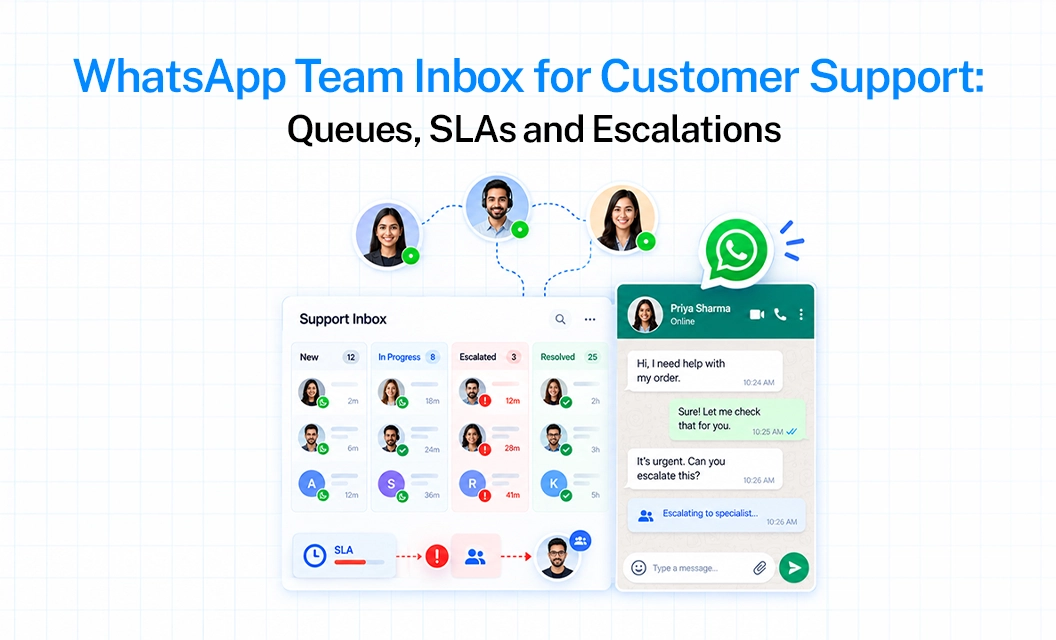
As organic lead volume grows, one WhatsApp number can become difficult to manage across multiple employees.
Assign conversations based on:
Product/service
Location
Language
Lead stage
Existing customer ownership
Sales/support requirement
A Shared Team Inbox can help multiple team members manage conversations while maintaining ownership and history.
This matters because WhatsApp lead generation without paid ads can fail at the same point as paid acquisition: the business generates enquiries but does not manage them quickly enough.
Organic does not mean unstructured.
11. Track Which Free Sources Actually Generate Sales
Do not group every enquiry under Source = WhatsApp.
WhatsApp is the conversation channel. The original lead source may be Google, website, Instagram, QR, referral or an event.
Track fields such as:
Original source
Landing page
QR location
Social platform
Referral
Product/service
Qualified lead status
Sales outcome
Revenue
A simple report might look like:
The goal is to identify which organic WhatsApp lead sources produce business value, not which generates the most messages.
12. Prioritise Channels With Existing Demand
You do not need to deploy every organic tactic simultaneously.
Start where your business already has attention.
If SEO traffic is strong: improve WhatsApp CTAs on commercial pages.
If Instagram engagement is strong: create content-to-conversation CTAs.
If you operate physical locations: use QR-code entry points.
If repeat customers are strong: develop referral pathways.
If events drive business: give each event a dedicated WhatsApp entry route.
If product discovery matters: improve catalogues and product links.
The cheapest organic lead is usually generated by improving an existing customer touchpoint rather than building a completely new channel from zero.
Build Organic Discovery Around a Clear WhatsApp Action
The strongest WhatsApp lead generation without paid ads strategy connects existing customer attention with a clear conversational next step.
Use search and website content to capture high-intent demand. Use organic social to turn content interest into enquiries. Add free WhatsApp entry points to Instagram, Facebook and your website. Use QR codes to connect offline customers. Let referrals create new conversations. Use Channels and catalogues where they genuinely improve discovery.
Then make sure those leads reach the correct next action.
A practical model is:
Organic Discovery → Relevant WhatsApp Entry Point → Contextual Conversation → Minimum Qualification → Human or Structured Next Step → CRM Outcome
WhatsApp's Business Platform documentation explicitly supports this model by recommending websites, storefronts and other off-WhatsApp channels for organic awareness and native entry points such as QR codes and website buttons to start customer conversations.
WhatsApp lead generation without paid ads works when WhatsApp is easy to find, the reason to message is clear and the conversation helps an already-interested customer take the next meaningful step.