

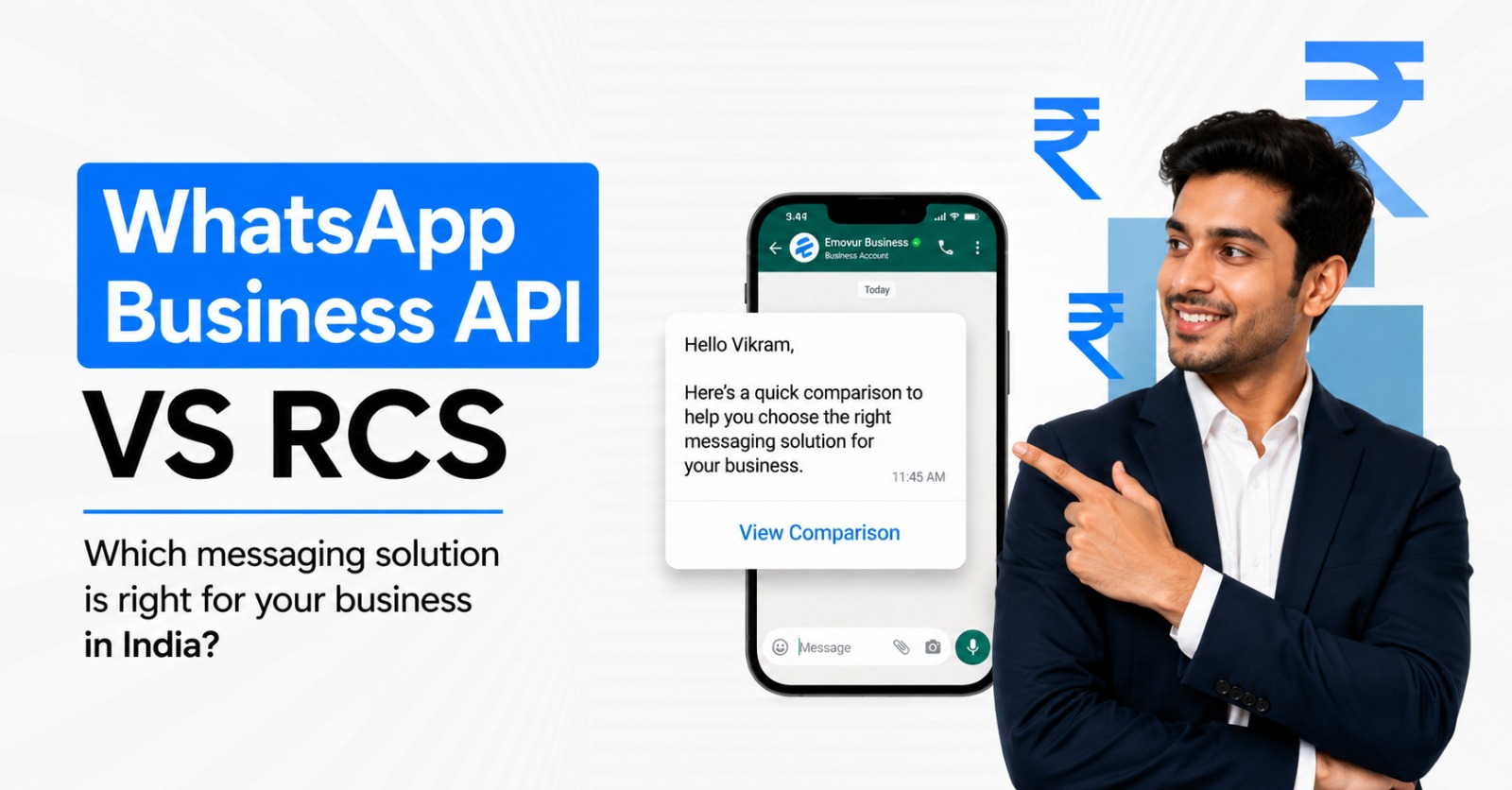
For Indian businesses, WhatsApp Business API and RCS solve different messaging problems. WhatsApp is generally stronger for conversational journeys, lead qualification, support, CRM-connected automation and ongoing customer relationships. RCS for Business is compelling for rich, branded messaging delivered through supported native messaging apps, particularly notifications, promotions and interactive campaigns. The better channel depends on customer reach, use case, device availability, interaction depth and cost—not on which technology has the longer feature list.
WhatsApp Business API vs RCS: The Core Difference
Both channels can support rich business messaging, but they begin from different ecosystems. WhatsApp Business API operates within WhatsApp and is designed to connect business messaging with automation, APIs, customer data and team workflows.
RCS for Business, also called RCS Business Messaging, brings rich business communication into supported native messaging applications. Google's current documentation describes RCS for Business as supporting Android and iOS, with branded agents, rich media, verification, read receipts and interactive experiences.
The strategic difference is easier to understand this way:
WhatsApp = Conversation-led customer journey
RCS = Rich native messaging experience
That distinction is not absolute, but it is a useful starting point.
WhatsApp vs RCS for Indian Businesses: Quick Comparison
Google explicitly advises businesses to check device capabilities because not every recipient or device supports the same RCS functionality. If RCS is unavailable, other channels such as SMS/MMS can form part of a fallback strategy.
1. When Does WhatsApp Business API Fit Better?
WhatsApp Business API is usually the stronger choice when the customer journey requires repeated two-way interaction, qualification, structured data capture, CRM updates, sales-agent involvement or ongoing support. Its value is not simply message delivery; it is the ability to connect WhatsApp conversations with broader sales, service and automation workflows.
Businesses should lean towards WhatsApp when conversation depth matters.
Strong WhatsApp Business API use cases include:
Lead qualification: Ask customers structured questions, capture requirements and move qualified prospects to sales.
Click-to-WhatsApp advertising: Continue an ad-generated enquiry directly inside a conversational sales journey.
CRM-connected sales: Create or update leads, assign owners and connect customer activity with pipeline stages.
Appointment booking: Collect required details, schedule appointments and continue with reminders or follow-up.
Customer support: Route enquiries between automation and human agents while maintaining conversation context.
Ecommerce journeys: Handle product enquiries, order communication, cart recovery and post-purchase conversations.
Renewal and retention: Continue customer communication after the initial transaction.
Structured information collection: Use WhatsApp Flows for qualification, booking, feedback or registrations.
Emovur's current WhatsApp Flows implementation supports structured journeys including lead qualification, appointment booking, feedback and event registration.
Example: Real-estate lead
A property company may need:
Ad → WhatsApp → Budget → Location → Property Preference → Site Visit → Salesperson
The value lies in keeping the customer inside one conversational journey while connecting the response with the sales operation.
For more examples rather than repeating them here, see the dedicated guide to WhatsApp Business API use cases in India.
2. When Does RCS for Business Fit Better?
RCS for Business becomes particularly attractive when a company wants a visually rich, verified message experience inside supported native messaging applications. It can suit transactional notifications, product discovery, promotions and interactive messages where rich cards, carousels, media and suggested actions can make a standard SMS-style notification significantly more useful.
Google's RCS rich cards can contain media, titles, descriptions and suggested replies or actions. Multiple cards can also appear as a carousel. Notably for India, Google currently supports PDFs inside RCS rich cards on the Google Messages client.
Strong RCS business messaging use cases include:
Product promotions: Show product imagery, information and relevant actions in one branded message.
Travel notifications: Combine itinerary information with actions such as opening a location or contacting support.
Financial notifications: Deliver branded transactional information through a verified business identity.
Order communication: Provide delivery or order information with richer presentation than standard SMS.
Event promotions: Combine event details, images and response options.
Product discovery: Use rich-card carousels to allow customers to explore several products or offers.
Document delivery: In supported India/Google Messages scenarios, PDFs can be incorporated into rich cards.
SMS modernization: Upgrade eligible recipients from plain text towards interactive rich messaging.
Example: Retail launch
Instead of a plain SMS:
“New collection launched. Visit our website.”
An RCS campaign could present:
Brand Identity → Product Image → Description → Carousel → View Product / Visit Store / Call
That is where RCS messaging for business becomes especially interesting: it brings app-like interaction into the messaging inbox.
3. Reach Is the Biggest Difference Businesses Should Not Ignore
A feature comparison alone can produce the wrong channel decision. RCS depends on the recipient's device, messaging application, region and operator support. Google recommends capability checks before starting an RCS interaction because supported features can differ between devices.
Google also confirms that RCS itself now works between Android and supported iPhones, but availability can still depend on the country and mobile operator.
For RCS, businesses should evaluate:
RCS-capable audience percentage: How many target customers can actually receive the intended RCS experience?
Carrier support: Availability can vary across operators.
Device capabilities: Some rich features may render differently or not be available.
Fallback strategy: Decide what happens when a recipient cannot receive RCS.
iOS reach: Do not assume every iPhone customer is automatically RCS-reachable.
Target geography: Coverage assumptions should be validated for the actual Indian audience.
For WhatsApp, evaluate:
Percentage of customers actively using WhatsApp
Customer opt-in and messaging eligibility
Existing WhatsApp customer behaviour
Whether customers already use WhatsApp for support or enquiries
Whether the journey requires sustained conversation
4. Which Channel Is Better for Marketing?
WhatsApp and RCS can both support marketing, but they create different experiences.
WhatsApp marketing is stronger when you need:
Segmented customer audiences
Reply-driven campaigns
Lead nurturing
Retargeting
Human sales takeover
Customer history
Continued conversations after the campaign
Workflow automation based on customer response
Businesses planning this model can use WhatsApp Broadcast functionality for opted-in audiences, personalization, customer groups, scheduling and campaign measurement.
RCS marketing is compelling when you need:
Rich visual presentation
Native inbox delivery
Verified brand identity
Product cards
Carousels
Suggested replies
Suggested actions
Rich promotional discovery
Google's verification process gives approved RCS agents a verification checkmark, helping customers identify the business sender.
The choice therefore depends on what happens after the customer sees the message.
If the objective is:
See → Explore → Click
RCS deserves serious consideration.
If the objective is:
See → Reply → Qualify → Converse → Convert
WhatsApp often has a stronger workflow advantage.
5. Which Is Better for Transactional Messaging?
Both channels can work well for transactional communication.
WhatsApp can handle journeys such as:
Order Placed → Confirmation → Shipping → Delivery → Support
RCS can handle:
Transaction Event → Branded Notification → Rich Information → Suggested Action
RCS for Business agents are explicitly designed for use cases ranging from one-way notifications to conversational interactions. Google's current agent categories include OTP, transactional, promotional and multi-use implementations.
Choose based on the customer action required
Simple rich notification: RCS can be highly effective.
Notification followed by conversation: WhatsApp may be stronger.
Mass mission-critical reach: Build a multi-channel design with an appropriate fallback.
This is why comparing only delivery cost can be misleading.
The workflow after delivery matters just as much.
6. WhatsApp vs RCS Pricing: Which Is Cheaper in India?
There is no responsible universal answer.
WhatsApp pricing follows Meta's Business Platform pricing structure plus any applicable provider/platform costs. Businesses can review current WhatsApp Business API pricing separately rather than duplicating volatile rates in this article.
RCS commercial pricing can depend on the implementation partner, market, billing category and carrier arrangement. Google's RCS documentation notes that carrier-managed launches may require direct commercial agreements with carriers.
Compare total campaign economics using:
Reachable Audience
×
Delivery / Messaging Cost
Platform / Partner Cost
Fallback Cost
=
Actual Channel Cost
Then measure:
Actual Channel Cost ÷ Business Outcome
For example:
Cost per qualified lead
Cost per booking
Cost per purchase
Cost per support resolution
Cost per successful notification
Cheapest cost per delivered message does not necessarily mean cheapest customer outcome.
7. Consent and Customer Control Matter on Both Channels
Businesses should not interpret native messaging reach as permission to send unlimited promotional communication.
For India specifically, Google Messages includes business-message consent controls. Google states that businesses need explicit consent to send RCS business messages, while users can block and unsubscribe from businesses. Customer-initiated interactions such as certain QR-code journeys can establish consent within Google's RCS experience.
For WhatsApp, businesses similarly need to build around Meta's current business-messaging and opt-in requirements.
The operational rule should be:
Capture valid customer consent.
Explain what communication the customer will receive.
Respect opt-outs.
Segment promotional communication.
Avoid irrelevant high-frequency messaging.
Review current platform policies before campaign launch.
Reach is valuable only while customer trust remains intact.
Four Questions Indian Businesses Ask About WhatsApp vs RCS
Is RCS Better Than WhatsApp Business API in India?
RCS is not universally better than WhatsApp Business API. RCS can be stronger for rich native messaging, verified branding, interactive promotions and transactional notifications. WhatsApp is usually stronger when businesses need deeper two-way conversations, lead qualification, CRM-connected workflows, automation and human-agent handover. The right choice depends on the use case and the percentage of the target audience actually reachable on each channel.
Which Is Better for Lead Generation: WhatsApp or RCS?
WhatsApp generally has an advantage when lead generation requires an extended conversation after the initial response. A prospect can move from enquiry to qualification, structured data capture and salesperson handover inside one journey. RCS can also generate responses through rich cards and suggested actions, making it valuable for visually strong acquisition campaigns where the main objective is discovery and an immediate action.
Which Is Better for Order Updates and Transactional Messages?
Both can work well. RCS is attractive when the goal is to deliver branded, visually rich transactional information with useful actions. WhatsApp becomes especially valuable when the notification may turn into a customer conversation—for example, when a delivery problem, booking change or payment issue needs support. Choose based on what the customer is expected to do after receiving the notification.
Can Indian Businesses Use WhatsApp and RCS Together?
Yes. For many larger businesses, WhatsApp and RCS should be viewed as complementary rather than competing channels. RCS can provide rich native messaging to reachable devices, while WhatsApp can manage deeper conversations, automation and ongoing customer relationships. A multi-channel strategy can select the best channel based on customer reach, consent, message purpose, urgency and the next action required.
WhatsApp vs RCS Use-Case Decision Matrix
For businesses that want to understand the actual WhatsApp workflows behind these examples, see WhatsApp automation workflows in India.
Emovur's View: Stop Asking Which Channel Is Better
The wrong question is:
“Is WhatsApp better than RCS?”
The better question is:
“What should happen after this message reaches the customer?”
If the answer is:
Read a branded notification → consider RCS.
Explore a visual offer → consider RCS.
Answer qualification questions → consider WhatsApp.
Book an appointment → consider WhatsApp.
Speak to sales → WhatsApp becomes compelling.
Receive an important notification across a broad audience → consider a multi-channel architecture.
Businesses should therefore design around:
Customer → Reachability → Message Purpose → Interaction → Business Outcome
—not around platform loyalty.
Frequently Asked Questions
Does RCS require customers to install another app?
RCS is delivered through compatible messaging applications rather than requiring a dedicated branded business app. However, the recipient still needs an RCS-capable device, supported messaging application and applicable operator/service availability. Businesses should check audience capabilities rather than assuming universal reach.
Can RCS messages contain images and buttons?
Yes. RCS for Business supports rich cards containing media, titles, descriptions and suggested replies or actions. Cards can also be combined into carousels. Actual rendering should be tested across the devices the business expects customers to use.
Is RCS available on iPhones?
RCS messaging is available on supported iPhones, but availability varies by region and operator. Google's current RCS for Business documentation also describes business engagement across Android and iOS. Businesses should validate actual reachable inventory before planning an India-wide campaign.
Does RCS replace WhatsApp Business API?
No. RCS adds another rich business-messaging channel. It does not eliminate the need for WhatsApp where customers prefer WhatsApp or where businesses require WhatsApp-specific workflows, automation, Flows, broadcasts, CRM integration and ongoing conversational engagement.
Choose the Channel Around the Customer Journey
The WhatsApp API vs RCS India business decision should not be based on which technology appears newer or more advanced. Use RCS where native reach, visual presentation, verified branding and rich interactive notifications create the strongest experience.
Use WhatsApp where conversation depth, lead management, automation, CRM connectivity and continued customer relationships matter most. Businesses building WhatsApp-led customer journeys can explore Emovur's WhatsApp Business API for the platform side of that strategy.
Start WhatsApp API Setup — when the customer journey needs more than message delivery and requires a conversation that can move towards a measurable business outcome.
TABLE OF CONTENTS