

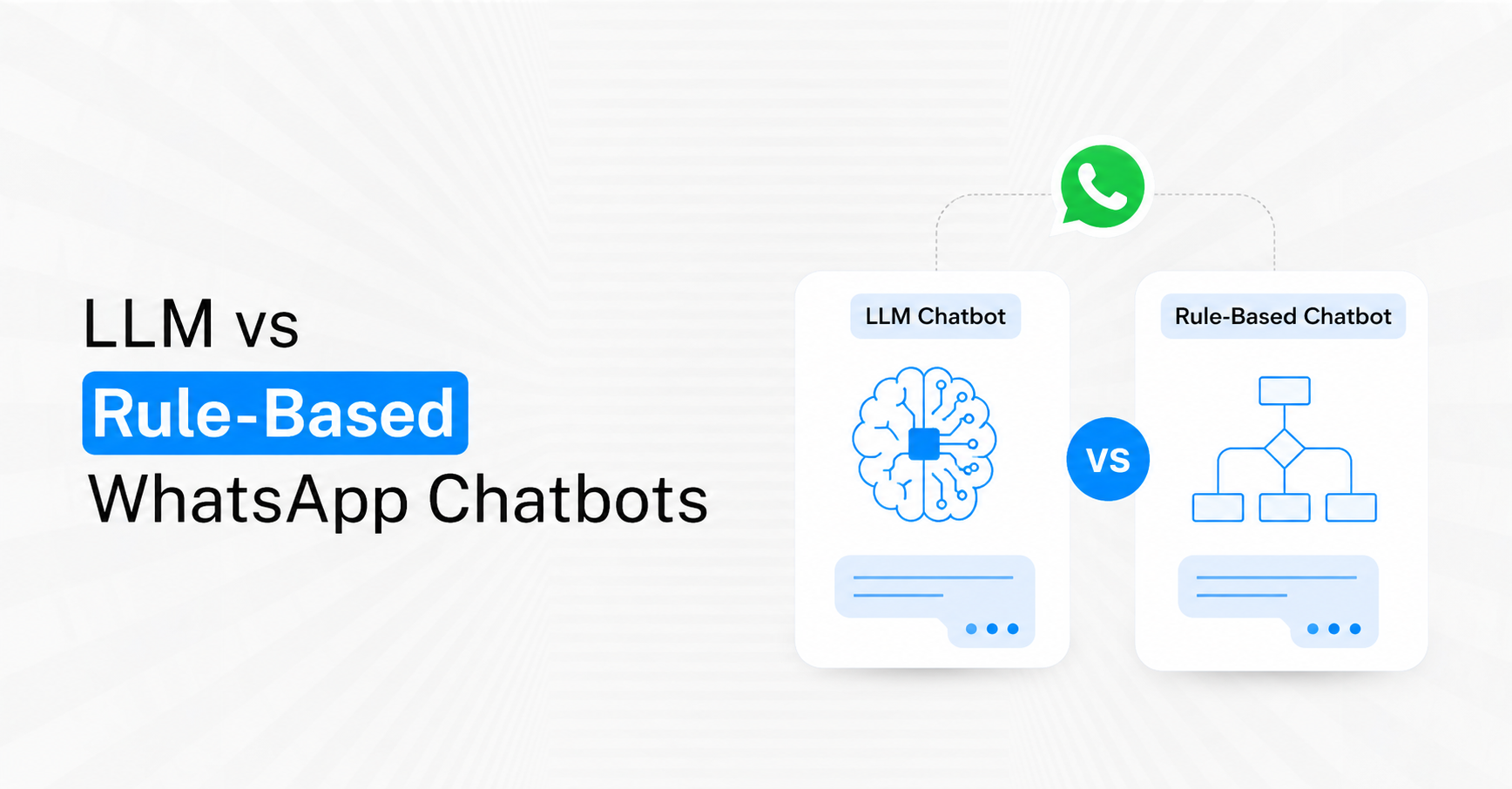
An LLM-powered WhatsApp chatbot is better when customers ask open-ended questions, use unpredictable language or need answers that depend on context. A rule-based WhatsApp chatbot is better when the journey must follow fixed steps such as menu navigation, appointment selection, lead capture or order-status checks. For many Indian businesses in 2026, a hybrid architecture works best: rules for predictable actions, LLMs for conversational understanding and humans for exceptions.
What Is the Difference Between an LLM and a Rule-Based WhatsApp Chatbot?
A rule-based chatbot follows predefined instructions. The business decides the questions, branches and responses before the conversation starts. An LLM chatbot uses a large language model to understand natural-language messages and respond using conversation context and approved business knowledge.
Rule-based chatbots are strongest when:
The journey is predictable: Customer paths are already known.
Outputs must stay fixed: The same condition should produce the same response.
Inputs are structured: Buttons, lists or forms can collect what is required.
Actions depend on rules: Business logic can be expressed as clear conditions.
Testing must be simple: Every major path can be reviewed before launch.
LLM chatbots are stronger when:
Language varies: Customers describe the same need in many different ways.
Questions are open-ended: The bot cannot rely on a small menu.
Context matters: Earlier messages change the correct response.
Knowledge is broad: Customers ask across products, policies or services.
Rule maintenance is growing: Too many keywords and branches are becoming difficult to manage.
The decision is predictable workflow versus conversational variability.
1. Choose Rule-Based Chatbots for Predictable Journeys
If the business already knows how a customer should move through a process, rule-based automation usually provides more control with less complexity.
Strong rule-based use cases include:
Appointment selection: Choose service, branch, date and time.
Lead capture: Collect name, location, budget or another standard field.
Order status: Ask for an order ID and return a known status.
Menu navigation: Route customers to sales, support or billing.
Feedback: Ask a fixed sequence of questions.
Transactional actions: Trigger predefined updates or processes.
These tasks require reliable execution more than conversational understanding. For structured data collection, WhatsApp Flows can handle use cases such as lead qualification, appointment booking, feedback and event registration. Emovur currently supports structured response collection through its Flow functionality.
2. Choose LLM Chatbots for Open-Ended Conversations
LLMs add value when customers do not speak in predefined keywords. One customer may ask, “Can three branches manage the same number?” while another asks, “Can all our locations reply centrally?” The intent may be identical even though the wording is different.
LLM-powered WhatsApp chatbots can help with:
Natural-language understanding: Interpret meaning instead of matching exact phrases.
Multi-intent questions: Separate several questions inside one message.
Follow-up context: Understand references such as “that plan” or “the second option”.
Conversational clarification: Ask for missing information when required.
Knowledge retrieval: Use approved FAQs, products, services or policies.
Longer explanations: Answer questions that cannot be solved with a button.
Emovur's WhatsApp AI Chatbot currently supports business-specific training using approved websites, documents, FAQs, products, services and policies.
3. Compare Control vs Flexibility
The biggest trade-off is straightforward. Rule-based chatbots maximise control. LLM chatbots maximise flexibility.
Rule-based chatbots favour: predictable responses, easier testing, clear workflow boundaries and simpler debugging.
LLM chatbots favour: varied language, contextual replies, wider question coverage and more natural conversations.
If certainty is the main requirement, start with rules. If customers constantly move outside predefined paths, an LLM becomes more valuable.
4. Do Not Assume LLM Means More Accurate
An LLM may understand more customer questions, but that does not automatically make every answer more reliable. Rule-based accuracy is easier to control because the business writes the response and defines when it appears. The weakness is coverage: unexpected questions often fall into a generic fallback.
LLM accuracy depends on model behaviour, knowledge quality and guardrails.
Evaluate an LLM chatbot on:
Knowledge grounding: Does it answer from approved business information?
Unknown-question handling: Can it say when information is unavailable?
Escalation: Does uncertainty trigger human support?
Action restrictions: Are important actions controlled by rules?
Context use: Does it correctly interpret earlier messages?
Testing: Has it been evaluated with realistic customer wording?
A strong AI chatbot also knows when automation should stop.
5. Compare Maintenance, Not Just Initial Setup
Rule-based chatbots can be easy to launch but difficult to expand. Every new product, exception or customer path may create another branch. LLM chatbots shift part of that maintenance from conversation trees to knowledge management.
Rule-based maintenance usually means adding keywords, branches, fallback logic and tests. LLM maintenance shifts towards updating the knowledge base, reviewing incorrect answers, improving guardrails and testing response quality.
For a small, predictable FAQ set, rules may be easier. For hundreds of product, policy and service variations, a large decision tree can become inefficient.
6. Use Rules for Execution and LLMs for Interpretation
One of the strongest architectures is to separate understanding from execution. An LLM can understand what the customer wants, while important business actions remain deterministic.
Example:
LLM: Understands that the customer wants to reschedule.
Rule or Flow: Presents valid appointment slots.
LLM: Explains the available options if necessary.
Rule/API: Confirms the selected appointment.
Human: Handles exceptions outside policy.
This gives customers conversational freedom while keeping critical actions predictable. A useful principle is LLM for interpretation, deterministic workflow for execution.
7. Which Is Better for Lead Qualification?
Both can qualify leads, but the choice depends on how structured the discovery process is.
Use rule-based qualification when:
Every prospect answers the same questions.
Scoring depends on fixed CRM fields.
Structured data is essential.
Qualification criteria rarely change.
Use LLM-assisted qualification when:
Prospects explain requirements in free text.
One answer contains several buying signals.
Follow-up questions depend on earlier responses.
Sales teams spend time manually interpreting enquiries.
Different services require different discovery paths.
A hybrid approach is often practical: use the LLM to interpret intent, then use structured fields or WhatsApp Flows for information that must enter the CRM consistently.
8. Which Is Better for Customer Support?
Rule-based chatbots work well for repeatable support. LLMs become more useful when customers describe problems unpredictably or answers need a larger knowledge base.
Rule-based support fits:
Order tracking
Branch information
Known FAQs
Basic troubleshooting
Fixed service requests
LLM support fits:
Broad product questions
Long customer descriptions
Multiple questions in one message
Policy or documentation lookup
Context-dependent follow-ups
When automation reaches an exception, route the conversation to a person. Emovur's Shared Team Inbox supports multi-agent conversation management, assignment, shared history and AI-to-human transitions.
9. Compare Total Operating Cost
Do not compare the two models only by subscription price. A rule-based bot may avoid AI-processing costs but require more workflow design and maintenance. An LLM may reduce rule creation but introduce model usage, knowledge-management and quality-control work.
Compare platform cost, AI usage, implementation effort, maintenance, human workload, error cost and conversion impact. The lower-cost chatbot is the one that produces the required outcome with acceptable accuracy and operating effort, not automatically the one with the lowest subscription.
10. When a Hybrid WhatsApp Chatbot Is Better
Many businesses should not choose exclusively between LLM and rule-based automation.
A hybrid journey can work like this:
Customer asks an open-ended question.
LLM identifies intent and answers from approved knowledge.
A rule determines whether structured information is required.
WhatsApp Flow collects the required fields.
CRM receives the data through a defined integration.
High-intent or unusual cases move to a human.
Shared Team Inbox keeps context available to the agent.
This suits businesses where customer language is variable but operational actions still need structure.
11. When You Should Not Use an LLM
Adding an LLM to a simple journey can increase cost and governance work without improving the customer experience.
Stay with rules when customers choose from a few known options, responses must use exact approved wording, the process is deterministic, no maintained knowledge source exists or a form already solves the problem cleanly. AI should solve conversational complexity, not create operational complexity.
12. Signs Rule-Based Automation Has Reached Its Limit
Rule-based chatbots become less efficient when language understanding becomes the bottleneck.
Warning signs include: frequent fallback responses, unrecognised customer questions, hundreds of keyword variants, large decision trees, repeated restarts and human agents constantly interpreting customer intent. These signals suggest that an LLM layer may reduce friction while the underlying workflows remain rule-controlled.
A Simple Decision Matrix
If the conversation is predictable, use rules. If the language is unpredictable, consider an LLM. If natural-language understanding must lead into controlled business actions, use hybrid architecture.
What Should You Test Before Launch?
Test with the language real customers send, not only ideal implementation-team questions.
For rule-based bots, test:
Major branches and buttons
Invalid inputs
Workflow failures
Escalation triggers
CRM or API updates
For LLM chatbots, test:
Paraphrased questions
Multi-intent messages
Missing information
Contradictory statements
Questions outside the knowledge base
Human-handoff scenarios
Long conversation context
Measure completion, fallback, escalation, accuracy and customer progression rather than simply counting automated conversations.
Choose the Architecture From the Customer Journey
For Indian businesses comparing an LLM WhatsApp chatbot vs rule-based chatbot, the right choice depends on how predictable the conversation is and how much control the business needs.
Use rule-based chatbots for fixed paths, structured data and deterministic actions. Use LLM chatbots when customers communicate unpredictably, context matters and maintaining every possible language variation is impractical. Use hybrid automation when natural-language understanding needs to lead into controlled workflows.
Book an Automation Demo when you have identified which parts of the WhatsApp journey require certainty, which require language understanding and which should remain human-led.