

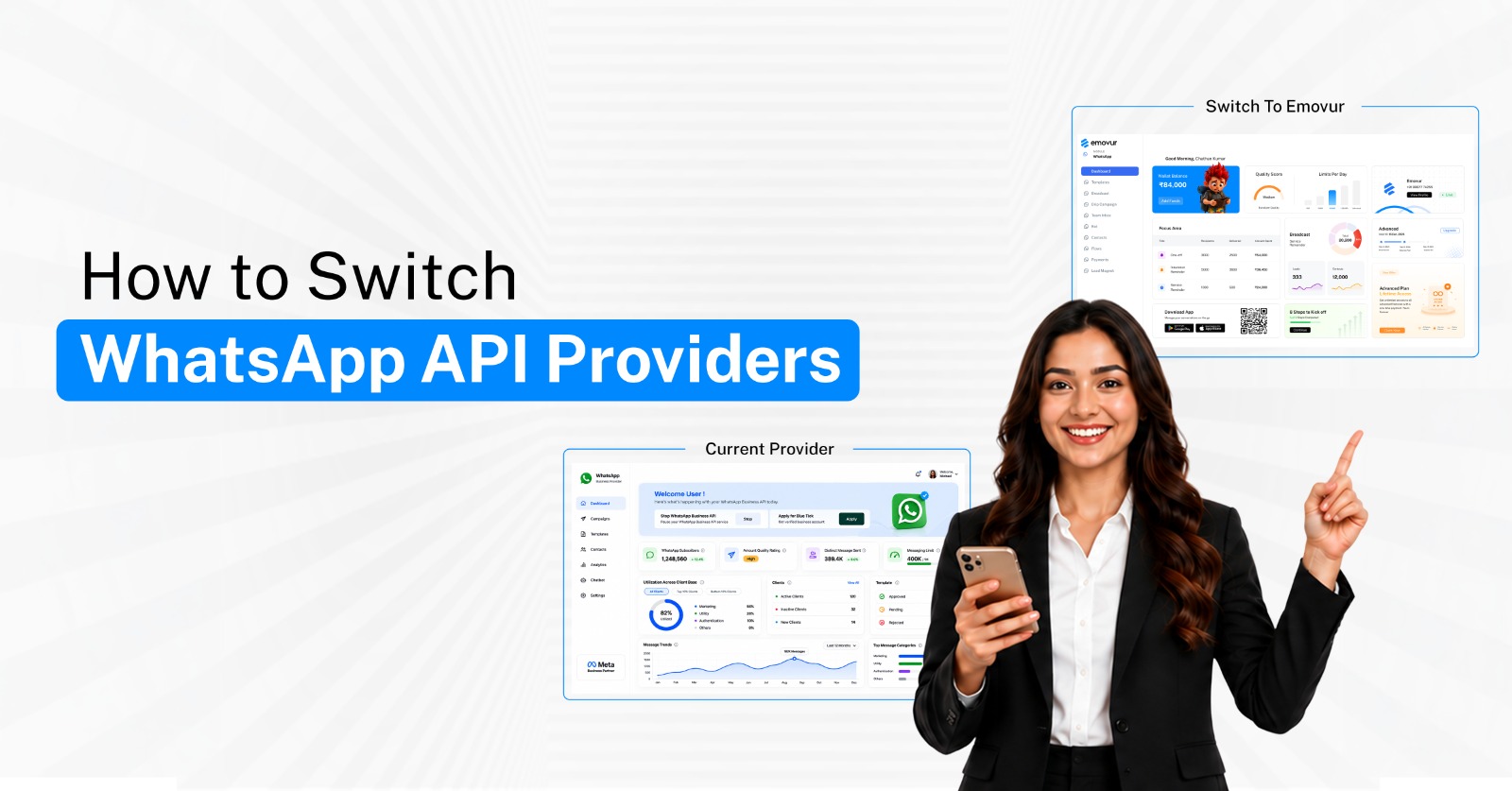
Switching your WhatsApp Business API provider does not automatically mean giving up the phone number your customers already use.
Meta supports migration of business phone numbers between eligible WhatsApp Business Accounts and Solution Partners. With the supported migration process, businesses can retain important number-level attributes instead of starting again with a completely new WhatsApp identity.
The bigger challenge is ensuring that everything surrounding the number—templates, automation, integrations, agent access, and customer workflows—continues working after the switch.
Here is how to manage the migration properly.
Can You Keep the Same WhatsApp Number When Switching Providers?
Yes. A business phone number can be migrated from one Solution Partner to another through Meta-supported migration processes when the account meets the applicable requirements. Meta states that migrations can preserve attributes including the display name, quality rating, messaging limit, and Official Business Account status.
This means you generally do not need to:
Inform every customer about a new number: Your existing business number can continue to represent your brand.
Rebuild customer awareness: Printed material, websites, advertisements, and existing customer contacts can continue using the same number.
Start messaging reputation from zero: Eligible number-level properties can remain associated with the migrated number.
Replace Click-to-WhatsApp destinations unnecessarily: Existing marketing assets using the same phone number may continue to remain relevant.
However, keeping the phone number does not mean every feature from your old provider automatically transfers.
Step 1: Identify Why You Are Switching
Migration should solve a specific business problem. Changing providers without understanding what is wrong with the current setup can result in the same limitations on a different platform.
Businesses commonly switch because of:
Pricing structure: Provider fees or markups become expensive as messaging volume grows.
Limited automation: Existing workflows cannot support more advanced customer journeys.
Poor team experience: Agents struggle with conversation assignment, visibility, or collaboration.
Integration limitations: CRM, website, webhook, or custom API requirements are not supported properly.
Support problems: Technical issues take too long to resolve.
Scaling requirements: The current platform is no longer suitable for the size of the operation.
Write down exactly what the new provider must improve before beginning the migration.
Step 2: Check What Will Transfer and What Will Not
This is one of the most important parts of switching providers.
Your WhatsApp number is a Meta asset, while many other parts of your current setup may belong to your existing provider's software environment.
Assets that may be handled through Meta's migration process include:
Business phone number
Display name
Number quality rating
Messaging limit
Official Business Account status, where applicable
Message templates through supported migration processes
Meta also provides a dedicated template-migration process for copying templates between WhatsApp Business Accounts.
Provider-specific assets may need to be recreated, including:
Chatbot flows
CRM connections
Agent-routing rules
Contact tags
Internal notes
Campaign configurations
Automation sequences
Custom dashboards
Webhook configurations
Historical provider reports
Plan for both the number migration and the platform migration.
Step 3: Back Up Your Existing Operational Setup
Before touching the current account, document everything your business actively uses.
This reduces the risk of discovering missing workflows after the number has already moved.
Create a migration inventory covering:
Templates: Record the templates currently used for marketing, utility, and authentication communication.
Automation: Document triggers, conditions, delays, and actions.
CRM mappings: Record which WhatsApp fields connect to CRM fields.
Agent setup: List users, teams, departments, and conversation-routing rules.
Integrations: Document APIs, webhooks, website forms, ecommerce systems, and other connected tools.
Campaigns: Identify scheduled or recurring campaigns that should be paused during migration.
Reporting: Export important historical information that may not exist on the new platform.
Do not rely on memory when rebuilding the system.
Step 4: Prepare the New WhatsApp Business API Provider
Your destination provider should be ready before the existing setup is disconnected.
If you are evaluating a new WhatsApp Business API provider, check both the technical platform and the migration support available.
Before migration, confirm:
Number migration support: The provider should support the appropriate Meta migration process.
WABA setup: Confirm where the WhatsApp Business Account will be managed after migration.
Template requirements: Identify what must be migrated or recreated.
API availability: Check whether existing applications can connect to the new platform.
Team access: Configure relevant agents and departments.
Automation readiness: Rebuild priority workflows before normal traffic resumes.
Support availability: Know who will handle problems during the cutover.
The destination environment should be prepared before moving production messaging.
Step 5: Compare the New Pricing Before Migrating
A migration is an ideal time to reassess the total cost of running WhatsApp.
Do not switch providers simply because the advertised monthly subscription is cheaper.
Compare the complete cost structure, including:
Platform fee: Monthly or annual software subscription.
Meta messaging charges: Applicable charges based on current WhatsApp pricing.
Provider markup: Any additional percentage or messaging charge added by the provider.
Agent pricing: Cost of adding sales or support users.
Automation access: Whether advanced workflows require a higher plan.
API and integration access: Whether developer features cost extra.
Support fees: Additional charges for priority or managed support.
Emovur currently positions its WhatsApp API pricing around 0% markup on Meta messaging charges and provides multiple platform options.
Always calculate pricing using your expected monthly messaging volume rather than comparing entry-level packages.
Step 6: Run the Number Migration
Once both environments are ready, the migration can be performed using the applicable Meta-supported workflow.
Meta provides migration options through Embedded Signup and programmatic processes for Solution Partners.
During the migration window:
Pause non-essential campaigns
Avoid making unrelated account changes
Keep the existing provider active until required steps are completed
Follow the destination provider's migration instructions
Confirm the number is connected to the intended WABA
Verify required templates
Reconnect relevant API credentials
Update webhook endpoints where necessary
Do not delete the existing phone number simply because you are switching providers. Use the supported migration route.
Step 7: Reconnect Your Business Workflows
Once the number is active on the new platform, reconnect the systems responsible for turning WhatsApp messages into business actions.
Prioritize revenue-critical workflows first:
Website leads: Confirm website and landing-page enquiries enter the correct WhatsApp journey.
CRM: Check that new and existing contacts sync correctly.
Sales routing: Ensure enquiries reach the right salesperson.
Chatbots: Recreate essential qualification and support flows.
Webhooks: Verify incoming events reach your applications.
Transactional messages: Test booking, order, payment, or service updates.
Campaign audiences: Rebuild segmentation carefully rather than immediately importing everything.
This is where most of the real migration work happens.
Step 8: Test Before Returning to Full Volume
Do not immediately restart every campaign once the number appears active.
Run controlled tests first.
Your post-migration checks should include:
Incoming message test: Send a real customer-style message and confirm it reaches the platform.
Outgoing message test: Verify customer responses and approved templates.
Template test: Check your most important business templates.
CRM test: Confirm the correct customer record is created or updated.
Automation test: Complete an entire chatbot or lead journey.
Agent test: Confirm conversations can be assigned and transferred.
Webhook test: Verify required events reach your systems.
Reporting test: Make sure important activity is measurable.
Increase traffic only after the critical workflows are stable.
Common Mistakes When Switching WhatsApp API Providers
Most migration problems are preventable.
Avoid these common mistakes:
Cancelling the old provider too early: Prepare the destination before terminating existing services.
Assuming everything transfers automatically: Provider-specific automation and data may need rebuilding.
Ignoring template migration: Identify critical templates before cutover.
Switching during a major campaign: Choose a controlled migration period.
Failing to export important data: Historical reports or provider-specific customer information may not move.
Not calculating the new total cost: Lower subscription pricing can still result in a higher overall bill.
Skipping post-migration testing: A connected number does not guarantee that your complete workflow is functioning.
Should You Switch Your WhatsApp Business API Provider?
Switch when the new provider delivers a measurable operational improvement—not simply because another company is offering a promotional price.
The right migration should give your business:
Better automation
Stronger integrations
More transparent pricing
Easier team collaboration
Better support
Greater scalability
More control over WhatsApp operations
If you are still setting up the platform for the first time rather than migrating an existing account, read our guide on how to get WhatsApp Business API in India.
Switch Providers, Not Your Customer Identity
Your WhatsApp number may already appear across your website, advertisements, customer phones, invoices, stores, and marketing campaigns.
A provider migration should protect that existing customer identity while improving the infrastructure behind it.
With the right preparation, businesses can move to a new WhatsApp Business API provider while retaining their existing number and rebuilding their WhatsApp operation around better pricing, automation, integrations, and team workflows.
Businesses considering a switch can explore Emovur's WhatsApp Business API and review the current WhatsApp API pricing before planning a migration.
The safest approach is simple: audit first, prepare the new environment, migrate the number, reconnect critical workflows, test thoroughly, and only then resume full messaging activity.