


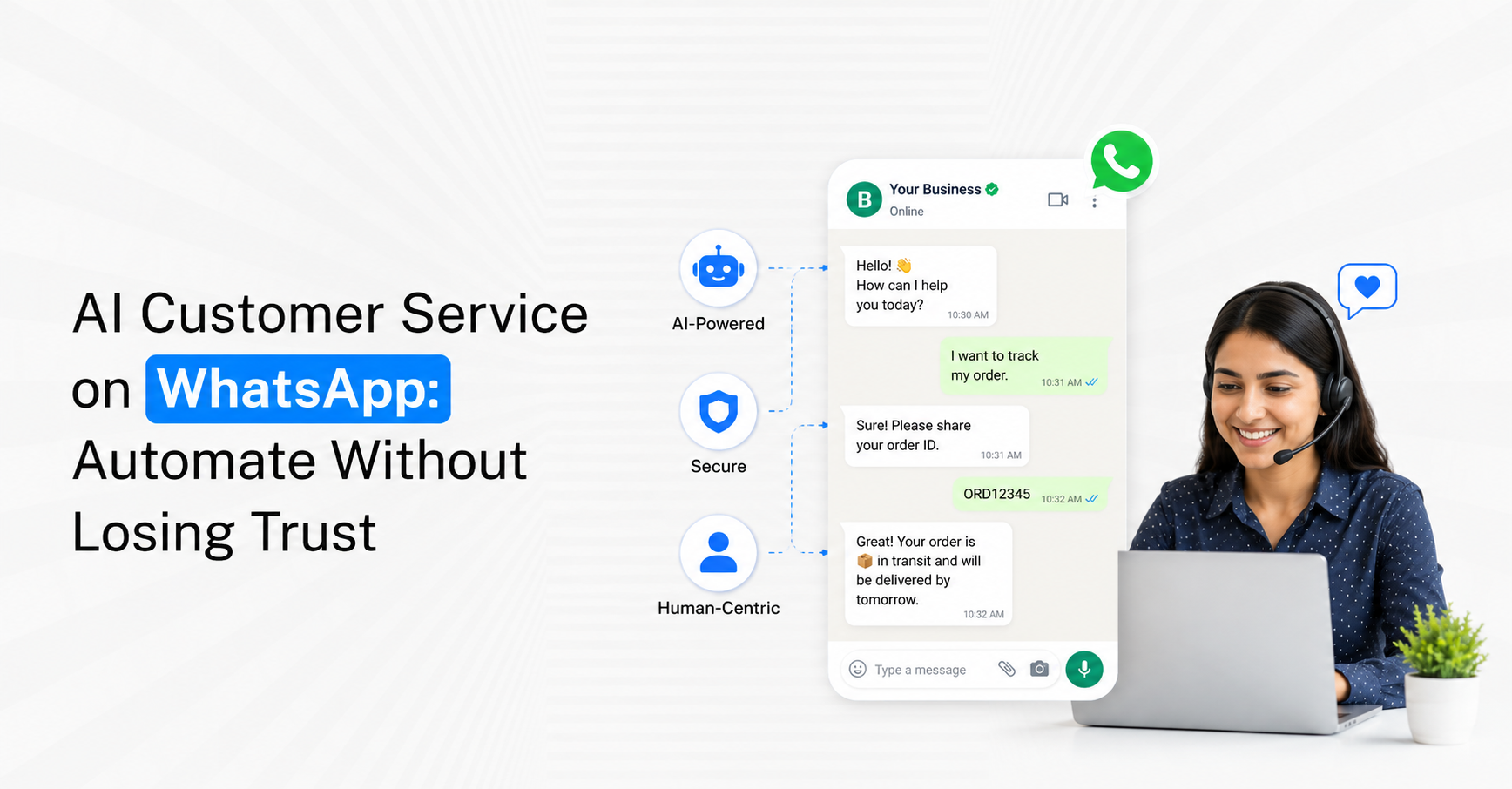
AI customer service on WhatsApp can reduce response time and handle repetitive enquiries at scale, but automation only works when customers can trust the answers and reach a human when necessary. For Indian businesses, the strongest model is selective automation: let AI handle routine questions, information retrieval and initial triage, while humans retain control over complaints, exceptions, complex account decisions and high-risk conversations. The objective is not maximum automation. It is faster customer service without reducing accuracy, accountability or confidence.
Why Trust Matters More Than the Automation Rate
Businesses often measure a WhatsApp AI chatbot by how many conversations it resolves without an agent. That metric can be useful, but maximising it blindly creates the wrong incentive.
A chatbot that automatically handles 90% of conversations is not successful if customers receive incorrect answers, repeat themselves after escalation or struggle to reach a person.
Trust in AI customer support depends on a few basic expectations:
Correct information: Answers should come from reliable business knowledge.
Clear limitations: AI should not invent an answer when information is unavailable.
Easy escalation: Customers should be able to reach a human when required.
Conversation continuity: A customer should not restart from the beginning after handoff.
Consistent policies: AI and human agents should not give conflicting answers.
Appropriate automation: Sensitive or exceptional situations should not be forced through a bot.
Meta's Business Agent initiative, introduced in June 2026, similarly combines automated customer assistance with business-defined human intervention rather than positioning AI as an unconditional replacement for customer teams.
1. Automate High-Confidence Questions First
Start with enquiries where the answer is clear, repeatable and supported by approved business information.
These conversations create the lowest-risk foundation for AI customer service on WhatsApp.
Good starting points include:
Business information: Location, timings, contact details and service areas.
Product FAQs: Standard specifications, availability rules or plan information.
Service information: What a service includes and how the process works.
Order questions: Status information where the appropriate system is connected.
Appointment information: Available services, branches or booking procedures.
Policy questions: Approved return, cancellation or support policies.
Onboarding questions: Standard steps new customers frequently ask about.
Emovur's WhatsApp AI Chatbot can use approved websites, documents, FAQs, products, services and policies as business knowledge for customer responses.
The principle is simple: automate where the business already knows what a good answer looks like.
2. Give AI a Controlled Knowledge Source
Customer trust deteriorates quickly when an AI chatbot confidently gives outdated prices, unavailable features or incorrect policy information.
Do not expect a general-purpose language model to automatically know what your business currently offers. Connect it to maintained sources of truth.
Useful AI knowledge sources include:
Website content: Current product and service information.
FAQ library: Approved responses to recurring customer questions.
Product catalogue: Current descriptions and specifications.
Pricing information: Only where prices can be kept current.
Policies: Cancellation, delivery, returns, support or warranty information.
Help documentation: Setup and troubleshooting instructions.
Internal knowledge base: Approved information suitable for customer use.
Assign someone responsibility for maintaining these sources. If the underlying information changes but the AI knowledge remains outdated, response quality will eventually decline.
The WhatsApp AI layer should therefore be treated as an interface to trusted business knowledge, not as the knowledge source itself. Emovur currently positions its AI tools around contextual replies, conversation summaries and custom AI integrations for customer interactions.
3. Design for Uncertainty, Not Just Correct Answers
One of the most important trust controls is what the AI does when it does not know the answer.
A weak chatbot attempts to answer everything. A well-designed support system recognises uncertainty and chooses a safer next action.
When confidence is low, the AI should be able to:
Ask for clarification: Obtain missing context before responding.
Use an approved fallback: Explain that additional information is required.
Search the permitted knowledge base: Check reliable business information.
Collect relevant details: Prepare the case for human support.
Escalate: Transfer the conversation instead of guessing.
This matters particularly for account-specific problems, unusual service cases and questions outside the AI's approved knowledge.
Customers generally tolerate an honest escalation better than a confident but incorrect answer.
4. Make Human Escalation Easy
AI customer service should shorten the path to resolution, not become another obstacle before the customer reaches support.
Define clear human handoff triggers before the chatbot goes live.
Escalate when:
The customer requests an agent: Do not repeatedly redirect them to automation.
The same problem remains unresolved: Repeated bot responses indicate the journey has failed.
The issue is unusual: Exceptions may need human judgement.
A complaint is escalating: Tone and context may require careful handling.
An account decision is required: Refunds, exceptions or commercial approvals may need authorised staff.
The AI lacks reliable information: Uncertainty should trigger escalation.
A high-value customer needs assistance: Human involvement may improve the outcome.
Emovur's AI chatbot supports transfer of complex conversations to human teams with conversation context, while its Shared Team Inbox provides the operational environment for multiple agents to continue customer conversations.
5. Preserve Context During the AI-to-Human Handoff
A customer should not explain the same problem twice simply because the conversation moved from AI to a person.
A useful handoff should give the agent enough context to continue immediately.
Pass information such as:
Customer intent: Why did the person contact the business?
Conversation summary: What has already been discussed?
Information collected: Order number, product, location or another relevant field.
Previous actions: What has the chatbot already attempted?
Unresolved question: What specifically still needs an answer?
Customer sentiment where reliably identified: Is the customer confused, urgent or dissatisfied?
This is one area where AI can improve customer service even when humans remain responsible for the final response.
Emovur's WhatsApp AI Copilot currently provides conversation summaries, contextual reply suggestions, business knowledge retrieval and next-step assistance for human agents.
6. Do Not Automate Every Customer-Service Decision
Some tasks are easy to automate technically but should still remain human-controlled.
The decision should consider the consequence of an incorrect answer or action.
Keep human control when conversations involve:
Policy exceptions: Situations outside normal rules.
Complex complaints: Cases where context and judgement matter.
Commercial negotiation: Custom pricing or unusual terms.
High-impact account actions: Actions that could materially affect the customer.
Disputed transactions: Where evidence needs review.
Ambiguous technical problems: Several causes may produce the same symptom.
Situations with inadequate knowledge: AI should not infer facts the business cannot verify.
A useful automation rule is: the higher the consequence of being wrong, the stronger the human control should be.
7. Tell Customers What the AI Can Actually Do
Trust improves when expectations match capabilities.
Businesses should avoid presenting an AI chatbot as capable of resolving every possible support problem if its actual role is limited to FAQs and initial triage.
Set expectations through the conversation itself.
Make clear where appropriate:
What type of assistance is available.
Which information the assistant can access.
When an agent can take over.
Whether an action has actually been completed.
When additional verification is required.
For example, there is a major difference between “Your refund has been processed” and “I can submit your refund request to our team.”
The AI should never present a requested action as completed unless the connected system confirms that it actually happened.
8. Separate Answering From Acting
A customer-service chatbot may be allowed to answer hundreds of questions while having permission to perform only a small number of actions.
That separation improves control.
The AI might be allowed to answer:
Product questions
Service FAQs
Policy questions
Setup guidance
Availability explanations
But actions may require structured controls for:
Changing an appointment
Cancelling an order
Updating account details
Initiating a refund
Modifying a subscription
Creating a service request
Where an action is deterministic, use a defined workflow or API rather than allowing the language model to improvise what should happen.
The customer can still experience one continuous conversation while different systems handle understanding and execution.
9. Use AI to Reduce Waiting, Not Customer Choice
One of the strongest benefits of WhatsApp customer service automation is immediate first response, especially when support volume is high or enquiries arrive outside normal working hours.
Meta said in June 2026 that more than one million businesses were already using Meta Business Agent across WhatsApp and Messenger to respond to customers around the clock.
Use that availability to improve service, not to prevent human access.
AI can handle the first layer by:
Identifying the request.
Answering routine questions.
Collecting relevant context.
Resolving known issues.
Routing unresolved cases.
Preparing the conversation for an agent.
That model can reduce waiting without forcing customers to remain inside automation.
10. Keep Tone Consistent With the Situation
One generic AI tone does not work for every support interaction.
A cheerful response may fit a product enquiry but feel inappropriate when someone is reporting a repeated service failure.
Configure tone around customer context while keeping responses concise and professional.
Good AI support responses should be:
Clear: Avoid unnecessarily complicated explanations.
Specific: Address the customer's actual question.
Calm: Do not become defensive when customers are dissatisfied.
Concise: WhatsApp support should not feel like reading a manual.
Action-oriented: Explain what happens next.
Consistent: Use terminology aligned with the business.
Emovur's current WhatsApp AI capabilities include AI-assisted response composition and tone adjustment for agent communication.
11. Review Failed Conversations Regularly
AI customer service quality should improve from observed failure patterns, not assumptions.
Create a recurring review of conversations where automation performed poorly.
Look for:
Unanswered questions: Topics missing from the knowledge base.
Incorrect answers: Information that needs correction or stronger grounding.
Repeated clarification: Questions customers find difficult to answer.
Frequent escalation topics: Areas that may need better workflow design.
Long conversations: Potential signs of inefficient automation.
Customer corrections: Cases where users repeatedly tell the bot it misunderstood.
Agent overrides: Situations where human staff routinely change AI recommendations.
Use these findings to improve knowledge, routing and escalation logic rather than simply expanding the bot's authority.
12. Measure Trust Alongside Efficiency
Response speed and automation rate should not be the only AI customer service metrics.
A stronger scorecard combines operational efficiency with customer outcomes.
Track metrics such as:
First-response time: How quickly customers receive useful assistance.
Resolution rate: Percentage of suitable enquiries resolved successfully.
Escalation rate: How often human assistance is required.
Repeat-contact rate: Whether customers return with the same unresolved problem.
Fallback rate: How often AI cannot confidently answer.
Incorrect-response rate: Errors identified through quality review.
Human takeover time: How quickly escalated conversations reach an agent.
Customer satisfaction: Feedback after support where available.
Average handling time: Whether AI assistance reduces agent workload.
Resolution quality: Whether the actual customer problem was solved.
A reduction in response time is valuable only if resolution quality remains strong.
Use AI Where It Improves the Customer Experience
The strongest approach to AI customer service on WhatsApp in India is not to ask, “How much support can we automate?” Ask, “Which parts of customer service become faster and easier without increasing the risk of a poor answer?”
Use AI for high-confidence questions, knowledge retrieval, initial diagnosis, context collection and routine support. Keep a clear human path for exceptions, complaints, uncertain answers and decisions requiring judgement. Preserve context when conversations transfer, and regularly review failed interactions to improve the system.
A practical model is AI for Speed → Knowledge for Accuracy → Rules for Control → Humans for Judgement.
For businesses building this service model, Emovur's WhatsApp AI can support AI-assisted customer conversations, while the WhatsApp AI Chatbot, AI Copilot and Shared Team Inbox can support different levels of automation and human involvement.
Book an Automation Demo when you know which customer-service conversations should be automated, which require human control and what a successful resolution should look like.