

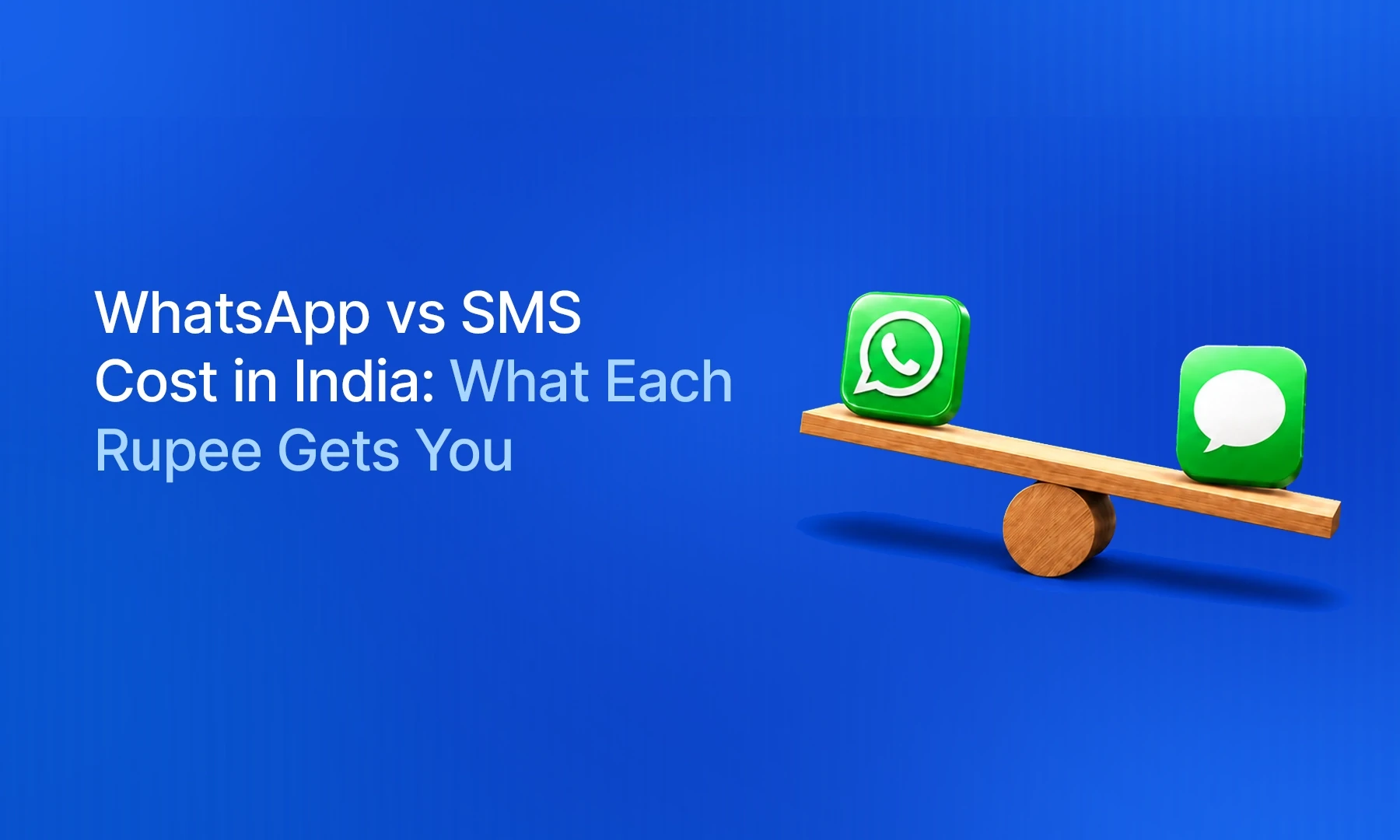
SMS looks cheaper on every rate card in India. A promotional text costs a fraction of a rupee, while Meta charges ₹0.8631 for a WhatsApp marketing message. So why do so many Indian businesses move their campaigns to WhatsApp anyway?
Because the price of a message is not the price of a result. A message that nobody clicks, answers or acts on is the expensive one, whatever it cost to send. This guide compares WhatsApp and SMS on what you get back for your money: clicks, replies, order updates and reach. It also shows where SMS is still the better buy.
Why Is Cost Per Message the Wrong Way to Compare WhatsApp and SMS?
Cost per message tells you what you pay to send. It does not tell you what you get. Two numbers decide the real cost: the price of each message, and the share of messages that lead to a click, a reply or a sale.
In India, Meta charges ₹0.8631 per delivered marketing message and ₹0.115 per delivered utility or authentication message, before GST and provider fees. Promotional SMS usually runs from about ₹0.10 to ₹0.25 on published rate cards. Your final WhatsApp bill also includes taxes and your provider's fee, and our guide to WhatsApp API pricing in India explains each layer.
How Do WhatsApp and SMS Compare on Clicks, Replies and Reach?
What you compare | SMS | WhatsApp Business API |
Price of the promotional message | About ₹0.10 to ₹0.25 | ₹0.8631 |
Price of an order or payment update | About ₹0.10 to ₹0.25 | ₹0.115 |
Click rate on campaigns (vendor-reported) | About 1% to 8% | About 15% to 60% |
Replies | Usually one way | Customer replies in the same chat |
Content | Plain text and a link | Images, documents, buttons, catalogues |
Reach | Any data, No phone required | Needs WhatsApp, data and opt-in |
Treat the click rates as direction, not a promise. They come from vendor reports, and they count clicks in different ways (some include button taps). Neither Meta nor TRAI publishes a benchmark, so the safest move is to test on your own list.
At What Click Rate Does WhatsApp Start Costing Less Than SMS?
Here is the sum that decides it. Take SMS at a mid-range ₹0.18 per message and WhatsApp marketing at ₹0.8631. Cost per click is the price of a message divided by the click rate.
Channel | Assumed Click Rate | Cost per Click |
SMS | 2% | ₹9.00 |
SMS | 4% | ₹4.50 |
WhatsApp Marketing | 5% | ₹17.26 |
WhatsApp Marketing | 10% | ₹8.63 |
WhatsApp Marketing | 20% | ₹4.32 |
WhatsApp Marketing | 30% | ₹2.88 |
These click rates are assumptions for the sum, and the figures exclude GST and provider fees. With SMS at 2%, WhatsApp breaks even at about 9.6%. Below that, SMS wins on cost per click. Above it, WhatsApp wins, and the replies and orders that follow come on top.
What Do You Get on WhatsApp That an SMS Cannot Give You?
Customers can reply: A customer who asks "is this still in stock?" reaches your team in the chat instead of calling. When a customer messages you first, your replies inside the 24-hour window are free for the first 1,000 per number each month, then ₹0.115 each (from 1 October 2026).
Order updates carry more: At ₹0.115, a shipping update costs about what a transactional SMS does. It can also include a product image, a tracking button or an invoice.
One tap replaces a link: Quick-reply buttons and catalogues let customers confirm an appointment, pick a product or ask for a callback without leaving the chat.
Your team sees the full thread: Replies can be assigned to the right agent in a shared team inbox, so a second person can pick up the conversation with the history in view.
Which Messages Should Move to WhatsApp and Which Should Stay on SMS?
Move to WhatsApp:
Offers and campaigns to opted-in customers, once a test clears the break-even click rate
Order, shipping, payment and appointment updates
Support conversations and follow-ups after a sale
Keep on SMS:
Urgent alerts where the customer may have no data
OTPs as a backup when WhatsApp delivery fails
Customers who have not opted in on WhatsApp, or are not on it
Many teams run both, with WhatsApp first and SMS as the backup. If you are comparing sending tools and their ban risk, our guide to WhatsApp bulk senders, their types and banrisk covers what is safe to use. For all three channels side by side, see our WhatsApp Business API vs email and SMS comparison.
Compare Cost Per Result, Not Cost Per Message
SMS wins on the price of a promotional message and on reach. WhatsApp wins when customers click, reply and buy, and when your order updates give them something to act on. Test both on a small opted-in list before you decide.
To see what your own message mix would cost, check the Emovur WhatsApp Business API pricing.
Frequently Asked Questions
Is WhatsApp more expensive than SMS in India?
Per marketing message, yes. Meta charges ₹0.8631, against roughly ₹0.10 to ₹0.25 for promotional SMS. Order and payment updates cost about the same, at ₹0.115 on WhatsApp. What matters is your cost per click or sale, which depends on how many people respond.
Do I pay when a customer replies on WhatsApp?
Messages from customers are free. Your free-form replies inside the 24-hour window are free for the first 1,000 per number each month, then ₹0.115 each from 1 October 2026. Check Meta's rate card before you budget, as these rules change.
Can WhatsApp replace SMS completely?
Not fully. WhatsApp needs data and an opt-in, so customers who are offline or not on WhatsApp will miss your message. Most businesses keep SMS for OTP backup and urgent alerts, and use WhatsApp for campaigns, updates and conversations.
Is WhatsApp worth it for a small business sending a few hundred messages a month?
At that volume, Meta's charges are small on both channels. The deciding factor is whether you want customers to reply and have someone to answer them. If your messages are one-way alerts, SMS may be enough.
How do I test WhatsApp against SMS before switching?
Split one opted-in list in two and send the same offer on each channel. After a week, compare clicks, replies and orders per rupee spent. Include GST and provider fees in your cost so the comparison is fair.
People Also Look for?
Best WhatsApp Business API provider in India
WhatsApp Business API pricing in India: what you actually pay
WhatsApp Bulk Sender: Types, Ban Risk & SMS vs WhatsApp