

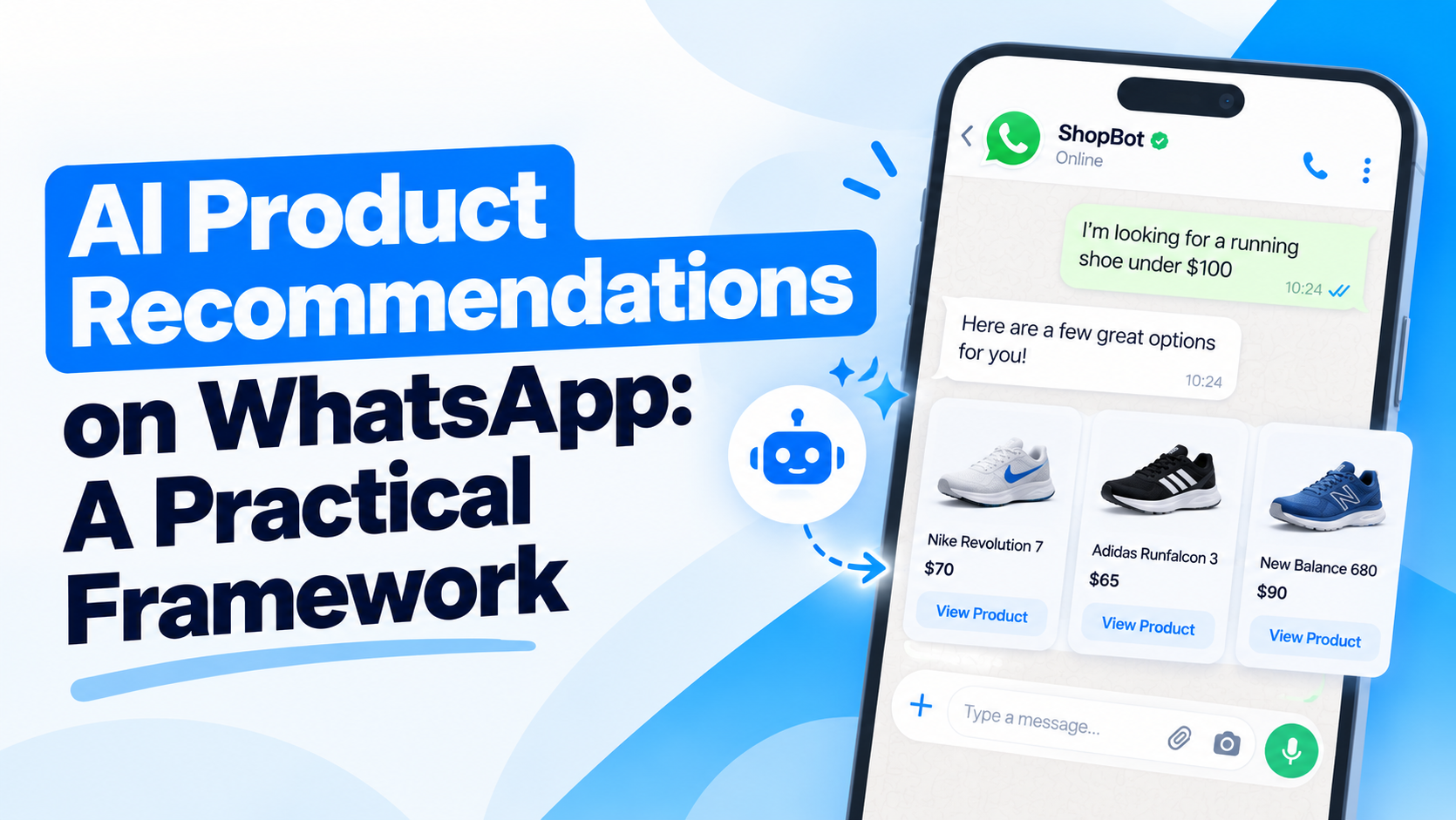
Customers often know what they want to achieve, but not always which product fits them best. On WhatsApp, that creates an opportunity for businesses to use AI to guide product discovery through conversation instead of forcing customers to browse long catalogues or compare multiple options manually.
AI product recommendations on WhatsApp can use customer questions, preferences, purchase history, product data and conversation context to suggest relevant products. The objective is not to show more products. It is to help the customer reach a better-fit choice with less effort.
Quick Answer
AI product recommendations on WhatsApp work by combining customer intent, product attributes, behavioural data and conversation context to suggest products that are more relevant to the individual customer.
A practical recommendation system should:
Understand what the customer is looking for
Collect only the information required to narrow the choice
Match customer needs with product attributes
Explain why a product is being recommended
Allow customers to refine or reject recommendations
Hand over to a human when the purchase requires judgement
The strongest recommendation experience feels like guided buying, not automated product pushing.
Start With Customer Intent, Not the Product Catalogue
AI recommendations should begin by understanding the customer's requirement. Showing popular products immediately may increase exposure, but it does not necessarily improve relevance.
The conversation should first identify what the customer is trying to solve.
Need: What does the customer want the product for?
Category: Which product type are they considering?
Budget: What price range is comfortable?
Preference: Are there specific features, brands, sizes or styles they prefer?
Urgency: Are they researching or ready to buy?
Constraints: Is anything unsuitable because of location, availability or compatibility?
For example, instead of asking a customer to browse 50 products, the system can first narrow the requirement to three or four relevant attributes.
Businesses already collecting structured customer information can use WhatsApp Flows for consent-based data collection where appropriate instead of asking every question through free-text chat.
Use Product Data That AI Can Actually Understand
Recommendation quality depends heavily on product data.
AI cannot reliably recommend the right product if the catalogue contains incomplete, inconsistent or poorly structured information.
Product data should ideally include:
Product category
Price
Features
Variants
Size or specifications
Availability
Use case
Compatibility
Customer type
Product limitations
The goal is to make product differences clear enough that the recommendation system can understand why one option may fit better than another.
For example, if three products differ mainly by price, capacity and intended use, those differences should be stored clearly rather than hidden inside long descriptions.
Build Recommendation Logic Around Fit
A useful recommendation system should rank products based on how well they match the customer's requirement.
The logic can combine several factors.
Requirement match: Does the product solve the stated need?
Budget fit: Is the product within the customer's expected range?
Feature fit: Does it contain the features the customer prioritised?
Availability: Can the product actually be purchased?
Compatibility: Will it work with the customer's existing setup or requirement?
Historical relevance: Have similar customers preferred or purchased this option?
The recommendation should not simply favour products with the highest margin or popularity.
A better system tries to answer:
Which available product is most suitable for this customer right now?
Keep the Number of Recommendations Small
AI recommendations become less useful when customers are shown too many options.
The purpose of conversational commerce is to reduce decision friction.
A practical response might provide:
Best Match: strongest overall fit
Budget Option: lower-cost alternative
Premium Option: higher-value option with additional features
Each recommendation should include a short reason.
For example:
Best Match: fits your stated budget and includes the two features you prioritised.
Budget Option: covers the basic requirement at a lower price.
Premium Option: adds additional capacity and longer-term flexibility.
This is more useful than sending a long product catalogue inside WhatsApp.
Let Customers Refine the Recommendation
A recommendation should not be treated as the final answer.
Customers should be able to change their preferences and immediately receive a better-fit option.
Useful refinement signals include:
"Something cheaper"
"I need a larger size"
"Show another brand"
"I don't need this feature"
"Is there something available today?"
"I want a premium option"
These responses give AI additional context and allow recommendations to improve during the conversation.
This creates a two-way product discovery process instead of a one-time recommendation.
Explain Why a Product Was Recommended
Customers are more likely to trust a recommendation when they understand the reason behind it.
The AI should therefore provide a simple explanation rather than only returning a product name.
Useful explanations may include:
Matches the requested budget
Includes the required feature
Suitable for the stated use case
Available in the preferred size
Compatible with the customer's requirement
Offers better value for the selected criteria
The explanation should stay short and practical.
AI should assist the buying decision, not overwhelm the customer with technical reasoning.
Use Customer History Carefully
Previous interactions can improve recommendations when they are relevant.
For example, a returning customer may have:
Purchased a related product
Asked about a specific category earlier
Selected a preferred brand
Shared a previous requirement
Responded to a product campaign
This context can make recommendations more personalised.
However, businesses should avoid assuming that an old preference still applies.
Customer history should be used as a signal, not as a fixed rule.
For businesses building richer conversational profiles, collecting zero-party data on WhatsApp can provide useful preference data directly from customers.
Know When AI Should Stop Recommending
Not every purchase should remain automated.
Human assistance becomes more useful when:
The customer has a complex requirement
Multiple products appear equally suitable
Pricing requires negotiation
The customer asks detailed technical questions
The purchase value is high
Customisation is required
The customer repeatedly rejects recommendations
At this stage, the conversation should move to a salesperson or product specialist with the collected context intact.
This avoids forcing AI to make decisions where human judgement is more appropriate.
Measure Recommendation Quality, Not Just Clicks
A recommendation system should be judged by whether it helps customers choose better, not simply whether they click a product.
Useful performance indicators include:
Recommendation acceptance rate
Product click-through rate
Add-to-cart rate
Purchase conversion
Average number of recommendations before selection
Recommendation rejection rate
Human handoff rate
Repeat purchase behaviour
The most valuable question is:
Did the recommendation help the customer reach a suitable product faster?
That is a better measure of recommendation quality than message volume alone.
Build AI Recommendations Around Customer Choice
The best AI product recommendations on WhatsApp are not designed to push products automatically.
They are designed to simplify product discovery.
A strong framework combines:
Clear customer intent
Structured product data
Relevant matching logic
Limited recommendations
Simple explanations
Customer refinement
Appropriate human handoff
When these elements work together, WhatsApp can become a guided product discovery channel instead of just another place to send catalogue links.