
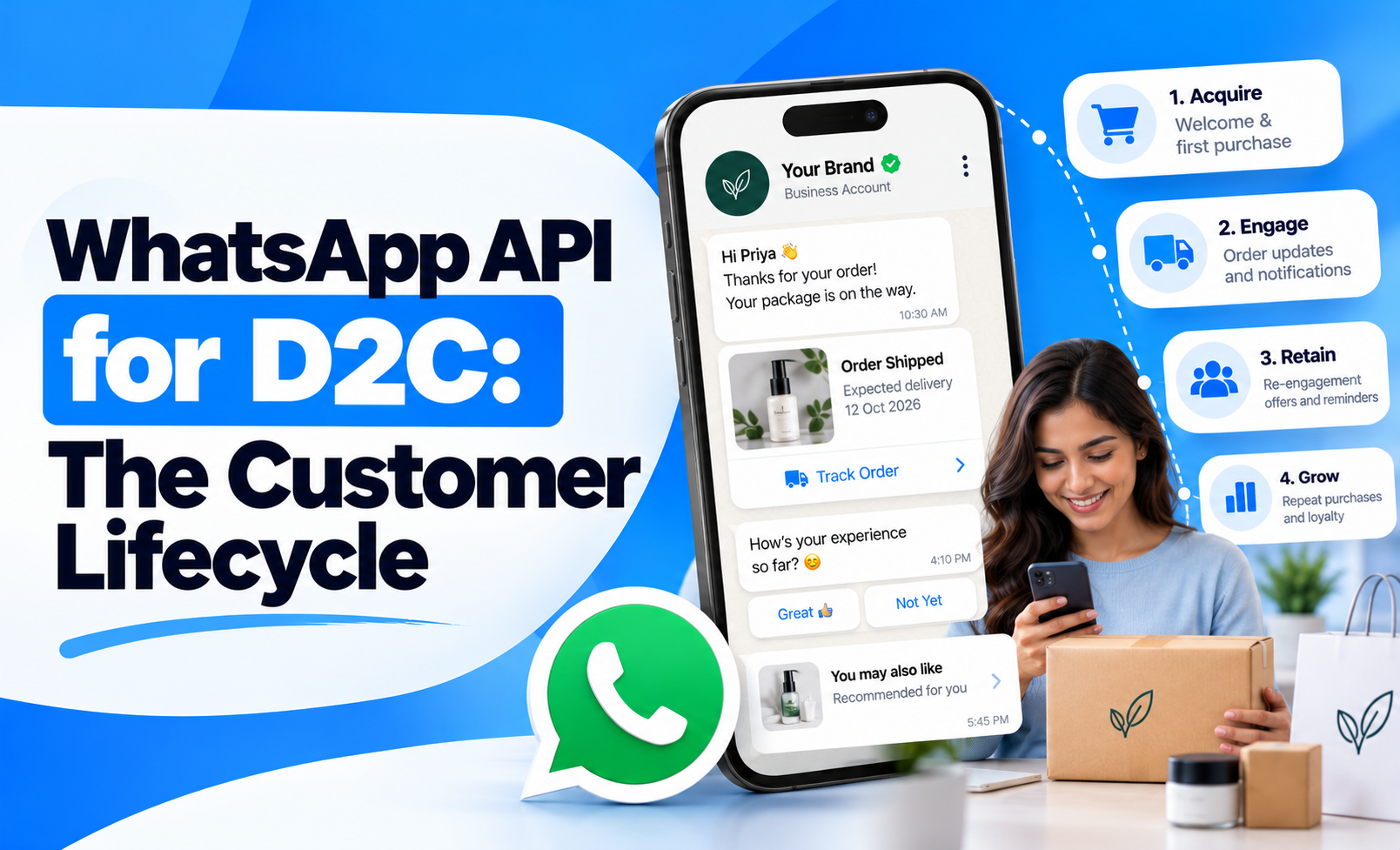
D2C brands often use WhatsApp for isolated tasks: sending order updates, running promotions or answering support queries. The bigger opportunity is to use WhatsApp across the entire customer lifecycle.
A connected WhatsApp journey can support the customer from the first enquiry to purchase, delivery, support, repeat buying and reactivation.
The value is not in sending more messages. It is in using WhatsApp at the right stage, with the right purpose, based on where the customer currently sits in the relationship.
Quick Concept
The WhatsApp API for D2C brands can support seven major lifecycle stages:
Acquisition
Product discovery
Purchase
Order fulfilment
Post-purchase support
Repeat purchase
Reactivation
Each stage needs a different type of communication. A customer who has just discovered the brand should not receive the same message as someone who has already purchased three times.
Use WhatsApp at the Acquisition Stage
At acquisition, the objective is to move the customer from interest into a useful conversation.
WhatsApp can support this when leads enter from:
Click-to-WhatsApp Ads: Customers can move directly from an ad into conversation.
Website CTAs: Product or category pages can direct high-intent visitors to WhatsApp.
QR codes: Offline packaging, retail displays or events can connect customers to the brand.
Social media: Interested users can continue the conversation without filling a long form.
The first interaction should focus on understanding intent, not immediately pushing a discount.
For paid acquisition, brands can use Click-to-WhatsApp Ads to turn campaign traffic into direct conversations.
Help Customers Discover the Right Product
Once the customer enters the conversation, WhatsApp can reduce the effort required to browse and compare products.
A strong discovery flow can include:
Understand the requirement: Ask what the customer is looking for before suggesting products.
Narrow the choice: Use category, budget, size, use case or preference to reduce options.
Show relevant products: Recommend a small number of products instead of sending the entire catalogue.
Answer objections: Clarify product differences, availability or suitability.
Move toward purchase: Give the customer a clear next step once they find the right option.
This works particularly well for categories where customers need guidance before buying.
Support the Purchase Without Adding Friction
At the purchase stage, WhatsApp should help the customer complete the transaction rather than creating another complicated checkout path.
Useful support can include:
Cart clarification: Answer final product or delivery questions.
Payment guidance: Provide the correct payment path where required.
COD confirmation: Confirm intent before dispatch for higher-risk orders.
Prepaid conversion: Offer a practical reason to switch from COD where appropriate.
Order confirmation: Immediately confirm that the purchase has been received.
For ecommerce brands managing COD-heavy order volumes, converting COD orders to prepaid on WhatsApp can improve order economics without forcing the customer.
Make Fulfilment Communication Proactive
After purchase, customers mainly want certainty.
They want to know whether the order was confirmed, dispatched and delivered on time.
Useful lifecycle messages include:
Order confirmed
Payment received
Packed
Shipped
Out for delivery
Delivery delayed
Delivered
These updates reduce the need for customers to contact support for routine status checks.
For transactional use cases, WhatsApp order utility messages can help structure post-purchase communication around actual order events.
Use Post-Purchase Communication to Build Confidence
The period after delivery is important because the customer is deciding whether the product and brand met expectations.
This stage should focus on value before the next sale.
Brands can use WhatsApp to:
Share product-use guidance: Help customers get better results from the purchase.
Collect feedback: Ask about the product or delivery experience at the right moment.
Resolve problems quickly: Give customers a clear route to support.
Answer usage questions: Reduce frustration that could otherwise lead to returns or negative reviews.
Capture preferences: Use customer responses to improve future communication.
A strong post-purchase experience can make the next purchase easier because the brand has already built trust.
Drive Repeat Purchases Based on Timing
Repeat purchase communication should follow product behaviour, not a fixed campaign calendar.
For replenishable D2C categories, useful signals include:
Average consumption period
Time since last purchase
Product type
Previous reorder frequency
Customer engagement
Stock availability
A practical repeat-purchase flow may look like:
Purchase → Expected Usage Period → Reorder Reminder → Quick Reorder
The important part is timing.
A reminder sent too early feels promotional. A reminder sent too late may arrive after the customer has already bought elsewhere.
Cross-Sell Based on What the Customer Already Owns
Cross-selling should extend the original purchase rather than feel random.
A good approach is:
Start from the first purchase: Understand what the customer already bought.
Identify the next logical need: Recommend a complementary product or upgrade.
Limit the options: One or two relevant recommendations are usually enough.
Explain the relationship: Tell the customer why the new product makes sense alongside the previous one.
This creates a more natural path to higher basket value without turning WhatsApp into a generic promotion channel.
Reactivate Customers Based on Lifecycle Signals
Some customers stop buying because they lose interest. Others simply fall out of the normal purchase cycle.
Reactivation should distinguish between the two.
A useful reactivation framework can include:
Identify meaningful inactivity: Compare the customer against their normal purchase pattern.
Use previous context: Reference categories or products the customer already knows.
Create a reason to return: New launches, product improvements or replenishment needs can work better than immediate discounting.
Reduce frequency if interest remains low: Repeated messages can damage the relationship.
For deeper lifecycle retention strategy, WhatsApp Retention Marketing for D2C Brands covers how to structure repeat-purchase and re-engagement communication.
Measure the Lifecycle, Not Individual Messages
D2C brands should not judge WhatsApp performance only through delivery rates or clicks.
The stronger metrics are lifecycle outcomes.
Track:
Acquisition-to-purchase conversion
Cart recovery rate
COD confirmation rate
Delivery-related support reduction
Repeat purchase rate
Average order value
Reactivation rate
Customer lifetime value
These metrics show whether WhatsApp is improving the customer relationship rather than simply increasing activity.
Build One Connected D2C Journey
The strongest WhatsApp API strategy for D2C brands connects the customer lifecycle instead of treating each interaction separately.
A practical lifecycle looks like:
Acquisition → Discovery → Purchase → Fulfilment → Support → Repeat Purchase → Reactivation
Each stage should have its own purpose, message type and trigger.
When WhatsApp is used this way, it becomes more than a campaign channel. It becomes a communication layer connecting the customer journey from first interest to long-term value.
Brands that want to build lifecycle messaging, automation and customer journeys at scale can explore the WhatsApp Business API.