


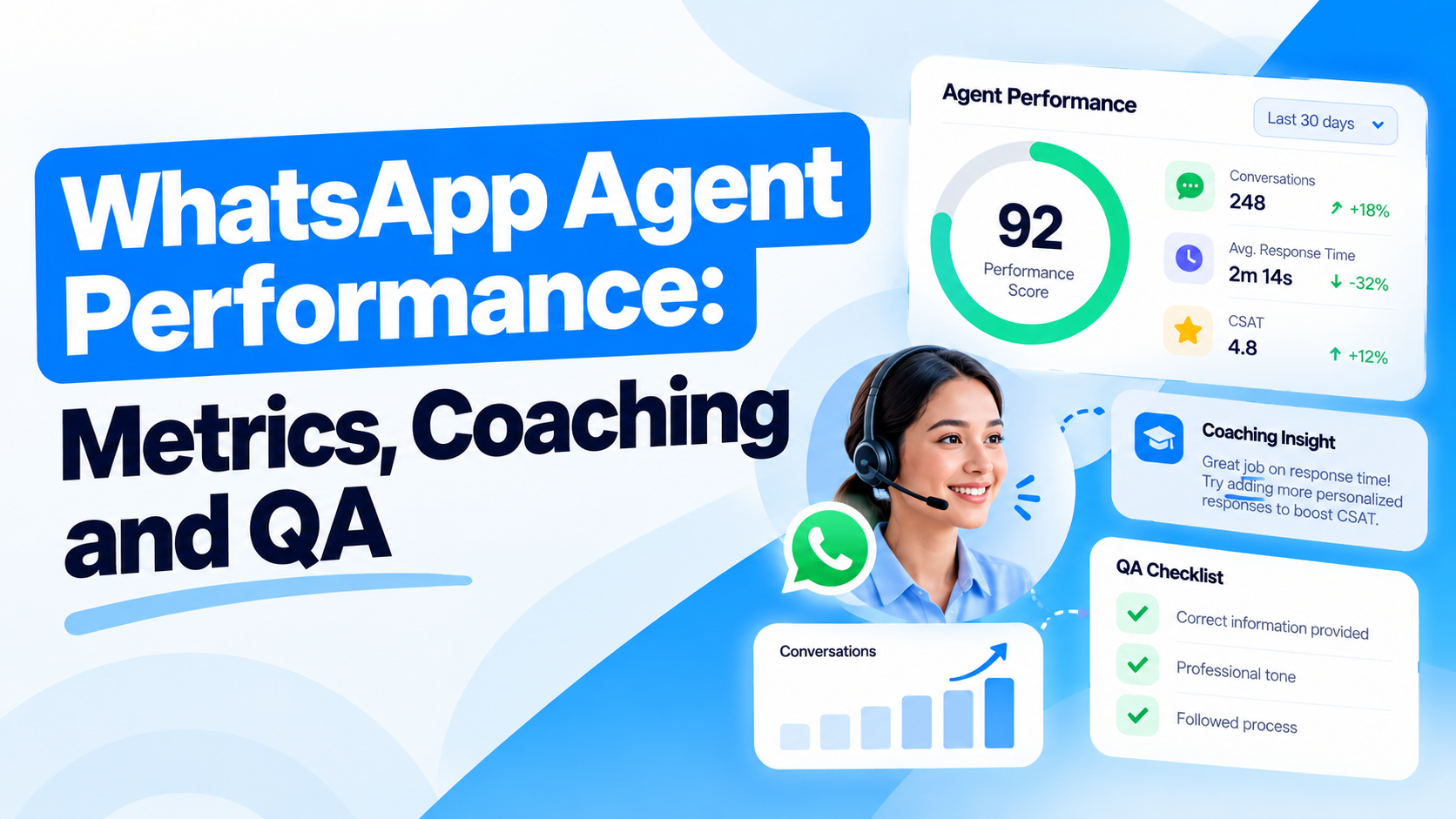
A WhatsApp support or sales team can handle thousands of conversations every month, but high message volume does not automatically mean good performance.
One agent may reply quickly but fail to resolve the customer’s issue. Another may take longer but provide a clearer answer and close the conversation properly.
That is why WhatsApp agent performance should be measured using a combination of speed, conversation quality, resolution and customer outcomes.
A strong QA process helps managers understand not only how fast agents respond, but how well they handle conversations.
Quick Answer
WhatsApp agent performance should be measured across three areas:
Efficiency: how quickly conversations are handled
Quality: how accurately and professionally agents respond
Outcome: whether the conversation reaches the right resolution
The most useful metrics include first response time, resolution time, conversation backlog, transfer rate, reopen rate, customer satisfaction and QA score.
The objective is not to monitor agents constantly. It is to identify coaching opportunities and improve the overall customer experience.
Which WhatsApp Agent Metrics Actually Matter?
Managers should avoid measuring performance using message count alone. Sending more messages can sometimes indicate inefficiency rather than better service.
A balanced scorecard should include:
First response time: How quickly an agent responds after a customer starts a conversation.
Average resolution time: How long it takes to resolve the issue or complete the required action.
Open conversation backlog: The number of customer conversations waiting for action.
Transfer rate: How frequently conversations are moved to another agent or department.
Reopen rate: How often customers return because the original issue was not fully resolved.
Customer satisfaction: Feedback collected after support or service conversations.
QA score: A structured evaluation of conversation quality.
Conversion or completion rate: Useful for sales, onboarding or appointment-focused teams.
For support-focused operations, WhatsApp chatbot analytics and resolution metrics can also help distinguish automated performance from human-agent performance.
Why Speed Alone Is a Poor Performance Metric
Fast responses are important, but they should not be treated as the only indicator of quality.
An agent may reply within 30 seconds and still provide:
An incomplete answer
Incorrect information
Unnecessary transfers
Poor instructions
No clear next step
This can create more messages and longer conversations.
Managers should therefore compare speed with quality metrics.
For example:
Fast response + low resolution rate: the agent may be rushing.
Slow response + high resolution rate: workload or routing may be the real issue.
High transfer rate: the agent may lack product knowledge.
High reopen rate: conversations may be closed too early.
Performance data becomes useful when metrics are interpreted together rather than individually.
Build a WhatsApp Conversation QA Scorecard
Quality assurance should use a consistent scorecard so managers are not reviewing conversations based only on personal opinion.
A practical QA scorecard can evaluate:
Accuracy: Was the information correct?
Understanding: Did the agent understand the customer’s actual requirement?
Clarity: Was the response easy to understand?
Tone: Was the conversation professional and appropriate?
Process adherence: Did the agent follow the required workflow?
Ownership: Did the agent take responsibility for moving the conversation forward?
Resolution: Was the issue properly resolved?
Next step: Was the customer clearly told what happens next?
The scorecard should remain simple enough that managers can apply it consistently across the team.
How Should Managers Review Conversations?
Managers do not need to manually read every WhatsApp conversation.
Instead, QA reviews can use a representative sample based on risk and performance.
Useful conversation groups include:
Random conversations
Low customer satisfaction conversations
Escalated cases
Reopened conversations
Long-resolution conversations
High-value customer interactions
Conversations with repeated transfers
New-agent conversations
This gives managers a more useful view than reviewing only successful interactions.
The purpose of QA is to find recurring patterns, not isolated mistakes.
Turn QA Findings Into Coaching
Performance data is valuable only when it leads to better behaviour.
Managers should convert QA findings into specific coaching actions.
Instead of saying:
“Improve your WhatsApp communication.”
give the agent something measurable to work on.
Examples include:
Reduce unnecessary transfers
Confirm the customer’s requirement before answering
Give one clear next step before closing
Avoid repeating information already provided
Improve product knowledge in a specific category
Use shorter, clearer responses
Escalate technical issues earlier
Coaching should focus on one or two improvements at a time.
This makes it easier to measure whether performance actually changes.
Use Conversation Patterns to Identify Training Gaps
Individual mistakes may sometimes indicate a wider team problem.
For example:
Several agents struggle with the same product question
Transfers increase after a new policy change
Customers repeatedly ask for clarification about the same process
Agents use inconsistent responses for the same issue
These patterns can indicate that the problem is not agent performance alone.
The business may need:
Better internal documentation
Updated response templates
Product training
Clearer escalation rules
Improved routing
Better automation
This is where QA becomes an operational improvement tool rather than just an agent scoring system.
Where Automation and AI Can Help QA
AI can support WhatsApp quality monitoring by helping managers review larger volumes of conversations.
Possible applications include:
Conversation summaries
Sentiment signals
Topic classification
Escalation detection
Missing-step detection
Repeated customer complaints
Suggested QA flags
However, AI-generated QA should still be reviewed by humans.
Tone, context and customer intent can be difficult to judge from automated signals alone.
For conversations that move between automation and human agents, human-AI WhatsApp handoff design is also important because poor handoffs can affect both agent performance and customer experience.
Build Performance Around Improvement, Not Surveillance
The purpose of WhatsApp performance management should be to help teams improve customer outcomes.
A useful system combines:
Operational metrics
Conversation quality
Customer feedback
Consistent QA reviews
Targeted coaching
Team-level process improvements
Managers should use the data to answer:
Where are conversations breaking down, and what can we improve?
When metrics, QA and coaching work together, agent performance becomes easier to improve without reducing the customer experience to response-time numbers alone.