

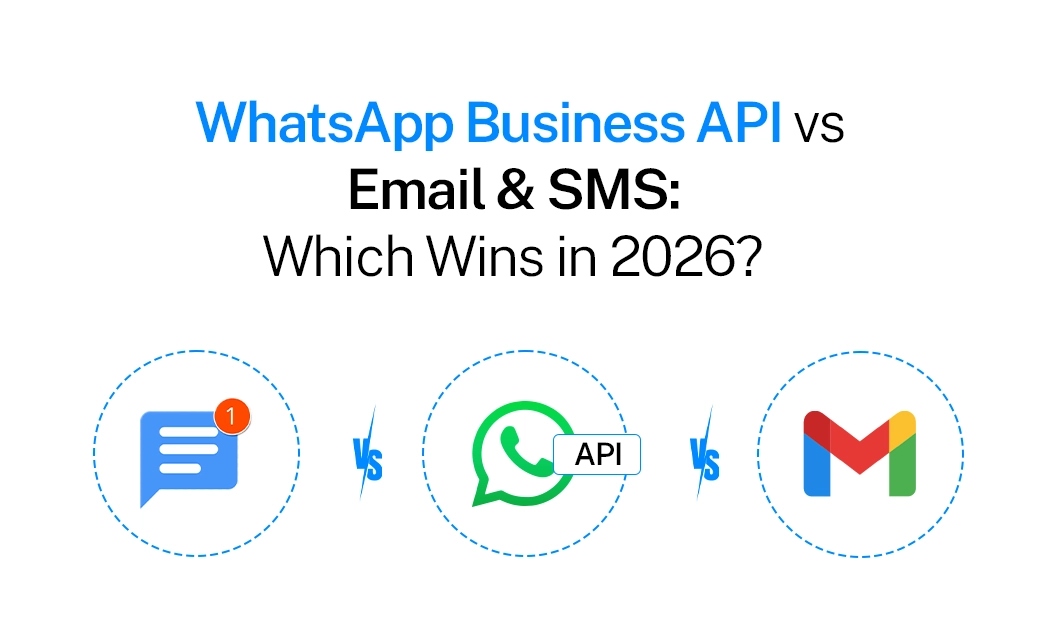
WhatsApp Business API vs Email & SMS: Which Wins in 2026?
Introduction:
Should your business communicate with customers through WhatsApp, email or SMS?
The answer isn't simply to replace one channel with another. Each channel works best for a different type of customer interaction.
WhatsApp is strongest for real-time engagement, conversations, automation and conversion. Email works better for long-form content and nurturing. SMS remains valuable for OTPs, urgent alerts and customers who may not use WhatsApp.
For businesses in India, the practical question is not “Which channel is best?” but “Which channel should I use for each customer journey?”
Is WhatsApp Business API Better Than Email and SMS?
Why WhatsApp Wins on Engagement
Email's real problem isn't reach, it's attention. Even with 35-45% "opens" reported by platforms, actual human engagement is closer to 20-25% once inflated opens from privacy-protection tools are excluded. WhatsApp doesn't have this problem: customers check it multiple times a day, so a message lands and gets seen, not filed into a promotions tab.
SMS still delivers strong open rates, but it's a dead end, one-way, plain text, no context. WhatsApp keeps the conversation going: a customer can ask a question, get a chatbot reply, or reach a live agent, all inside the same thread the promotion arrived in.
Where Email and SMS Still Win
Email is still the right channel for newsletters, detailed product documentation, invoices, and anything that needs a permanent, searchable record.
SMS is irreplaceable for OTPs and urgent, time-boxed alerts (delivery windows, appointment reminders) where a customer might not have data or app access at that exact moment.
Opt-In Requirements Aren't Equal Across Channels
WhatsApp requires explicit opt-in under Meta's policy before you can message a customer at all, a stricter bar than the list-building norms most businesses are used to with SMS and email. That difference directly affects how fast you can build a WhatsApp audience compared to the other two channels, and it's a planning consideration that almost no side-by-side comparison calls out directly.
Conclusion
WhatsApp Business API beats email and SMS on the metrics that matter most for engagement, open rate, response speed, and two-way conversation — which is why it's become the primary channel for support and sales conversations. But the smartest setup isn't a total replacement:
keep email for long-form and compliance records, SMS for internet-independent urgent alerts, and let WhatsApp carry the bulk of real-time customer engagement.
FAQs
1. Is WhatsApp Business API really better than email for marketing?
For engagement, yes — WhatsApp's ~98% open rate far outpaces email's realistic 20-25%. Email is still better for long-form newsletters and formal documentation.
2. Is WhatsApp cheaper than SMS?
It depends on volume. SMS is often cheaper per single message, but WhatsApp Business API is priced per conversation, which tends to be more cost-effective at scale with two-way engagement included.
3. Can I use WhatsApp, SMS, and email together?
Yes, and most successful businesses do — WhatsApp for support and sales conversations, SMS for urgent alerts, and email for detailed or formal communication.
4. Does WhatsApp Business API require customer opt-in?
Yes, Meta requires explicit opt-in before you can message a customer on WhatsApp, which is stricter than typical SMS or email list-building rules.
5. How do I get started with WhatsApp Business API?
You'll need a Business Solution Provider to handle registration, template approval, and your dashboard. Book a demo with Emovur to get set up.