

WhatsApp BSP vs Meta Cloud API: Which Should You Choose?
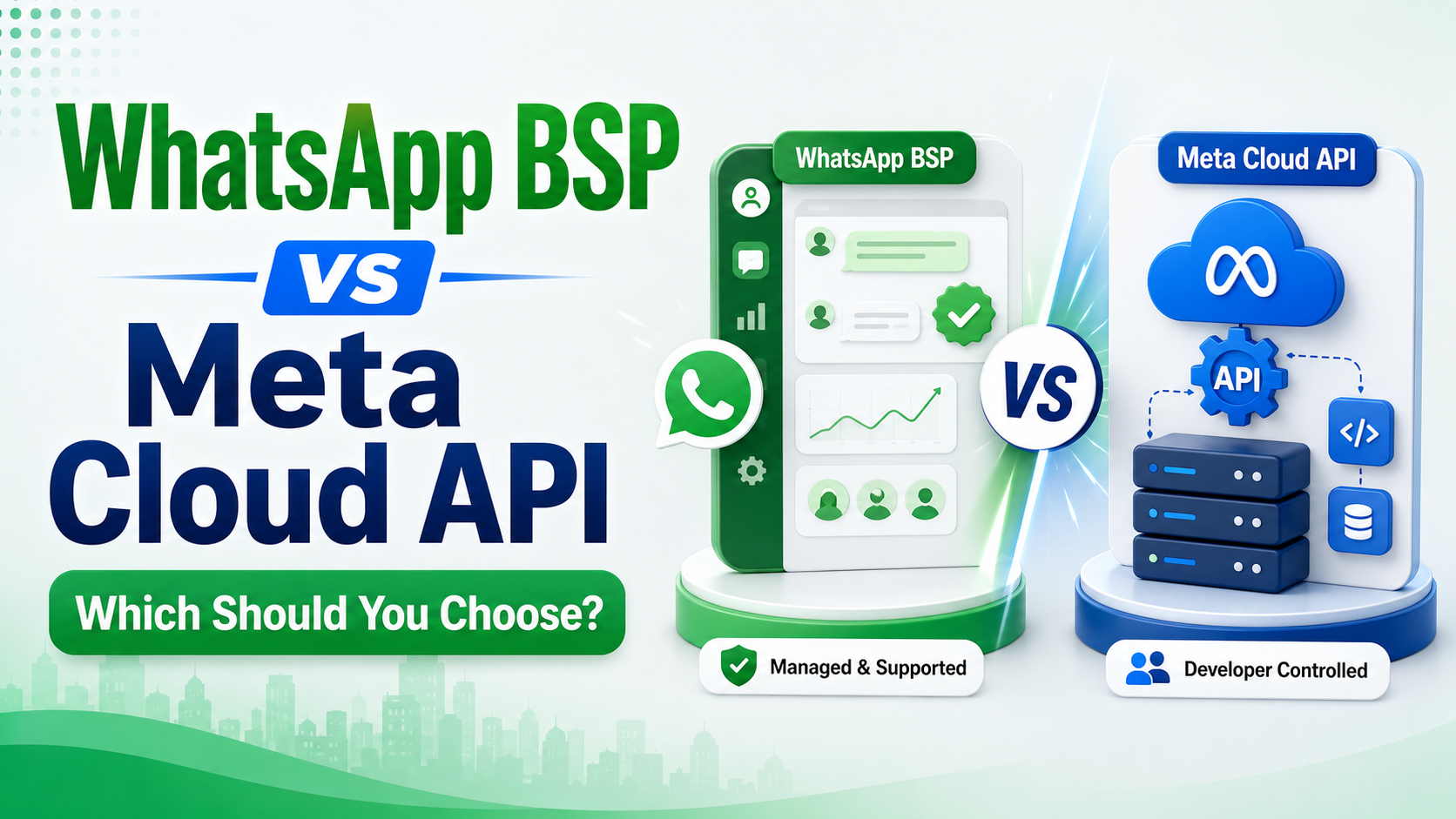
Direct answer: They're not actually two separate APIs. Meta's Cloud API is the only infrastructure that runs the WhatsApp Business Platform today — a BSP (Business Solution Provider) doesn't give you a different API, it gives you a managed layer of tools, support, and onboarding built on top of that same Cloud API. The real decision isn't "which API" — it's whether you build and maintain that layer yourself, or pay a BSP to hand it to you already built.
That distinction matters more than it sounds like it should, because a lot of comparison content online still gets it wrong.
Clearing Up the Confusion First
Until October 2025, Meta ran two separate hosting models: the on-premise API (self-hosted on your own servers) and the newer Cloud API (hosted entirely by Meta). On-premise was deprecated, and Cloud API is now the only infrastructure path. So when people say "Cloud API" today, they mean the underlying WhatsApp Business Platform itself — not a specific competing product to a BSP.
A Business Solution Provider is a company Meta has approved to sell and support access to that same Cloud API, with added software on top — a chatbot builder, a shared team inbox, campaign tools, analytics, and onboarding help. Meta's own developer documentation describes this as onboarding as a WhatsApp Tech Provider so that a company can start providing messaging services to its own clients — which is exactly what a BSP is.
So the real choice in 2026 is:
Go direct — connect to Meta's Cloud API yourself, and build (or buy separately) whatever inbox, chatbot, and reporting tools you need around it.
Go through a BSP — get that same Cloud API access plus a ready-made operating layer, in exchange for a subscription fee or a small per-message markup.
WhatsApp BSP vs Direct Cloud API: At a Glance
When Direct Cloud API Makes Sense
Going direct is the right call when most of the following are true for your business:
You already have a developer (or team) who can own webhooks, token management, and template submissions on an ongoing basis — not just at launch.
You need custom logic that off-the-shelf chatbot builders genuinely can't express — deeply bespoke routing, unusual integrations, or a very specific internal system it needs to talk to.
Your message volume is high enough that even a small BSP markup adds up to a meaningful monthly cost.
You're comfortable owning monitoring, incident response, and ongoing maintenance yourself, indefinitely — not just during setup.
The trade-off most teams underestimate here isn't the initial build — it's the ongoing maintenance. Templates need resubmission, webhooks need monitoring, and Meta's platform changes through the year (more on that below) need someone tracking them.
When a BSP Makes Sense
A BSP is the better fit when most of the following are true:
Your goal is to get WhatsApp working as a customer channel, not to run an engineering project around an API.
You need a shared inbox for a sales or support team on day one, not in three months once someone builds it.
You want a no-code chatbot and automation builder, so marketing or support can own the logic without pulling in a developer for every change.
You want CRM, e-commerce, or payment integrations pre-built rather than custom-coded.
You'd rather have a support team to call when something breaks than debug a webhook at 11 PM yourself.
For most Indian SMEs and growing businesses, this is where the decision actually lands — not because direct Cloud API is worse, but because the internal engineering time it takes to replicate what a BSP already provides usually costs more than the BSP's fee. In full transparency: Emovur operates on the BSP model, so we have a stated position here — but the "direct Cloud API" case above is genuinely the right call for teams that fit that profile, and we'd say so either way.
The Hybrid Path
There's a third option that gets underexplored in most comparisons: connecting your own Cloud API credentials directly to Meta, while still using a BSP-style platform purely as a management interface — bots, inbox, reporting — layered on top of your own connection. This suits teams that want data control and direct billing from Meta, but don't want to build the operating layer from scratch. It's less common than a straightforward direct-vs-BSP choice, but worth knowing exists before you commit either way.
What Changed in 2026 That Affects This Decision
A few platform-level shifts through 2026 are worth factoring in, since they change how much "onboarding complexity" a BSP is actually saving you compared to a year ago:
Messaging tier changes. Meta has been moving toward a higher default daily messaging limit for verified businesses, removing some of the step-by-step tier progression that used to make scaling slower. This reduces one reason teams used to lean on a BSP purely to navigate tier upgrades.
In-app signup. Meta made in-app opt-in signup more broadly available, letting businesses generate a deeplink for WhatsApp opt-in directly from ads, websites, or other channels — a feature that used to require more custom integration work.
Currency and billing changes. Meta has been rolling out local-currency billing for WhatsApp Business Platform accounts in more markets, per the platform's changelog. Whichever path you choose, keep an eye on how your billing is structured, since this affects direct Meta invoicing differently than a BSP's consolidated billing.
None of these changes flip the decision on their own, but they do mean the gap between "direct is hard, BSP is easy" has narrowed slightly for teams with real engineering capacity — while the day-to-day tooling gap (inbox, chatbot builder, reporting) hasn't narrowed much at all. If your want to see the complete guide - see our Best whatsApp API providers complete comparison guide
Decision Framework
Ask these three questions in order:
Do you have a developer who will actively own WhatsApp integration work for the long term, not just at launch? If no, go BSP. If yes, continue.
Do you need a team inbox, no-code automation, or pre-built CRM integrations on day one? If yes, a BSP still gets you there faster even with developer capacity available elsewhere. If no, continue.
Is your message volume high enough that a BSP markup meaningfully changes your unit economics? If yes, direct Cloud API (or the hybrid path) is worth the build effort. If no, the BSP route is almost always the more efficient use of your team's time.
Whichever path you choose, the underlying setup steps — Meta Business verification, WABA creation, phone number registration — are the same either way. Emovur's step-by-step guide to getting WhatsApp Business API in India walks through that process in full.
FAQs
Is a BSP a different WhatsApp API than Cloud API? No. Both run on the same underlying WhatsApp Business Platform (Cloud API). A BSP is a company that provides tooling, support, and onboarding on top of that infrastructure — not an alternative to it.
Is direct Cloud API cheaper than going through a BSP? On Meta's per-message fees, yes — you pay the same rate either way, and a BSP typically adds a subscription or small markup on top. But "cheaper" only holds if you don't count the engineering time needed to build and maintain the inbox, chatbot, and integration layer yourself. See Emovur's WhatsApp API pricing in India breakdown for the current Meta fee structure.
Can I switch from a BSP to direct Cloud API later, or vice versa? Generally yes, since both connect to the same underlying WABA. Migrating phone numbers and templates between providers is a well-established process, though it's worth confirming data portability and migration support before committing to either path.
Do I need to be a developer to use direct Cloud API? Not strictly, but in practice, yes — someone on your team needs to manage webhooks, template submissions, and ongoing maintenance. If nobody on your team can own that indefinitely, a BSP removes that requirement entirely.
If your team doesn't have a developer who wants to own WhatsApp infrastructure long-term, the BSP route will almost always get you live faster and keep you operating without a maintenance burden. If you do have that capacity and specific custom needs a BSP's tooling can't express, direct Cloud API is a legitimate, well-supported path — just budget the ongoing engineering time honestly, not just the setup time. Either way, the WhatsApp Business API setup fundamentals are the same starting point.