


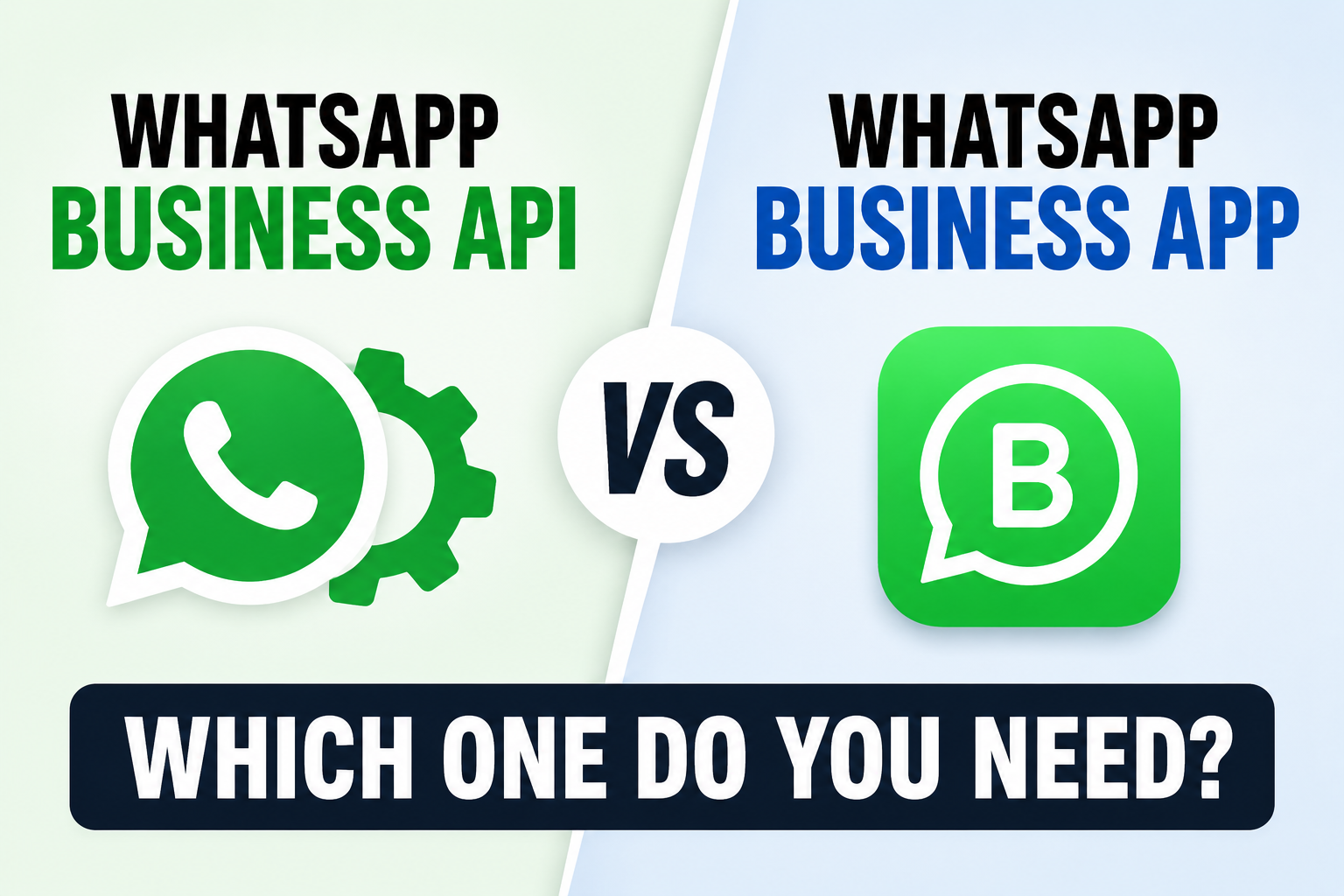
Here is the direct answer: the WhatsApp Business App is a good starting point for solo operators and very small teams that manually handle a low number of customer conversations. But if your business needs automation, multiple agents, CRM syncing, large broadcasts to opted-in users, campaign analytics, or trigger based follow-ups, WhatsApp Business API is the better long-term option.
The
mistake many businesses make is not choosing the wrong tool on day one. The
mistake is continuing with the free app after the business has already outgrown
it.
|
This is not a forced API upsell. If your business
only handles a small number of conversations and does not need automation,
the WhatsApp Business App may still be the right option. The API makes sense
only when the business problem has grown beyond manual WhatsApp handling. |
Quick Decision: App or API?
|
Business
Situation |
Better
Fit |
Why |
|
Solo operator or very small
team |
WhatsApp Business App |
Simple manual replies,
labels, catalog, and basic auto-replies may be enough. |
|
Fewer than 50 customer
conversations per day |
WhatsApp Business App |
Manual handling is still
manageable if there is no CRM or automation requirement. |
|
Multiple sales/support
agents handling WhatsApp |
WhatsApp Business API |
A shared inbox helps avoid
missed replies, duplicate follow-ups, and lost context. |
|
Need automated reminders,
order updates, or lead follow-ups |
WhatsApp Business API |
The API supports triggered
workflows, templates, journeys, and integrations. |
|
Need broadcasts beyond
small contact lists |
WhatsApp Business API |
API campaigns can reach
larger opted-in lists with better segmentation and tracking. |
|
Need CRM sync or campaign
analytics |
WhatsApp Business API |
WhatsApp conversations can connect with CRM, support tools, and reporting systems. |
|
In real business use, the switch usually becomes necessary
when teams start losing lead context, manually repeating the same follow-up
messages, or depending on one person’s phone to manage customer
communication. |
What Is the WhatsApp Business
App?
The
WhatsApp Business App is Meta’s mobile app for small businesses that personally
manage customer conversations. It is useful when communication is simple,
volume is low, and the business does not need deep automation or external
system integration.
What the WhatsApp Business
App Does Well
·
Create a basic business profile with business
name, description, address, hours, website, and contact details.
·
Organize chats with labels such as New Lead,
Pending Payment, Follow-Up, or Completed.
·
Use quick replies for repeated answers.
·
Set basic greeting and away messages.
·
Create a product or service catalog for customers
to browse.
·
Use linked-device support for small teams,
subject to WhatsApp’s current device limits and eligibility.
·
Send broadcasts within WhatsApp’s app-level
broadcast limits.
|
WhatsApp’s official Business App materials position
the app as a tool for small businesses that personally manage conversations,
use labels, quick replies, away messages, catalog features, and basic
business messaging tools. |
Where the WhatsApp Business
App Starts Becoming a Bottleneck
·
Broadcast lists are limited compared to API-based
campaign sending.
·
There is no advanced chatbot, drip sequence, or
conditional workflow builder inside the basic app experience.
·
CRM integration is not available in the same
scalable way as API-based setups.
·
Multi-agent collaboration is limited compared to
a proper shared inbox.
·
Campaign analytics and delivery reporting are
limited compared to API platforms.
·
Customer data often stays scattered across phones
instead of being connected to the business system.
The
Business App is genuinely useful at the right scale. The problem starts when
the team keeps using it for work that should be automated, tracked, assigned,
and connected to a CRM.
What Is WhatsApp Business
API?
WhatsApp
Business API, also called WhatsApp Business Platform, is not a mobile app. It
is a business messaging infrastructure that lets businesses send and receive
WhatsApp messages through dashboards, CRMs, automation platforms, support
tools, and backend systems.
Most
businesses access it through a WhatsApp API provider or Business Solution
Provider. Technical teams can also work with Meta’s Cloud API directly, but
that requires development, webhook handling, integration, monitoring, and
maintenance.
|
The API is not valuable only because it allows more
messages. It becomes valuable when it connects WhatsApp with sales, support,
marketing, lead follow-up, order updates, reminders, segmentation, and
reporting. |
What the API Makes Possible
That the App Cannot Handle Well
·
Large-scale broadcasts to opted-in customer
lists.
·
Automated follow-up journeys and drip sequences.
·
Chatbots and rule-based flows for FAQs, lead
qualification, support routing, and reminders.
·
Multi-agent shared inbox for sales, support, and
operations teams.
·
CRM integrations with systems such as Zoho,
HubSpot, Salesforce, or custom CRMs.
·
Trigger-based messages such as payment reminders,
appointment reminders, order confirmations, shipping updates, renewal alerts,
and reactivation campaigns.
·
Campaign analytics, delivery tracking, team
performance visibility, and better reporting.
·
Template-based outbound communication aligned
with WhatsApp policy and message categories.
Full Feature Comparison
|
Feature |
WhatsApp
Business App |
WhatsApp
Business API |
|
Best for |
Solo operators and very
small teams |
Growing businesses, sales
teams, support teams, D2C brands, clinics, education, real estate,
automotive, finance, and multi-location businesses |
|
Primary usage |
Manual customer chat |
Scalable business communication,
automation, campaigns, support, and CRM-connected workflows |
|
Agents / users |
Limited linked-device setup
depending on current WhatsApp limits and eligibility |
Multi-agent shared inbox
through provider dashboard |
|
Broadcasts |
App-level broadcast list
limits |
Large opted-in campaigns
with segmentation and reporting |
|
Automation |
Basic greeting and away
messages |
Chatbots, workflows, drip
sequences, triggered messages, and journeys |
|
CRM integration |
Not built for full CRM sync |
Supported through provider
integrations or custom API setup |
|
Message templates |
Limited app-based messaging
tools |
Full approved template
workflow for outbound business messages |
|
Analytics |
Limited app insights |
Campaign, delivery,
conversation, and agent reporting depending on provider |
|
Customer data ownership |
Often stays inside
phones/chats |
Can connect with CRM,
dashboard, and business systems |
|
Compliance control |
Manual discipline required |
Template governance, opt-in
workflows, role control, and reporting can be managed better |
|
Cost |
Free for basic app usage |
Meta message charges +
provider/platform fee, depending on provider |
The Cost Question: Free vs
Paid
The
WhatsApp Business App is free for basic usage. WhatsApp Business API has a cost
because it is built for scaled communication, automation, team workflows,
templates, integrations, and reporting.
For
this blog, use the following India pricing values:
|
Message
Category |
Use
Case |
India
Pricing to Use in Blog |
|
Marketing |
Promotions, offers, product
launches, campaign broadcasts, re-engagement messages |
₹0.863 |
|
Utility |
Order updates, appointment
reminders, delivery alerts, payment alerts, service updates |
₹0.115 |
|
Authentication |
OTP, login verification,
identity confirmation, two-factor authentication |
₹0.115 |
|
Service |
Customer-initiated support
conversations inside the customer service window |
Free |
|
Pricing must be published carefully. WhatsApp Business Platform pricing is category-based and market-based, and Meta may
update its rate card. Before publishing, verify the latest official India
pricing from Meta or Emovur’s current pricing page. Service should be written
as free only for eligible customer-initiated conversations inside the
customer service window, not as “all WhatsApp support is always free.” |
·
Meta’s message charges based on category and
recipient market.
·
Provider or platform subscription fee.
·
Provider markup, if any.
·
Optional add-ons for automation, users,
integrations, support, or advanced analytics depending on the platform.
Emovur
positions itself around 0% markup on Meta charges. That means businesses should
check whether they are paying the Meta rate clearly, plus the selected Emovur
platform plan, instead of hidden markups on message charges.
|
The article should not say the API is “cheap” for
every business. It should explain when the cost makes business sense: fewer
missed leads, less manual follow-up, better campaigns, cleaner customer data,
and improved team efficiency. |
When the API Cost Makes Sense
·
Your team spends hours manually sending the same
follow-up messages.
·
Leads are lost because response time is slow.
·
Sales or support conversations are scattered
across employee phones.
·
You need to broadcast to a full opted-in customer
list, not just a small broadcast list.
·
You need appointment reminders, payment
reminders, order updates, renewal alerts, or reactivation campaigns.
·
You want WhatsApp conversations connected to CRM,
support, or sales systems.
·
You are using unofficial bulk-sending tools and
want a safer official route.
When the Free WhatsApp
Business App Is Still the Right Call
·
You are a solo operator or a very small team.
·
You handle a low number of customer conversations
each day.
·
You do not use CRM or automation.
·
You do not need drip campaigns, chatbots, or
trigger-based messaging.
·
Your broadcast needs are small and fit inside
app-level limits.
·
Your business does not depend on repeat
transactions, reminders, or structured follow-up.
|
A business should not move to the API only because
it sounds more advanced. Move when the manual process is affecting speed,
lead conversion, customer experience, reporting, or team coordination. |
5 Signs You Have Outgrown the
WhatsApp Business App
1. Multiple Team Members Are
Sharing One WhatsApp Account
When
sales or support teams depend on one phone or one account, messages get missed,
duplicate replies happen, and customer history becomes unclear. The API solves
this through a shared team inbox where conversations can be assigned, tracked,
and managed properly.
2. Your Team Repeats the Same
Follow-Up Manually
If
someone is sending the same “just checking in” or “payment reminder” message
every day, that is automation work being done manually. API workflows can send
these messages based on triggers, stages, or timelines.
3. Broadcast Limits Are
Blocking Campaigns
If
your customer list is larger than the app-level broadcast limit, your campaign
reach becomes fragmented. The API supports larger opted-in campaigns with
segmentation, templates, and reporting.
4. Customer Data Lives Only
in WhatsApp
If
your CRM does not show what happened on WhatsApp, your team is working with
incomplete customer history. API integration helps keep conversation context
connected to the business system.
5. You Are Using Unofficial
Bulk Tools
Unofficial
tools may look cheaper in the beginning, but they increase account risk and
damage customer trust. The API is the safer official route for scaled WhatsApp
communication.
|
A responsible WhatsApp strategy should avoid cold
blasting, unclear consent, hidden opt-outs, misleading templates, and
unauthorized bulk tools. The goal is not just sending more messages; it is
sending relevant messages to people who expect them. |
Compliance: The Part
Businesses Should Not Ignore
WhatsApp
API gives businesses more scale, but scale comes with responsibility. Before
sending campaigns, your business should have clear opt-in, approved templates,
and an easy opt-out path.
|
Compliance
Area |
What
to Do |
Why
It Matters |
|
Opt-in |
Message people who have
shared their number and agreed to receive WhatsApp communication |
Reduces spam complaints and
protects trust |
|
Templates |
Use approved templates for
business-initiated messages outside the customer service window |
Keeps outbound
communication aligned with WhatsApp rules |
|
Category accuracy |
Do not put offers inside
Utility templates |
Wrong category can increase
cost or lead to rejection |
|
Opt-out |
Let people stop receiving
promotional messages easily |
Improves customer
experience and reduces negative feedback |
|
Human escalation |
Provide a clear way to
reach a person when automation cannot solve the issue |
Protects support quality |
|
Template category matters for both pricing and
approval. A message that includes a discount, offer, upsell, or campaign
language should not be forced into Utility just to reduce cost. |
The Decision: Which One Is
Right for You?
Use the WhatsApp Business App
if:
·
You are a solo operator or a very small team.
·
You handle a manageable number of conversations
manually.
·
You do not need CRM integration.
·
You do not need chatbots, drip sequences, or
advanced automation.
·
Your broadcasts are small and occasional.
·
You are still validating customer communication
volume.
Move to WhatsApp Business API
if:
·
You want automation for reminders, follow-ups,
updates, and lead nurturing.
·
You want your team to manage WhatsApp from a
shared inbox.
·
You need to run campaigns to a larger opted-in
audience.
·
You need CRM or support tool integration.
·
You need analytics and reporting for WhatsApp
campaigns.
·
You want cleaner governance over templates,
opt-in, and team replies.
·
You are currently using unofficial bulk messaging
tools.
Business Examples: App vs API
Fit
|
Business
Type |
App
May Be Enough When |
API
Is Better When |
|
Clinic |
Only a few patients message
daily |
You need appointment
reminders, report updates, follow-up sequences, and team replies |
|
Automotive dealer |
Only a few enquiries come
through WhatsApp |
You need test-drive
booking, lead nurturing, service reminders, and campaign follow-up |
|
D2C brand |
Small number of manual
order queries |
You need abandoned cart,
order updates, broadcasts, segmentation, and CRM sync |
|
Real estate business |
Few direct enquiries and
manual follow-up is manageable |
You need lead
qualification, site-visit reminders, project updates, and team tracking |
|
Education institute |
Small admissions team with
low volume |
You need enquiry nurturing,
webinar reminders, fee alerts, and admission follow-ups |
Questions to Ask Before
Moving to WhatsApp Business API
1.
How many customer conversations do we handle each
day?
2.
How many team members need access to WhatsApp?
3.
Are we losing leads because follow-up is slow?
4.
Are we manually sending repeat reminders or
updates?
5.
Do we need CRM or support tool integration?
6.
Do we need to send campaigns to a larger opted-in
list?
7.
Do we have clear consent for WhatsApp messages?
8.
Which message categories will we use most:
Marketing, Utility, Authentication, or Service?
9.
What will the monthly cost look like based on our
message volume?
10.
Does the provider charge markup on Meta rates?
11.
What platform fee applies?
12.
Do we get shared inbox, automation, templates,
analytics, and support?
|
A good WhatsApp API provider should answer these
questions before onboarding, not after payment. The business should
understand both the benefits and the cost structure clearly. |
The WhatsApp Business App and WhatsApp Business API are not competitors for the same stage of business. They serve different levels of communication maturity.
The
App is best when conversations are simple and manual.
The
API is best when WhatsApp becomes part of your sales, support, marketing, and
automation system.
The
App helps you start.
The
API helps you scale.
Choose
the App if your business still runs well manually. Choose the API when manual
communication starts costing you leads, time, visibility, and customer
experience.
|
The right choice is not the most advanced tool. The
right choice is the one that matches your conversation volume, team size,
automation need, customer journey, and budget. |
Not Sure Which One Fits Your
Business?
Emovur
can review your WhatsApp usage, conversation volume, team structure, automation
needs, CRM requirement, broadcast requirement, and monthly message mix to help
you decide whether the WhatsApp Business App is still enough or whether it is
time to move to WhatsApp Business API.
With
Emovur, businesses can manage WhatsApp API setup, broadcasts, templates, shared
inbox, automation journeys, segmentation, WhatsApp Flows, and campaign
analytics from one platform.
Talk to Emovur’s WhatsApp API Team
FAQs
1. Is WhatsApp Business App
free?
Yes.
The WhatsApp Business App is free for basic business usage. It is designed for
small businesses that personally manage conversations with customers.
2. Is WhatsApp Business API
free?
No.
WhatsApp Business API has message charges based on category and market, and
most providers also charge a platform fee. The cost depends on your message
volume, categories, provider pricing, and selected platform features.
3. What is the current
WhatsApp API pricing to use in this blog?
Use
Marketing: ₹0.863, Utility: ₹0.115, Authentication: ₹0.115, and Service: Free
for eligible customer-initiated service conversations inside the customer
service window. Verify current rates before publishing.
4. Is service messaging
always free?
Service
should be written carefully. It is free only for eligible customer-initiated
support conversations inside the customer service window. Business-initiated
marketing, utility, and authentication messages have category-based charges.
5. What is the biggest
difference between the App and API?
The
App is built for manual small-business communication. The API is built for
scale, automation, team inbox, templates, campaigns, integrations, and
analytics.
6. Can I send broadcasts from
the WhatsApp Business App?
Yes,
but app-level broadcast limits apply. WhatsApp Help Center states that
broadcast lists can include up to 256 contacts per list. API-based campaigns
are better for larger opted-in audiences.
7. Can I use automation in
the WhatsApp Business App?
The
App supports basic tools such as greeting messages, away messages, quick
replies, and labels. For advanced chatbots, drip sequences, conditional flows,
and trigger-based messages, the API is the better option.
8. Can WhatsApp API connect
to CRM?
Yes.
WhatsApp API can connect with CRMs or business systems through providers,
integrations, or custom development. This helps keep conversation history and
customer context in one place.
9. When should a business
move from App to API?
Move
when manual WhatsApp handling starts causing missed leads, delayed follow-ups,
poor team coordination, limited broadcasts, scattered customer data, or lack of
reporting.
10. Does Emovur charge markup
on Meta message charges?
Emovur
positions itself around 0% markup on Meta charges. Businesses should confirm
the latest Emovur pricing, platform fee, and included features before
onboarding.
11. Can I message anyone
after switching to WhatsApp API?
No.
Businesses should message people who have opted in or are expecting communication.
Consent, relevance, template approval, and opt-out handling are important.
12. Which one should a small
business choose?
If the business is still small, has low conversation volume, and does not need automation, the WhatsApp Business App is usually enough. If the business needs automation, team access, CRM, and larger campaigns, the API is the better fit.
TABLE OF CONTENTS
Grow every location with Emovur
Practical playbooks and product ideas for multi-location businesses — WhatsApp, CRM, reviews, and social, all in one platform.
Explore EmovurRelated reads
Get local marketing tips, straight to your inbox
One short email a fortnight. No product pitches.