

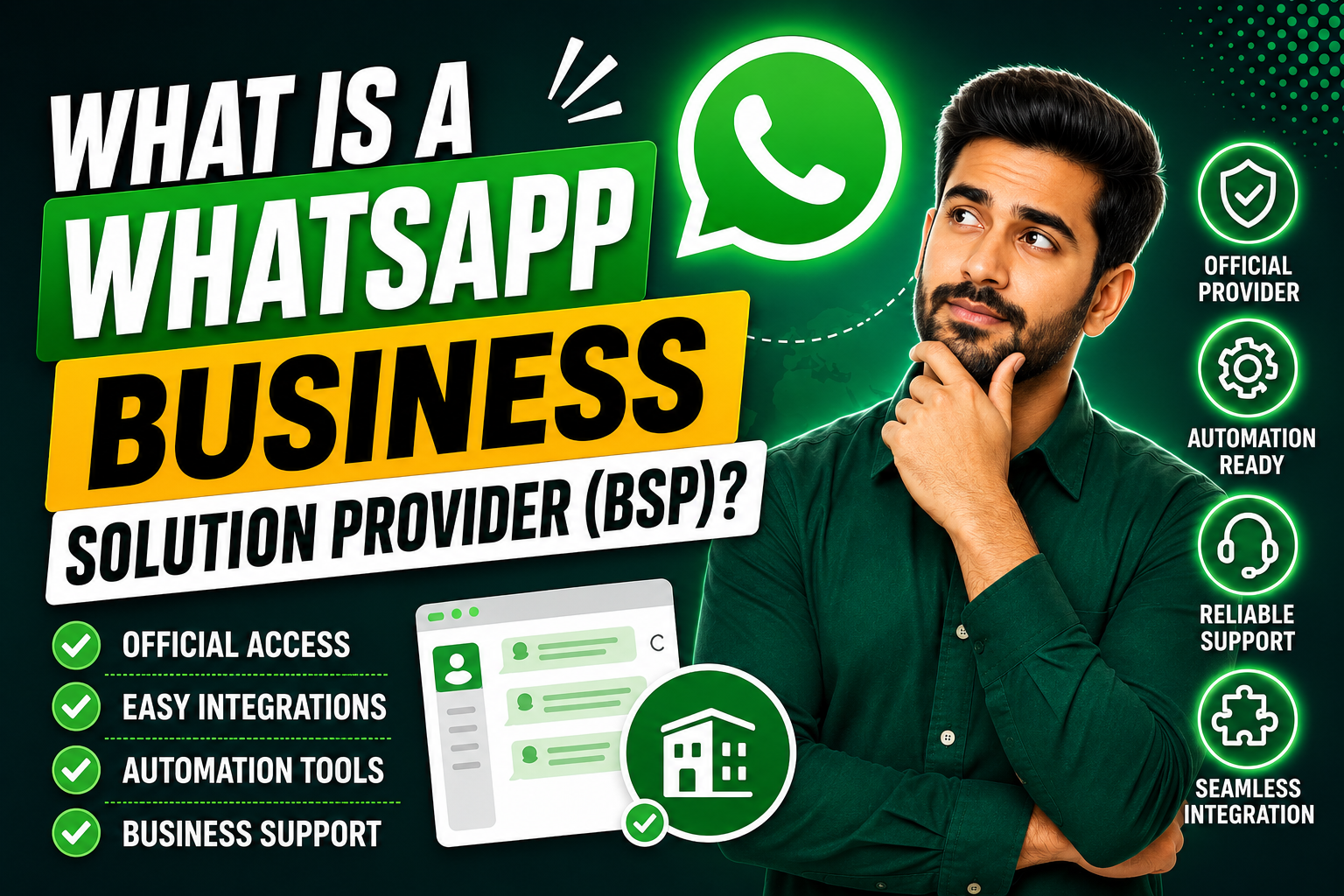
Direct answer: A WhatsApp Business Solution Provider — usually just called a "BSP" is a company authorized by Meta to give businesses access to the WhatsApp Business API, along with the software layer needed to actually use it: onboarding, a team inbox, automation tools, template management, and support. That's accurate as a plain-language definition. But "BSP" is also an informal umbrella term for something Meta itself now defines more precisely and understanding that precision is what separates a buyer who gets a fair deal from one who doesn't.
This guide covers the full picture: what a BSP actually is in Meta's current terminology, how you actually get cess to WhatsApp's API (a BSP isn't the only path), what it really costs in 2026, how messaging limits and quality ratings work, what the verification badges mean, and how to evaluate a provider properly before you sign anything.
What this guide covers:
Meta's real 2026 partner structure (Solution Partner, Tech Provider, Tech Partner)
The full access spectrum — free app vs. direct Cloud API vs. BSP
What a BSP actually does, step by step
How WhatsApp API pricing actually works in 2026
Messaging limits, quality ratings, and why they matter to your BSP choice
Verification badges (Blue Tick / Green Tick / Official Business Account)
Core features to expect
The compliance landscape
Types of BSPs in the market
How to evaluate one properly
Common mistakes
Glossary of terms you'll hit immediately
1. Meta's Real 2026 Partner Structure
Meta's own developer documentation describes its Partners program as three distinct categories, not one:
Neither model is inherently better. A Solution Partner's credit line removes the friction of managing a separate Meta payment method. A Tech Provider or Tech Partner relationship is structurally more transparent on cost, since there's no intermediary billing layer for Meta's own fees to be marked up through. The point is knowing which one you're evaluating — most buyers never ask, and that's exactly where surprise costs come from.
2. The Full Access Spectrum
A BSP isn't the only way to use WhatsApp for business — it's one of three tiers, each suited to a different kind of business:
Most businesses reading this guide fall into the middle column — which is why "what is a BSP" is such a common early research query. If you're weighing whether to skip a provider entirely and connect directly to Meta's infrastructure yourself, that decision deserves its own dedicated comparison rather than a table row here.
3. What a BSP Actually Does: The Onboarding Sequence
Here's what actually happens, step by step, when you go live through a BSP:
Meta Business Portfolio verification. Your business identity gets verified with Meta — this is the foundation everything else depends on, and it's the same step whether you use a BSP or go direct.
WhatsApp Business Account (WABA) creation. Your BSP creates and configures the account that will hold your phone number, templates, and messaging settings.
Phone number registration. Your dedicated business number gets connected — often through Meta's Embedded Signup flow, which most BSPs support to make this a few-click process rather than a manual API integration.
Message template submission. You draft the pre-approved messages you'll send outside a customer-initiated conversation (reminders, confirmations, broadcasts), and your BSP submits them to Meta for review — correctly categorized as marketing, utility, or authentication, since miscategorizing this step directly affects your cost (more on that below).
Platform configuration. Team inbox setup, chatbot/automation flows, and any CRM or e-commerce integrations get connected.
Go live. Once templates are approved and your number is verified, you're sending and receiving messages.
A capable BSP compresses this into a day or two of active work (though Meta's own verification timelines vary). A weak one leaves you waiting on template resubmissions and unclear verification status for weeks.
4. How WhatsApp API Pricing Actually Works in 2026
This is the section most "what is a BSP" articles skip entirely, and it's directly connected to the partner-tier question above.
There are four message categories, and the category determines the rate:
Marketing: promotions, broadcasts, re-engagement messages. The highest cost per message, with no volume discount.
Utility: order updates, appointment reminders, payment confirmations. Meaningfully cheaper than marketing, and free if sent inside an open customer service window.
Authentication:OTPs and verification codes. The lowest cost of the template categories.
Service: your free-form replies inside the 24-hour window that opens after a customer messages you first. Free, no template required.
Rates are set by the recipient's country, not your business location — a business in India messaging a customer in Germany pays Germany's rate for that message, not India's. India is consistently one of the lowest-cost markets globally for WhatsApp messaging, which is a meaningful advantage for India-based businesses messaging domestic customers. Meta publishes its current rates directly, organized by market and category, and updates them periodically — so treat any specific number you see (including in this article) as a snapshot, not a permanent figure.
The category boundary matters more than it sounds like it should. A shipping update is utility. The same message with "and here's 10% off your next order" added is marketing — and that reclassification can mean paying several times more per message. Getting template categorization right at submission is one of the most underrated things a good BSP actually does for you.
A billing shift is scheduled for October 2026 worth knowing about now: service messages and utility templates sent inside the customer service window — free since late 2024 — are set to start being billed. This changes the calculus for workflows built on long, open-ended chat replies versus structured, template-based interactions. Confirm this is still Meta's current timeline before treating it as fact, since Meta's pricing structure has already shifted more than once through 2026.
Your actual bill = Meta's rate + your provider's fee. This is where the partner-tier distinction from section 1 becomes concrete: a Solution Partner's invoice typically bundles a markup into that per-message rate, while a Tech Provider/Tech Partner relationship keeps Meta's portion and the provider's portion visibly separate.
5. Messaging Limits and Quality Ratings
Every WhatsApp Business number operates under a messaging tier — the number of unique contacts you can message in a rolling 24-hour period:
New, unverified accounts start around 250 unique contacts/day.
Verified businesses can progress through 1,000 → 10,000 → 100,000 → unlimited tiers.
As of 2026, verified businesses can reach the 100,000 tier considerably faster than the older step-by-step progression required.
Your quality rating gates this progression. Meta assigns every number a Green, Yellow, or Red quality signal based on block rates and spam reports. A drop to Yellow freezes your current tier; a drop to Red can reduce it. No amount of sending volume overrides a poor quality rating ,this is a genuinely useful thing to ask a prospective BSP about, since a provider that helps you segment audiences and avoid over-messaging is protecting a number you can't easily replace.
Service messages inside the customer window don't count against these limits — another reason structured, service-window-first workflows tend to perform better than broadcast-heavy ones.
6. Verification Badges: Blue Tick, Green Tick, and Official Business Account
You'll see these terms used inconsistently across the industry, so it's worth being precise: Meta's own platform documentation refers to the verified badge as Official Business Account (OBA) status — the blue checkmark beside a business's name that signals to customers they're messaging a verified, legitimate business. "Blue Tick" and "Green Tick" are the informal names commonly used in India and other markets for the same underlying status. A BSP can guide you through the application; approval decision sits with Meta, not the provider — treat any provider that claims to guarantee approval as a red flag.
7. Core Features to Expect From a BSP
Whichever partner tier you're evaluating, a genuine BSP platform should include:
A shared team inbox so more than one agent can handle conversations without duplication or missed messages.
A no-code chatbot/automation builder, so changes don't require a developer for every update.
WhatsApp Flows support — Meta's structured, multi-screen in-chat forms for bookings, lead capture, and surveys.
Template management with categorization guidance, to avoid the marketing-vs-utility cost trap above.
CRM and e-commerce integrations, pre-built rather than custom-coded.
Analytics on delivery, response times, and quality rating trends.
8. The Compliance Landscape You're Inheriting
Choosing a BSP means inheriting a set of ongoing compliance responsibilities, not a one-time setup task:
Consent (opt-in) is required before automated messaging begins — governed by the WhatsApp Business Messaging Policy that applies regardless of which partner tier you use.
AI-generated messaging has specific rules as of Meta's 2026 policy update — general-purpose, open-ended AI chatbots are restricted, while task-specific AI (support, bookings, order tracking) with disclosure and human handoff remains fully compliant. A good BSP should be actively helping you stay inside these lines, not leaving you to discover them after a violation.
Sector-specific data rules apply on top of WhatsApp's own policy — healthcare and financial services businesses in India, for example, need to consider the Digital Personal Data Protection (DPDP) Act alongside WhatsApp's messaging policy, which is a compliance layer a BSP can guide but not fully own on your behalf.
9. Types of BSPs in the Market
Not every provider is built for the same buyer:
Enterprise-focused platforms — built for very high message volumes, deep API access, and dedicated account management, often at a higher price point.
SMB-focused, all-in-one platforms — bundle the API, inbox, automation, and CRM into one accessible subscription, prioritizing fast setup over deep customization.
Vertical-specific providers — built around a specific industry's workflows (healthcare patient communication, real estate lead qualification, e-commerce cart recovery), often with pre-built templates for that use case.
API-only/developer-first providers — raw API access with minimal or no dashboard, suited to teams that want to build their own interface layer on top.
Knowing which category you actually need narrows the field faster than comparing feature lists across all of them.
10. How to Properly Evaluate a BSP
Beyond the partner-tier question, a genuine evaluation should cover:
Cost transparency — a specific, stated markup or fee structure, not a vague "competitive pricing" claim.
Support responsiveness — tested before you commit, not assumed from a sales call.
Template approval speed — ask for a real median turnaround time on the provider's recent submissions, not just "usually fast."
Migration flexibility — what happens if you want to leave later; a confident provider answers this plainly.
Data residency — relevant if you operate under regional compliance requirements.
For the full, structured evaluation script — ten specific questions with what a good answer sounds like and the red flag for each — see WhatsApp API Provider Checklist
11. Common Mistakes When Evaluating a "BSP"
Assuming all providers work the same way — two providers can both accurately call themselves "official WhatsApp partners" while operating on completely different billing structures.
Not asking about markup until after signing up — the single most common and most avoidable surprise cost.
Confusing template category boundaries — sending a marketing message through a utility template gets it rejected; miscategorizing a promotional message as utility risks policy violation, not just a pricing error.
Ignoring quality rating until it's already a problem — a BSP that doesn't proactively help you manage sending volume and segmentation is setting you up to hit a Yellow or Red rating without warning.
Picking based on features alone — a feature-rich dashboard says nothing about your actual monthly cost, which depends on the partner-tier and pricing-category questions covered above.
12. Glossary: Terms You'll Hit Immediately
- WABA — WhatsApp Business Account, the container for your phone number(s), templates, and messaging settings.
Template — a pre-approved message format required for any business-initiated message outside a customer service window.
Webhook — the mechanism by which Meta notifies your system (or your BSP's system) in real time when a message arrives, a button is tapped, or a delivery status changes.
Quality Rating — Meta's Green/Yellow/Red signal for a phone number, based on block rates and spam reports, which gates your messaging tier.
Service Window — the 24-hour period after a customer messages you, during which free-form replies are free.
OBA (Official Business Account) — the verified badge status, informally called Blue Tick or Green Tick depending on the market.
Embedded Signup — Meta's streamlined onboarding flow that lets a BSP register your WABA and phone number in a few clicks rather than a manual API integration.
FAQs
Is a WhatsApp API partner the same thing as a BSP? In everyday usage, yes. Technically, Meta's current documentation defines the ecosystem as Solution Partners, Tech Providers, and Tech Partners — "BSP" is informal shorthand that doesn't map cleanly onto just one of them.
Do I have to use a BSP to get the WhatsApp Business API? No — direct Cloud API integration is available, though it requires your own engineering resources to replicate what a BSP's tooling provides. Most small and mid-sized businesses find a BSP faster and less resource-intensive.
Why do some providers charge a markup and others don't? It traces back to the credit-line structure in section 1. Solution Partners extend their own credit line and bill you directly, which is typically where a markup shows up. Tech Providers and Tech Partners don't hold that credit line — you pay Meta directly for messaging, removing the markup path on the messaging cost itself.
What's the actual cost difference between marketing, utility, and authentication messages? Marketing messages consistently cost several times more than utility or authentication messages in the same market, with no volume discount available on marketing. Getting your template categories right at submission is one of the most direct ways to control cost.
What happens if my quality rating drops? A Yellow rating freezes your current messaging tier; a Red rating can reduce it. This affects how many contacts you can reach per day regardless of your provider which is why segmentation and message relevance matter as much as the provider you choose.
Where to Go From Here
Understanding the partner-type distinction and the real pricing mechanics is the foundation and the next practical step is bringing the 10-question provider checklist into an actual conversation with any provider you're evaluating, and confirming exactly which partner tier, pricing structure, and support model you're signing up for before you commit.
TABLE OF CONTENTS